Free FSBO purchase agreement template for Arizona
Arizona FSBO sellers don’t need a Realtor to get a purchase agreement. The Arizona Association of REALTORS (AAR) publishes a Residential Resale Real Estate Purchase Contract that’s the standard form used in nearly every residential transaction in the state. Agents use it. Title companies expect it. And while it’s technically designed for agent-represented transactions, FSBO sellers can use it too, or choose from several free alternatives that work just as well.
Here’s which form to use, how the key sections work, and the Arizona-specific process (the BINSR) that catches first-time FSBO sellers off guard.
Which purchase agreement form to use
Arizona law doesn’t require any specific contract form for residential sales. You could write one from scratch. But every title company and escrow officer in the state is built to process the AAR form, so using a recognized contract keeps things moving. Here are your options.
AAR Residential Resale Purchase Contract
This is the dominant form. The AAR updates it periodically, with the most recent version released in February 2026. It runs about 9 pages (the buyer attachment portion), covers everything from earnest money to the BINSR inspection process, and includes provisions for the Seller’s Property Disclosure Statement (SPDS), financing contingencies, and the CURE notice process.
The AAR form is available through AAR’s website at aaronline.com. It’s designed for agent-represented transactions, but the provisions work the same way when a seller is acting without an agent. Your attorney can walk you through the sections that need customization for a FSBO deal.
Free online templates
Sites like eForms and freeforms.com offer free Arizona residential purchase agreement templates in PDF and Word format. These cover the basics: parties, property description, price, earnest money, contingencies, and closing terms. They’re legal and functional. But they won’t include the AAR’s specific BINSR framework or the CURE notice provisions that Arizona title companies are accustomed to processing.
If you go this route, have your attorney review the template before you use it. A generic form missing Arizona-specific provisions will slow things down at escrow.
Pioneer Title FSBO contract
Pioneer Title Agency publishes a free FSBO-specific set of escrow instructions and contract terms. It’s a stripped-down version designed specifically for owner-to-owner transactions. If you’re using Pioneer as your title and escrow company, ask them about it. It covers the essential contract terms and ties directly into their escrow process.
Attorney-drafted contract
A real estate attorney can draft a purchase agreement from scratch or customize any standard form for your transaction. Arizona attorneys charge around $284 per hour on average, and many offer flat-fee FSBO packages in the $750 to $1,250 range. This is the safest route if your deal has any wrinkles: seller financing, an as-is sale, or unusual contingencies.
My recommendation: get the AAR form or a free template, read through it so you understand the structure, then let your attorney fill in the sections that require legal judgment.
Do FSBO sellers have to use the AAR form?
No. Arizona law doesn’t mandate any specific contract. Unlike Texas, where TREC publishes an official state form that agents must use, Arizona’s standard form comes from the Realtors’ association, not the state government. As an unlicensed seller, you’re free to use any contract you want.
But the AAR form is what every escrow officer, title company, and lender in Arizona expects to process. Hand them a contract they recognize and closing runs smoothly. Hand them something unfamiliar and they’ll spend time figuring out which provisions are missing and how to work around them.
Use a form built for Arizona transactions. The AAR contract, a free Arizona-specific template, or an attorney-drafted agreement all work. A generic form from the internet usually doesn’t.
The key sections and what they mean
Every Arizona purchase agreement covers the same core provisions. Here are the ones where mistakes cost money.
Purchase price and financing
The total price, how the buyer is paying (cash, conventional mortgage, FHA, VA), and the breakdown of the down payment versus financed amount. If the math doesn’t add up (down payment plus loan amount doesn’t equal purchase price), the escrow company will catch it, but it’ll delay things. Double-check before you sign.
Earnest money
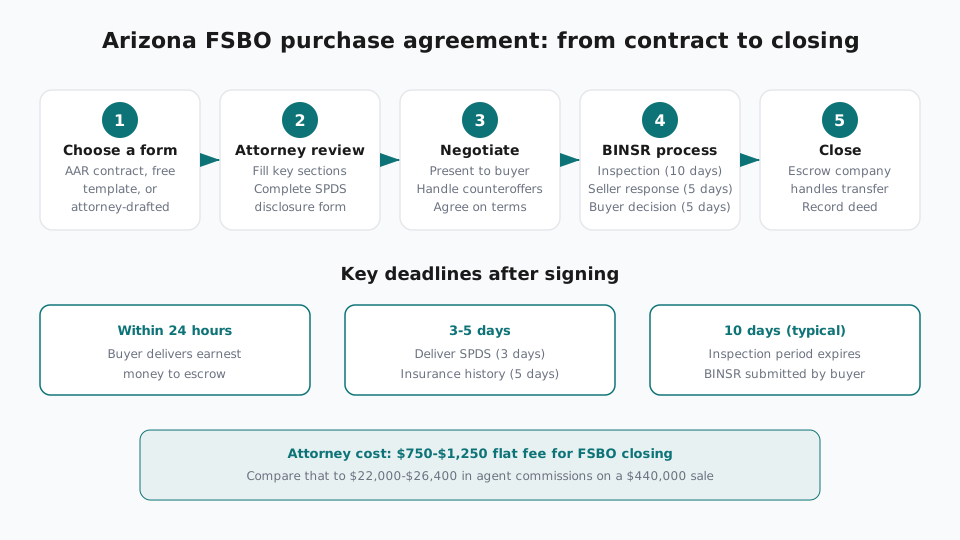
In Arizona, earnest money typically runs 1% to 3% of the purchase price. On a $440,000 home (close to the current state median of about $439,000), that’s $4,400 to $13,200. The buyer delivers the earnest money to the escrow company within 24 hours of contract acceptance. Not to you. To escrow.
If the buyer backs out without a valid contractual reason (outside a contingency window), you may be entitled to keep the earnest money. But that depends on the contract language. Make sure your agreement includes a liquidated damages provision, and make sure your attorney explains what triggers it.
The inspection period and the BINSR
This is the Arizona-specific process that separates the state from most others. The standard inspection period is 10 days, though it’s negotiable. During those 10 days, the buyer hires a home inspector and evaluates the property.
At the end of the inspection period, the buyer submits the Buyer’s Inspection Notice and Seller’s Response form, known as the BINSR. The buyer gets exactly one shot at this. One BINSR. They list every item they want addressed.
The buyer has three options on the BINSR:
- Accept the property as-is and move forward.
- Request repairs or credits for specific items found during inspection.
- Cancel the contract and get their earnest money back.
If the buyer requests repairs, you have 5 days to respond. You can agree to all of the requests, some of them, or none. If you don’t respond within 5 days, Arizona contract law treats your silence as a refusal to address any of the items. That’s automatic. There’s no grace period, no “I was busy” excuse.
If you offer a partial fix and the buyer doesn’t like your response, the buyer gets 5 more days to either accept your counter or cancel the contract. If the buyer cancels during this window, they get their earnest money back.
The critical thing to understand: the BINSR deadline is hard. If the buyer doesn’t submit their inspection notice before the inspection period expires, they’ve waived their right to request repairs. Period. And the seller’s 5-day response window is equally firm. Track these dates yourself. Don’t rely on anyone else to remind you.
The CURE notice
Arizona contracts include a CURE provision that doesn’t exist in most other states. If either party fails to comply with any provision of the contract, the other party can deliver a written CURE notice specifying the non-compliance. The non-complying party then has 3 days to fix the problem. If they don’t fix it within those 3 days, it becomes a breach of contract.
This matters for FSBO sellers because buyers can use the CURE notice to force action on things you might overlook: late delivery of the SPDS, failure to provide the insurance claims history, or missing documentation. Conversely, you can use it if the buyer fails to deliver earnest money on time or misses a financing deadline.
The CURE notice is a tool, not a threat. Understand it so you can use it when you need to and respond to it when the buyer does.
Seller’s Property Disclosure Statement (SPDS)
Arizona requires sellers to deliver a completed SPDS to the buyer within 3 days of contract acceptance. The SPDS is a 10-page form covering the property’s condition, systems, history, and any known material defects.
The disclosure standard in Arizona is “known material facts.” You disclose what you actually know. You’re not required to hire an inspector or go looking for problems. But if you know about a cracked foundation, a history of flooding, or that the AC unit is on its last legs, and you don’t disclose it, the buyer can come after you.
The SPDS covers:
- Structural condition — roof, foundation, walls, floors, and any modifications
- Mechanical systems — HVAC, electrical, plumbing, water heater, pool equipment
- Water and sewer — whether you’re on municipal water or a private well, and whether you have a public sewer or septic system
- Environmental hazards — lead-based paint (pre-1978 homes), asbestos, radon, underground storage tanks
- Flood and drainage — any history of water intrusion, flooding, or drainage issues
- HOA and zoning — association rules, fees, and any zoning restrictions
- Insurance claims — any claims filed in the past 5 years
One additional requirement that catches sellers off guard: the AAR contract also requires you to deliver a 5-year insurance claims history report (or for your length of ownership, if shorter) within 5 days of contract acceptance. This is a separate document from the SPDS. Your insurance company can generate it, or you can pull it from your CLUE (Comprehensive Loss Underwriting Exchange) report.
For more on disclosure specifics, read our seller’s disclosure breakdown.
Financing contingency
If the buyer is getting a mortgage, the financing contingency protects both of you. The contract specifies deadlines for loan application and loan commitment. If the buyer’s financing falls through before the commitment deadline, they can cancel and get their earnest money back.
Cash buyers skip this section. But demand proof of funds. A bank statement or a letter from the buyer’s financial institution showing the money is there. A verbal “I’m good for it” isn’t a document.
Close of escrow
Arizona is an escrow state. A neutral third-party escrow company (often the same company providing title insurance) handles the closing. The purchase agreement specifies the escrow company, the closing date, and how proceeds will be delivered. Wire transfer is standard.
A closing timeline in Arizona typically runs 30 to 45 days from contract acceptance. Cash transactions can close in as little as 2 weeks if there are no complications.
Wire fraud warning: call the escrow company directly to verify wire instructions before you wire any money. Never trust wire instructions sent by email alone. This fraud is real, growing, and it’s hit Arizona sellers.
Arizona closing costs sellers should expect
Arizona has one major advantage over most states: no real estate transfer tax. Arizona is one of the few states that doesn’t charge a transfer tax on residential sales. That’s money you keep.
Here’s what you will pay.
Title insurance. The seller typically pays for the buyer’s owner’s title insurance policy in Arizona. On a $440,000 home, expect $1,200 to $2,000 depending on the title company.
Escrow fees. Usually split between buyer and seller. The seller’s share runs $500 to $1,200 depending on the sale price and the escrow company.
Recording fees. The county recorder charges a small fee for recording the deed and other documents. Typically under $100.
Prorated property taxes. Arizona property taxes average about 0.62% of the home’s assessed value, one of the lowest rates in the country. On a $440,000 home, that’s roughly $2,730 per year. Your share at closing depends on when you close relative to the tax billing cycle.
Attorney fees. Budget $750 to $1,250 for a flat-fee FSBO closing, or about $284 per hour if your attorney bills hourly.
Add it all up and a FSBO seller in Arizona is looking at roughly $2,700 to $4,800 in closing costs on a $440,000 sale (excluding any buyer agent compensation you’ve agreed to). Compare that to $22,000 to $26,400 in agent commissions at 5% to 6%. The math isn’t close.
The five mistakes that cost Arizona FSBO sellers money
Missing the BINSR response deadline. The buyer submits their inspection notice. You have 5 days to respond. If you don’t respond, the contract treats your silence as a refusal to address anything. That might be what you want, but if you intended to negotiate repairs, you’ve lost the window. Track the dates.
Late SPDS delivery. You have 3 days after contract acceptance to deliver the completed Seller’s Property Disclosure Statement. If the buyer receives the SPDS and finds something they don’t like, they can disapprove within the inspection period or within 5 days of receiving the SPDS, whichever is later. Deliver it late and you’ve extended the buyer’s window to back out.
Forgetting the insurance claims history. The AAR contract requires delivery of a 5-year insurance claims history within 5 days of contract acceptance. Most FSBO sellers have never heard of this requirement. Contact your insurance company or order your CLUE report before you list, so you’re ready to deliver it the moment a contract is signed.
Ignoring the CURE notice process. If the buyer sends you a CURE notice for non-compliance, you have exactly 3 days to fix the problem. Ignoring it or assuming it’s a bluff puts you in breach of contract. Read any CURE notice immediately and respond within the 3-day window.
Assuming the escrow company works for you. The escrow company is a neutral party. They facilitate the transaction. They don’t review the contract for your benefit, they don’t track your deadlines, and they don’t advise you on whether a provision is in your interest. That’s your attorney’s job. Don’t confuse the two.
Your attorney makes this manageable
Arizona doesn’t require an attorney to close on a house. Escrow companies handle the mechanics. But when you’re selling without an agent, you need someone reviewing the contract, the SPDS, and the closing documents who has a legal obligation to represent your interests.
A real estate attorney for a FSBO closing in Arizona costs $750 to $1,250 for a flat fee. On a $440,000 home, that’s about 0.2% of the sale price. Compare that to the $22,000 to $26,400 you’d pay in agent commissions. And unlike an agent, your attorney has a legal obligation to represent your interests and only your interests.
Get the AAR form or a free Arizona-specific template. Read through it once so you know what you’re looking at. Then hand it to your attorney and let them fill in the parts that matter. For the full document checklist you’ll need at closing, here’s the complete FSBO closing checklist.
Keep reading
Arizona FSBO disclosure requirements: what you must tell the buyer
Arizona sellers must disclose known material facts, deliver the SPDS fast, and handle HOA, well, septic, and lead paperwork correctly.

Free FSBO purchase agreement template for Pennsylvania
Pennsylvania FSBO sellers can use a free purchase agreement template, but it needs the right zoning, disclosure, and transfer-tax terms before anyone signs.
Free FSBO purchase agreement template for California
California FSBO sellers have several contract options beyond the CAR RPA -- here's which form to use, what each section means, and the disclosure traps that sink deals.