
Skip the agent, hire an attorney
One of the biggest revelations I had when selling my first house FSBO was that I could hire a real estate attorney to hold my hand through the entire transaction. Not a Realtor. Not a broker. A licensed attorney with a law degree and years of real estate experience, for a flat fee that barely registered compared to what an agent would have cost me.
I’ve used attorneys on every FSBO sale since. The peace of mind, the legal expertise, and the transparency I got from working with a lawyer was something I never experienced working with an agent. And it cost me between $600 and $1,500 each time.
Let me break down why this is the single most important hire you’ll make when selling FSBO.
What a real estate attorney actually does
When people hear “real estate attorney,” they picture a courtroom. That’s not what this is. A good real estate attorney handles the transactional side of your sale, the paperwork and legal details that actually make the deal happen.
Here’s what mine have done for me:
- Drafted and negotiated the Purchase and Sale Agreement (the “buy-sell” contract that governs the entire transaction)
- Reviewed contingency timelines and made sure nothing slipped
- Handled the seller’s disclosure document (this varies by state, and getting it wrong can expose you to liability)
- Performed due diligence and property research
- Drafted deeds and related agreements
- Coordinated with escrow, the title company, and the buyer’s lender to make sure closing went smoothly
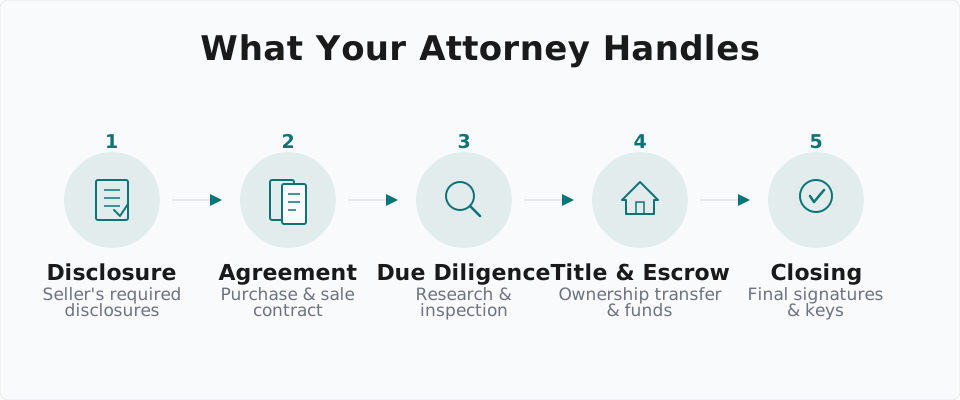
That’s the same scope of work an agent would claim to handle. The difference is your attorney actually went to law school.
The gap at a glance
| Real Estate Agent | Real Estate Attorney | |
|---|---|---|
| Education | 40–180 hours of coursework | 7+ years including doctorate |
| Cost on $400K sale | $24,000 | $500–$3,000 |
| Fiduciary duty | Limited; dual agency allowed | Highest standard in law |
| Represents | May represent both sides | Only you |
The education gap is enormous
This is the part that made me angry once I understood it. A real estate agent in most states needs a high school diploma and somewhere between 40 and 180 hours of pre-licensing coursework. In Alaska, it’s 40 hours. In Florida, 63 hours. You can get licensed faster than you can finish a semester of community college.
A real estate attorney has a four-year undergraduate degree, a three-year law degree, and passed a bar exam with a roughly 61% pass rate. That’s a minimum of seven years of higher education, plus ongoing continuing legal education every year after that.
So when your agent confidently walks you through contract terms or advises you on disclosure requirements, remember: they had a few weeks of training. Your attorney had seven years. On a transaction worth hundreds of thousands of dollars, that gap matters.
The cost comparison is absurd
On a $400,000 home sale, a 6% agent commission costs you $24,000. That’s the number. It comes straight off your equity at closing.
A real estate attorney charges a flat fee or an hourly rate. Based on my own transactions, I’ve paid between $600 and $1,500. Current market rates across the country range from about $500 to $3,000, depending on your state and the complexity of the deal. Even at the high end, you’re paying roughly 12% of what a full commission would cost.
Here’s another way to think about it. That $24,000 agent commission could pay for an attorney ($1,500), a professional photographer ($250), a flat fee MLS listing ($300), and you’d still have over $21,000 left in your pocket. That’s a car. That’s a year of your kid’s tuition. That’s your money.
Your attorney works for you. Only you.
This is the part most sellers don’t think about, and it’s the most important.
When you have a lawyer representing you, they get paid their flat fee regardless of what happens with the sale. If the deal falls through, they still get paid. If you reject a lowball offer, they still get paid. They have zero incentive to push you toward a bad deal.
Your agent? They only get paid if the sale closes. And their commission is a percentage of the sale price, which means the difference between you accepting a $390,000 offer today and holding out for $400,000 next week is worth about $150 to them. Of course they want you to take the first offer.
There’s a legal term for this: fiduciary duty. Attorneys owe the highest fiduciary duty known to the law. They’re governed by state bar associations, subject to malpractice liability, and can be disbarred for putting their interests above yours. Real estate agents have a lesser standard, and in 41 states, they can legally practice dual agency, representing both the buyer and the seller in the same transaction. Think about that for a second. The person you’re trusting to negotiate on your behalf could also be working for the person on the other side of the table.
An attorney can’t do that. Ethics rules effectively prohibit it. When you hire a real estate attorney, they have one client: you.
Many states already require attorneys
If you needed more proof that the legal system trusts attorneys over agents for real estate transactions, consider this: roughly 16 states either require or partially require an attorney to be involved in real estate closings. States like Connecticut, Massachusetts, New York, Georgia, South Carolina, and others have decided that an agent’s training isn’t sufficient for the legal complexities of a property transfer.
Even in states where attorneys aren’t required, nothing stops you from hiring one. And you should.
The playing field is shifting
The 2024 NAR settlement changed how buyer-agent commissions work. Sellers are no longer required to offer compensation to the buyer’s agent on the MLS, and buyers now sign written agreements disclosing what their agent will earn. The old system, where agents could steer buyers away from FSBO listings or low-commission properties, is cracking.
For FSBO sellers, this is good news. The structural advantages that agents held are eroding. An attorney-assisted FSBO sale is becoming a more straightforward path than it’s ever been.
How to find the right attorney
Start by searching for real estate attorneys in your area. Not general practice lawyers. You want someone who specializes in residential real estate transactions. Ask friends or family who’ve recently sold a property, or check your state bar association’s referral service.
Schedule consultations with two or three. Most will do an initial call for free. Ask them:
- How many residential closings do you handle per year?
- What’s your flat fee for a standard FSBO sale?
- Will you be available throughout the process, or will a paralegal handle most of the communication?
- How do you handle negotiations with the buyer’s agent?
Pick the one you feel comfortable with. Communication style matters. You want someone who explains things in plain English, not someone who talks over your head to justify their fee.
Your next move is to make those calls this week. The attorney is the first hire, before the photographer, before the listing, before any of it. Get your legal foundation set, and the rest of the process gets a lot less scary.
For a full walkthrough of every step, check out the complete FSBO guide. If you want to understand exactly how much you’re saving by cutting the agent commission, run the numbers through the savings calculator. And for advice on finding the right attorney in your area, here’s how to find and hire a real estate attorney.
Keep reading
FSBO closing checklist: every document you need
The complete list of documents sellers need to gather, review, and sign at closing -- organized by who prepares what and when you need it.

The Real Cost of Traditional Agent Commissions (Even After the NAR Lawsuit)
A $24,000 commission on a $400,000 home is just the beginning. Factor in opportunity cost, lifetime sales, and taxes, and the true price of the traditional commission model is staggering.
Best flat fee MLS services in Georgia (2026)
A side-by-side comparison of Georgia flat fee MLS companies, with real pricing, Atlanta MLS fine print, and the closing-fee math sellers miss.