
How to find and hire a real estate attorney for your home sale
If you’ve read why hiring a real estate attorney is the single best move you can make as a FSBO seller, the next question is obvious: how do you actually find one?
It’s easier than you’d think. And it’s the kind of thing you can knock out in a week if you know where to look and what to ask.
Where to search
Your state bar association
Start here. Every state bar runs a Lawyer Referral Service that only lists attorneys who are in good standing, carry malpractice insurance, and have been vetted. Many of these services offer a free or reduced-fee initial consultation.
Just search “[your state] bar association lawyer referral service.” In Texas, for example, you can call (800) 252-9690. In California, the State Bar maintains a searchable directory of certified referral services. In New York, the NYSBA runs a similar program. Every state has one.
Online directories
Two worth using:
Martindale-Hubbell (martindale.com) is the oldest attorney rating system. Look for the “AV Preeminent” rating, which means other attorneys have rated them highly for legal expertise and ethics. That peer rating carries more weight than client reviews alone.
Avvo (avvo.com) uses a 1-10 rating algorithm based on the attorney’s background, peer endorsements, and client reviews. The rating can’t be bought. Look for an 8 or higher.
Both platforms let you search by practice area and location, so you can filter specifically for real estate attorneys in your market.
Word of mouth
Ask your title company or escrow officer. They work with real estate attorneys every day and know who’s responsive, who’s thorough, and who’s phoning it in. If you know anyone who’s sold FSBO in your area, ask who they used.
What to look for
You want a real estate specialist, not a general practice lawyer who “also does” real estate. The difference matters.
A dedicated real estate attorney handles dozens of closings a year. They know your county’s recording requirements, local transfer tax rules, and standard contract forms inside and out. A generalist who primarily does family law or personal injury might not have touched a purchase agreement in months.
If your state offers board certification in real estate law, that’s the strongest credential you can look for. Check the ABA’s state certification directory to see if your state has a program. States like Florida, Texas, Arizona, and Connecticut all offer specialty designations.
Beyond credentials, you want someone who:
- Handles a high volume of residential closings (not just commercial)
- Has specific experience working with FSBO sellers
- Communicates in plain English, not legalese
- Is responsive. If they take three days to return your call during the interview stage, imagine what happens when you’re two days from closing.
Questions to ask in the consultation
Most real estate attorneys will do a free initial call. Interview at least two or three. Here’s what to ask:
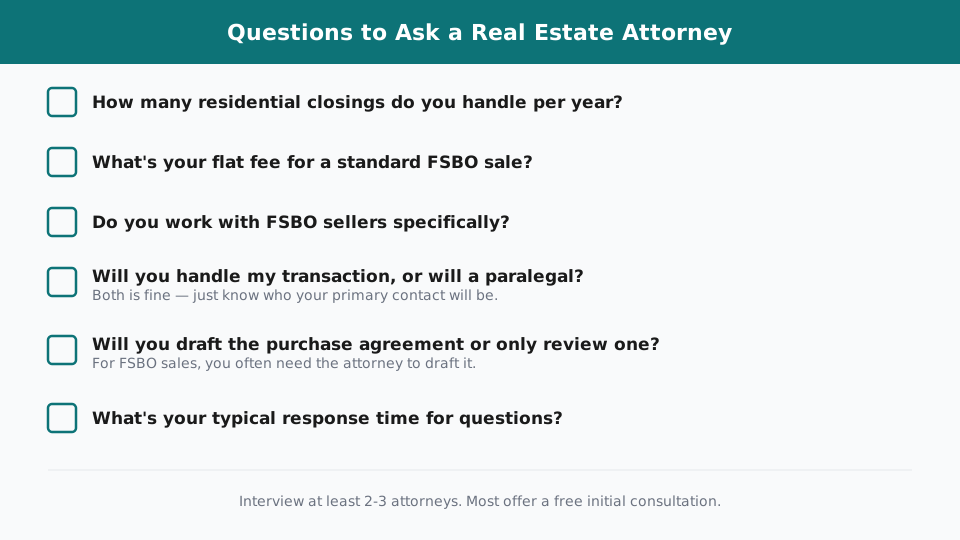
- How many residential closings do you handle per year? You want someone who does this regularly, not occasionally.
- What’s your flat fee for a standard FSBO sale? Most charge $500 to $3,000 depending on your state and the deal’s complexity. If they won’t give you a clear number, that’s a red flag.
- Do you work with FSBO sellers specifically? Not all real estate attorneys do. You want someone who understands the gaps they need to fill when there’s no listing agent.
- Will you handle my transaction, or will a paralegal? Both is fine. A paralegal doing the day-to-day with the attorney reviewing is standard. But you should know who your primary contact will be.
- Will you draft the purchase agreement or only review one? For FSBO sales, you often need the attorney to draft the contract, not just review a template.
- What’s your response time for questions? Set expectations early. During a live transaction, a 48-hour email lag can cost you a deal.
Red flags
Walk away if you see any of these:
- They can’t quote a fee. Any experienced real estate attorney can give you a flat fee or realistic estimate for a standard residential sale. Vague answers about cost mean vague bills later.
- They guarantee outcomes. No ethical attorney promises your closing will go perfectly. If they do, they’re selling you, not advising you.
- They want to represent both sides. A real estate attorney cannot ethically represent the buyer and the seller in the same transaction. This is a hard conflict of interest. If they suggest it, leave.
- They’re hard to reach. The number-one complaint against attorneys nationwide is lack of communication. If it’s bad before you’ve hired them, it’ll be worse after.
- They have no malpractice insurance. State bar referral services require it, but if you find someone through other channels, ask. No insurance means no recourse if they make a mistake.
What it costs (by state)
Real estate attorney fees for a standard residential sale range from $500 to $3,000 nationally. Where you fall in that range depends mostly on your state and the complexity of the deal.
| State | Typical Range | Attorney Required? |
|---|---|---|
| Texas | $500-$1,500 | No, but recommended |
| Florida | $800-$2,000 | No, but recommended |
| California | $1,000-$2,500 | No, but recommended |
| New York | $1,500-$3,000 | Yes (for closings) |
| Massachusetts | $1,000-$2,000 | Yes (for closings) |
| Georgia | $800-$1,500 | Yes (for closings) |
| South Carolina | $800-$1,500 | Yes (for closings) |
| Connecticut | $1,000-$2,000 | Yes (for closings) |
| Ohio | $500-$1,200 | No, but common |
| Arizona | $500-$1,000 | No |
Compare that to a 5-6% agent commission. On a $400,000 house, that’s $20,000-$24,000. Even at $3,000, the attorney costs you roughly 12% of what a full commission would. The savings calculator shows you the exact math at your price point.
Most attorneys offer a flat fee for a standard transaction. Get the full breakdown in writing before you sign anything, including what counts as “additional charges” if the deal gets complicated.
What I learned hiring mine
The thing that stood out most was how much more confident we felt throughout the entire transaction. With a Realtor, I always second-guessed the advice we were getting. Were they recommending we accept that offer because it was good for us, or because they wanted to close the deal and collect their commission? I never really knew.
With an attorney, that doubt disappeared. We were getting real legal advice from someone with actual legal training, and their fee was the same whether we closed in a week or three months. Their incentives were aligned with ours. For the first time in a real estate transaction, I felt like we had the upper hand.
Your first step is to pick two or three attorneys from your state bar’s referral service and schedule consultations this week. You’ll know after one or two calls who feels like the right fit. And once your attorney is in place, the rest of the FSBO process gets a lot less intimidating.
For the full walkthrough of every step, check out the complete FSBO guide. If you want to see how attorney fees stack up against agent commissions at different price points, here’s the savings breakdown.
Keep reading

The FSBO Savings Calculator: How Much Will You Actually Keep?
At 6% commission, a $400,000 sale costs you $24,000. Here's the real math on what you save selling FSBO, including the costs you'll still have.

Best flat fee MLS services in Arizona (2026)
A side-by-side comparison of Arizona flat fee MLS companies, with real pricing, local MLS questions, and the fine print sellers miss.

Selling a House FSBO During Divorce: Legal Considerations
A practical, cautious framework for spouses considering a for-sale-by-owner home sale during divorce: authority, title, pricing, closing, taxes, and professional help.