
What is a seller's disclosure and what do you need to include?
One of the biggest fears FSBO sellers have is getting the legal stuff wrong. And the seller’s disclosure is usually the first piece of legal paperwork that comes up after you decide to sell.
Good news: it’s not as complicated as it sounds. A seller’s disclosure is a form where you tell the buyer what you know about the condition of your home. Known defects, past repairs, environmental hazards, anything that could affect the value or safety of the property. Every state handles it a little differently, but the basic idea is the same everywhere. Be honest about what you know.
Your real estate attorney will walk you through the entire thing. But it helps to understand what you’re signing and why.
What goes on the form
Most seller disclosure forms cover the same general categories, though the specific questions vary by state. Here’s what you’re typically disclosing:
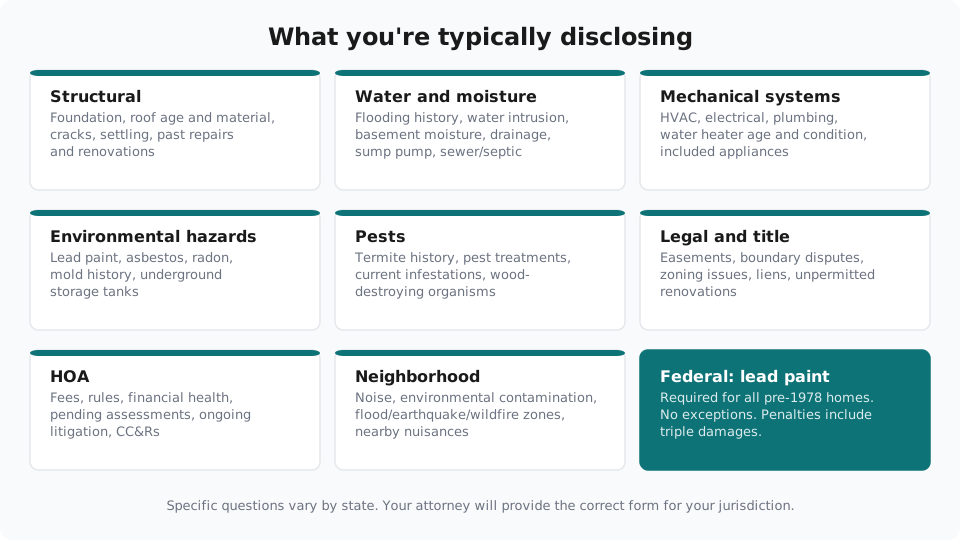
Structural. Foundation condition, roof age and material, any history of cracks, settling, or repairs. If your roof is 18 years old, you say that. If you had foundation work done in 2019, you disclose it.
Water and moisture. History of flooding, water intrusion, basement moisture, drainage problems. This is the section that makes sellers most nervous, and it’s also the one where honesty matters most. Water damage is the number one source of disclosure disputes.
Mechanical systems. HVAC age and condition, electrical system, plumbing, water heater. The buyer wants to know what’s working and what’s on its last legs.
Environmental hazards. Lead paint (more on this below), asbestos, radon, mold history, underground storage tanks. If your home was built before 1978, the lead paint disclosure is a federal requirement, not optional.
Pests. Termite history, pest treatments, any current infestations. If you had your house treated for termites three years ago, that goes on the form.
Legal and title. Easements, boundary disputes, zoning issues, liens, whether renovations were properly permitted. That deck addition your previous owner built without a permit? If you know about it, disclose it.
HOA. If your home is in an HOA, you’ll need to disclose fees, rules, financial health, pending assessments, and any ongoing litigation. Buyers have a right to know what they’re signing up for.
Neighborhood and environment. Noise issues, nearby environmental contamination, natural hazard zones. Some states require you to disclose whether the property is in a flood zone, earthquake zone, or wildfire area.
The form is mostly checkboxes and yes/no questions. It’s not asking you to write an essay. It’s asking you to be straightforward about what you know.
The one federal requirement that applies everywhere
Regardless of what state you’re in, if your home was built before 1978, you are federally required to provide a lead-based paint disclosure. This comes from the Residential Lead-Based Paint Hazard Reduction Act, and it applies to every seller in every state. No exceptions.
Here’s what you have to do:
- Give the buyer the EPA pamphlet “Protect Your Family From Lead in Your Home”
- Disclose any known lead-based paint hazards
- Provide any records or reports you have about lead in the home
- Include a lead warning statement in the sales contract
- Give the buyer 10 days to get a lead inspection (they can waive this, but you have to offer)
- Keep signed copies of the disclosure for three years after the sale
The penalties for skipping this are serious. The buyer can sue you for triple the actual damages. On a $15,000 remediation bill, that’s $45,000 in liability. The EPA can also hit you with civil penalties north of $11,000 per violation. This is one of the few areas where “I didn’t know I had to do this” won’t protect you.
Your attorney will handle the lead paint disclosure as part of the closing paperwork. It takes about five minutes. Skipping it can cost you tens of thousands.
How requirements vary by state
About 44 states require sellers to complete a standardized disclosure form. The forms range from a handful of questions to 50+ (California and New York are the most detailed).
A handful of states still follow “caveat emptor” (buyer beware) rules, meaning there’s no mandatory disclosure form. Alabama, Arkansas, and Wyoming are among them. But even in those states, you cannot actively conceal known defects, you must answer direct questions honestly, and you still have to comply with the federal lead paint requirement.
Some states have requirements worth knowing about. California requires disclosure of deaths on the property within three years. Florida requires a radon disclosure statement in every real estate contract. Texas has additional floodplain disclosures. New York recently expanded its form from 49 to 56 questions, adding flood-related requirements and eliminating the old $500 opt-out that let sellers skip the form entirely.
About 22 states also require an attorney to be involved in the closing. In those states, your attorney is already at the table and disclosure review is built into the process. In states where an attorney isn’t required, hiring one anyway is still the smartest move a FSBO seller can make. The specifics of disclosure law vary enough from state to state that you want someone who knows your jurisdiction cold.
What happens if you don’t disclose
Sixty percent of sellers admit to not disclosing a known problem with their property, according to a Cinch Home Services survey. That’s a gamble most of those sellers will eventually lose.
If a buyer discovers a defect you knew about and didn’t disclose, they can come after you for:
- Repair costs and damages — whatever it takes to fix the problem, plus any diminished property value
- Rescission — unwinding the entire sale, meaning you take the house back and refund the buyer
- Punitive damages — available when a court determines you intentionally concealed a defect
- Triple damages — specifically under the federal lead paint law
And 95% of homebuyers find issues after closing. If one of those issues traces back to something you knew about and left off the form, you’re exposed.
Here’s what most sellers don’t realize: disclosing a problem doesn’t kill the deal. It makes it a negotiation point. The buyer might ask for a repair credit or a price adjustment. But a known problem that’s disclosed up front is infinitely better than a lawsuit six months after closing. A $3,000 repair credit at closing beats a $30,000 lawsuit any day.
”As-is” doesn’t mean you can skip the disclosure
This is one of the most common misunderstandings in real estate. Selling “as-is” means you won’t pay for repairs. It does not mean you can hide known defects.
Courts across multiple states have been clear on this. An “as-is” clause does not eliminate your legal obligation to disclose. You still have to complete the disclosure form honestly. You still have to comply with the federal lead paint requirement. If you knowingly conceal a material defect and hide behind an “as-is” clause, you’re still liable for fraud.
“As-is” protects you from repair demands. It doesn’t protect you from misrepresentation claims.
Your attorney makes this easy
This is one of the first things your attorney will handle when you hire them. They’ll give you the correct form for your state, explain what each question is asking, and review your answers before anything goes to the buyer.
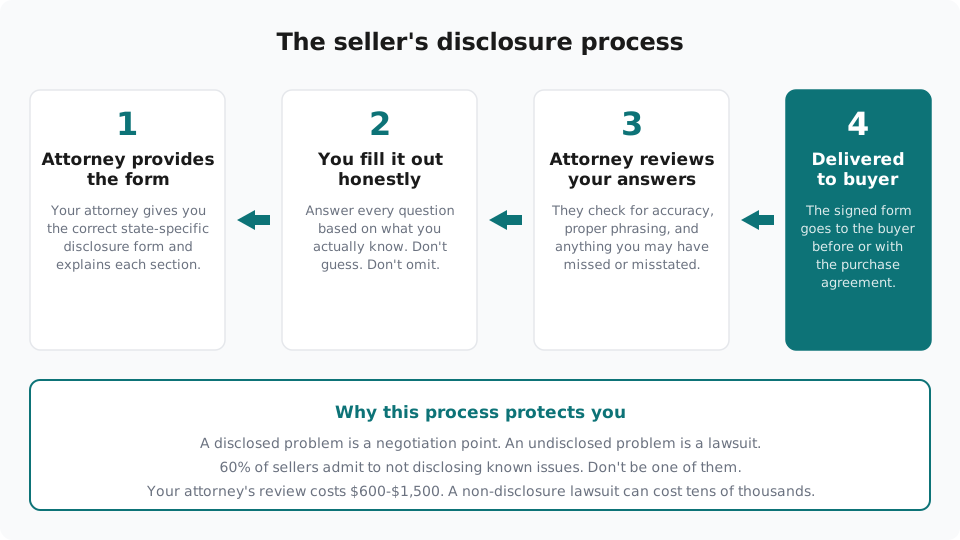
When we filled out our disclosure, our attorney gave us a lot of confidence that we were disclosing the right things and phrasing our answers properly. That matters more than you might think. The way you describe an issue on a disclosure form can be the difference between a reasonable negotiation and a legal headache. And this is a place where a Realtor realistically cannot help you. They’re not licensed to give legal advice. An attorney is. For $600 to $1,500, you’re getting someone with actual legal training reviewing a document that protects you from lawsuits. That’s one of the best deals in the entire FSBO process.
If you haven’t hired an attorney yet, here’s how to find and hire one. If you want to understand why an attorney is a better investment than an agent for this kind of work, that breakdown is here.
Your disclosure checklist before listing:
- Download your state’s seller disclosure form (free from your state real estate commission website)
- Walk through every room with the form in hand and answer honestly
- Note any past repairs, insurance claims, or known defects — even ones you’ve fixed
- Check the lead paint requirement if your home was built before 1978
- Gather documentation: permits, repair receipts, insurance claim records, HOA documents
- Have your attorney review your completed form before it goes to the buyer
Disclosure requirements vary significantly by state. Texas has additional floodplain disclosures. California requires disclosure of deaths on the property within three years. New York recently expanded its form to 56 questions. Florida mandates a radon statement in every contract. We’ll be publishing state-specific disclosure guides for the most common FSBO states — including Texas, Florida, California, Ohio, and Arizona — in the coming months.
Your next step: look up your state’s seller disclosure form. Read through the questions so nothing catches you off guard. Then hand it to your attorney and let them make sure every answer protects you. For the full process from disclosure through closing day, read the FSBO inspection and closing process.
Keep reading
Free FSBO purchase agreement template for Arizona
Arizona FSBO sellers can use the AAR Residential Resale Purchase Contract or a free alternative -- here's how the contract works, what the BINSR process means, and where sellers trip up.

The FSBO Savings Calculator: How Much Will You Actually Keep?
At 6% commission, a $400,000 sale costs you $24,000. Here's the real math on what you save selling FSBO, including the costs you'll still have.
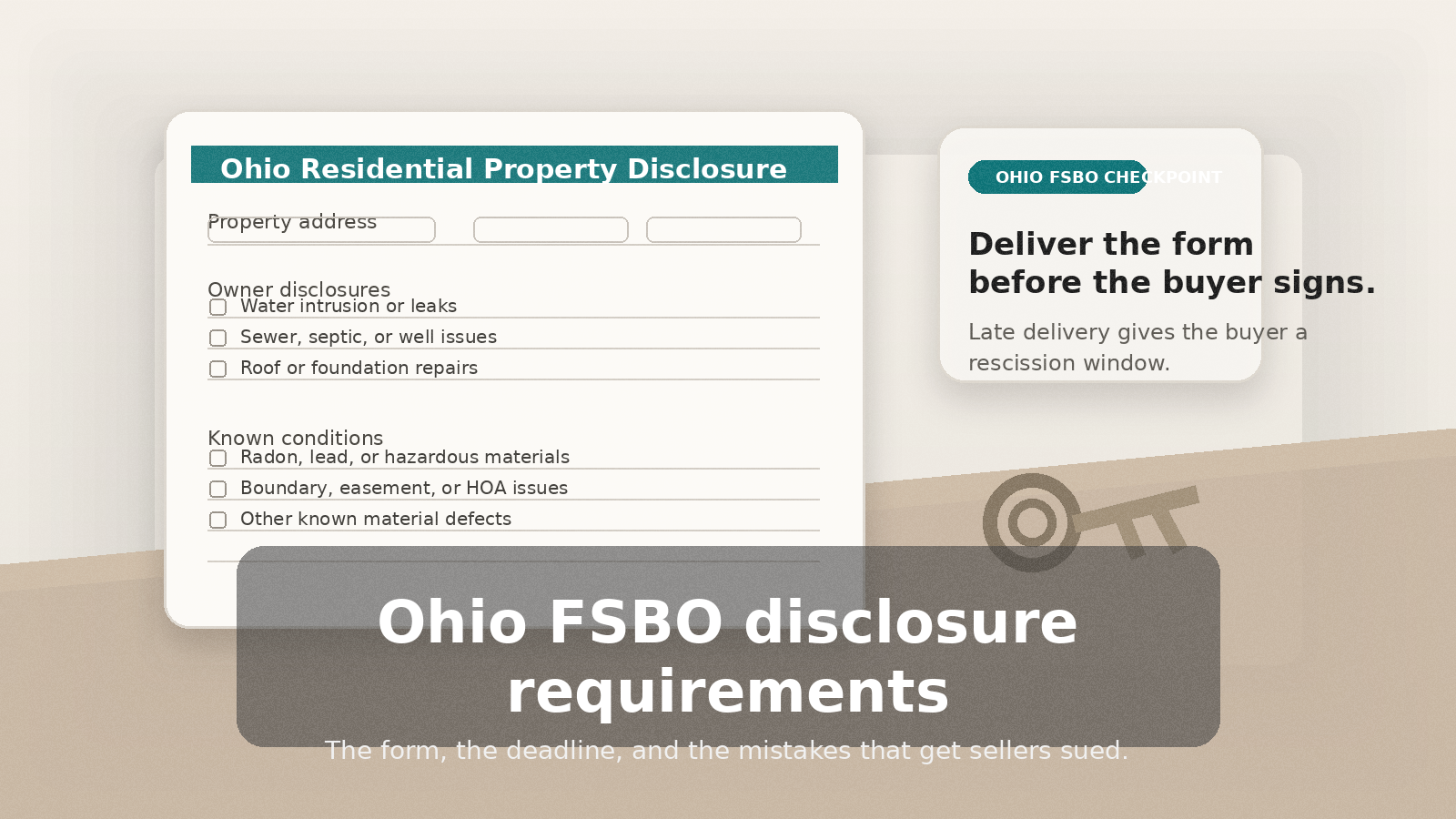
Ohio FSBO disclosure requirements: what you must tell the buyer
Ohio Revised Code 5302.30 requires most 1-4 unit sellers to deliver a Residential Property Disclosure Form. Here's what it covers, who is exempt, and when a buyer can cancel.