Free FSBO purchase agreement template for Georgia
Georgia FSBO sellers hit a wall that sellers in most other states don’t: the standard purchase agreement form used by every agent in the state is off-limits. The GAR Form F201, published by the Georgia Association of Realtors, is a copyrighted document restricted to licensed Realtors. You can’t download it, you can’t buy it, and no one is going to hand it to you because you asked nicely.
That’s the bad news. The good news is you don’t need it. Georgia law doesn’t require any specific form for a residential purchase agreement. What it requires is a written contract that meets a few basic legal standards, and an attorney at the closing table. Georgia is one of a handful of states where a lawyer must be physically present to close the deal. That built-in safety net is a major advantage for FSBO sellers.
Here’s where to get a purchase agreement, what it needs to include, and the Georgia-specific costs and disclosure rules that catch sellers off guard.
Why you can’t use the GAR form (and what to use instead)
The GAR Form F201 is the purchase and sale agreement that agents use in virtually every Georgia residential transaction. It’s well-drafted, it’s updated every year (the 2026 edition rolled out in January with nine changes), and every closing attorney in the state knows it by heart.
But it’s proprietary. GAR restricts access to its members and licensees who pay for a subscription. If you’re selling FSBO, you’re not a GAR member, and you’re not getting access.
Your options:
Hire a real estate attorney to draft your contract. This is the move I recommend. A Georgia attorney will draft a purchase agreement tailored to your transaction for $500 to $800 (some include this in their flat closing fee). The contract will comply with Georgia’s Statute of Frauds, include the right contingencies, and hold up if anything goes sideways. Since Georgia already requires a closing attorney, you’re paying for legal help anyway. Get them involved at the contract stage, not just at the closing table.
Use a free template and have your attorney review it. Sites like eForms and iPropertyManagement offer free Georgia residential purchase agreement templates. These are generic, not Georgia-specific in the way the GAR form is, but they cover the basic elements. Download one, fill it out, and send it to your attorney before anyone signs. Budget $200 to $400 for a contract review.
Use a flat-fee MLS service that includes GAR forms. Some flat-fee brokers in Georgia give you access to the GAR forms as part of their package. If you’re already paying for MLS access, this can be a nice perk. Just know that the broker is providing the form, not legal advice on how to fill it out.
The smart play: Get your attorney involved before you have a buyer, not after. Have them prepare a blank purchase agreement ready to go. When a buyer shows up, you hand them a professional contract. It signals that you know what you’re doing, and it puts you in control of the terms.
What your purchase agreement must include
Georgia’s Statute of Frauds (O.C.G.A. 13-5-30) says any contract for the sale of land must be in writing, signed by the party being held to it, and must identify three things: the buyer and seller, the property, and the purchase price. That’s the legal minimum. A contract that only hits those three points would be enforceable but reckless.
A solid Georgia purchase agreement covers all of these:
Parties and property
Full legal names of every buyer and seller, exactly as they appear on the deed. The property needs both the street address and the legal description from your deed or tax records, including the county and tax parcel ID. Your closing attorney will need the legal description to prepare the deed, so get this right from the start.
Purchase price and earnest money
The total price, broken down into earnest money (deposit), financing, and the balance due at closing. Earnest money in Georgia typically runs 1% to 3% of the purchase price. On a $350,000 house, that’s $3,500 to $10,500. The money goes to a neutral escrow holder, usually the closing attorney’s trust account. Never let the buyer hand you the deposit directly and never deposit it into your personal account.
The contract should specify when the earnest money is due (usually within 3 to 5 business days of the binding agreement date) and what happens to it if the deal falls apart.
Due diligence period
This is Georgia’s version of an inspection contingency, and it’s the section that matters most for FSBO sellers. The due diligence period gives the buyer a window, typically 10 to 14 days, to inspect the property, review documents, get appraisals, and generally decide whether they want to go through with it.
During this window, the buyer can walk away for any reason and get their earnest money back. Any reason. The inspection report scared them. They changed their mind. Their mother-in-law didn’t like the kitchen. Doesn’t matter.
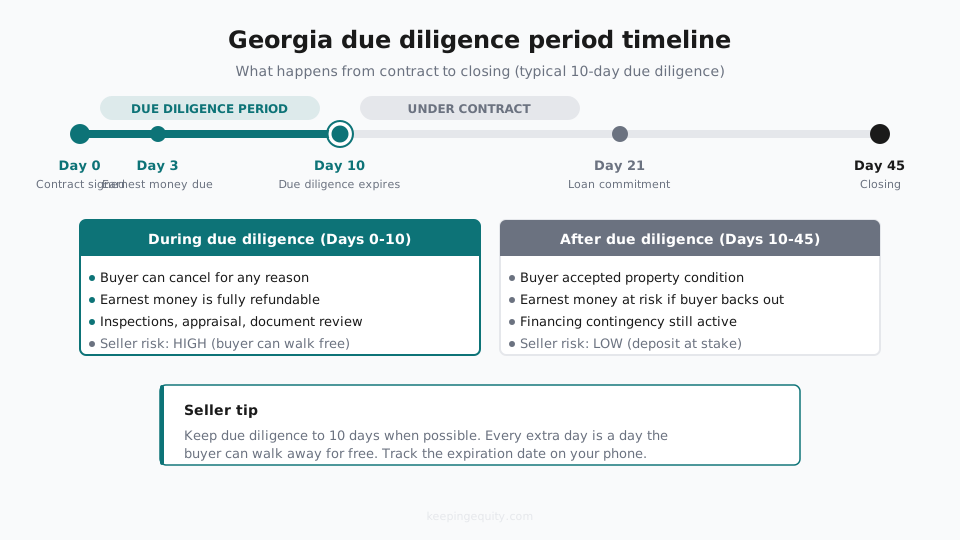
Once the due diligence period expires and the buyer hasn’t terminated, they’ve accepted the property. Their earnest money is at risk if they back out after that (with exceptions for financing and other specific contingencies).
Keep this period as short as the buyer will accept. Ten days is reasonable. Seven is tight but doable in a competitive market. Don’t agree to 21 or 30 days unless there’s a strong reason, because every day in due diligence is a day the buyer can walk away with no penalty.
Financing contingency
If the buyer is getting a mortgage, the contract should specify the loan type (conventional, FHA, VA), the amount, the interest rate ceiling, and the deadline for the buyer to get a loan commitment. If the buyer can’t get approved by that deadline and notifies you in writing, the contract terminates and they get their deposit back.
Cash buyers don’t need a financing contingency, but you need proof of funds. A recent bank statement or a letter from their financial institution showing liquid assets equal to or greater than the purchase price. “Trust me, I have the money” is not proof of funds.
Closing date, location, and possession
Georgia closings happen at the closing attorney’s office. The contract should specify the closing date (typically 30 to 60 days from the binding agreement), which attorney will handle the closing, and when the buyer takes possession. Most Georgia transactions hand over possession at closing, but spell it out.
Default and remedies
What happens if the buyer backs out after due diligence? What happens if you, the seller, can’t deliver clear title? The standard remedy in Georgia is liquidated damages, meaning the buyer forfeits their earnest money to you as compensation for the failed deal. The 2026 GAR forms also added construction deposits to the liquidated damages pool, so if your attorney is drafting from scratch, make sure the default provisions are clear and fair.
Special stipulations
Any terms that don’t fit neatly into the standard sections go here. Repairs the seller agreed to make. Items that stay or go. The buyer’s pet deposit. Anything negotiated between the parties that the pre-printed form doesn’t cover. Your attorney will know what belongs here.
Georgia’s disclosure rules (the “buyer beware” trap)
Georgia is a “buyer beware” state. Legally, it’s called caveat emptor, and it means Georgia does not require sellers to fill out a mandatory property disclosure form. That makes Georgia unusual. Most states require a detailed disclosure. Georgia doesn’t.
Don’t let that fool you into thinking you can stay silent about everything.
Here’s what Georgia law actually says:
You must answer direct questions truthfully. If a buyer asks “Does the basement flood?” and it does, and you say no, that’s fraud. Georgia courts have consistently held that lying about known defects or actively concealing them is actionable, regardless of caveat emptor.
You must disclose latent defects you know about. A latent defect is something that wouldn’t show up during a normal inspection. A foundation crack you patched and painted over. A roof that leaks only during heavy storms. Mold behind a finished wall. If you know about a problem and a buyer couldn’t reasonably discover it on their own, you need to disclose it.
Federal lead-paint rules apply. If your home was built before 1978, you must disclose known lead-based paint hazards, provide any existing inspection reports, hand over the EPA’s “Protect Your Family From Lead in Your Home” pamphlet, and give the buyer 10 days to get a lead-based paint inspection. This is federal law. Georgia’s caveat emptor doctrine doesn’t override it.
Stigmatized property is protected. Under O.C.G.A. 44-1-16, you don’t have to disclose that someone died in the home (by any cause) or that a prior occupant had a communicable disease. But if the buyer asks you directly, you have to answer truthfully (unless doing so would violate fair housing law).
My advice: fill out a seller’s disclosure anyway. The GAR publishes a Seller’s Property Disclosure Statement that covers roof, appliances, plumbing, HVAC, structural issues, and more. Your attorney can provide a similar form. A voluntary disclosure protects you because it creates a record of what you knew and when you disclosed it. If a buyer sues you two years later claiming you hid a defect, your signed disclosure is your best defense.
Georgia closing costs for sellers
Georgia’s closing costs are lower than a lot of states, partly because the transfer tax is modest. Here’s what a FSBO seller should budget on a $350,000 sale:
Real estate transfer tax: $350. Georgia charges roughly $1 per $1,000 of the sale price (the exact math: $1.00 for the first $1,000, then $0.10 for each additional $100). The seller pays this by default. It’s collected at closing, and the closing attorney files the PT-61 form with the state.
Closing attorney fees: $750 to $1,250. Georgia requires an attorney at the closing table, so this isn’t optional. The attorney drafts the deed, runs the title search, manages escrow, records the deed, and makes sure every document is in order. Most charge a flat fee for straightforward transactions.
Owner’s title insurance: $1,200 to $1,750. In Georgia, the seller customarily pays for the buyer’s owner’s title insurance policy. On a $350,000 property, expect to pay around $1,200 to $1,500. This is negotiable, so check what’s standard in your county.
Prorated property taxes. You pay your share of property taxes through the closing date. If you close in June, you owe about half the year’s tax bill.
Recording fees. Small but present: $14 plus $3 per page for the deed recording.
Add it all up and a FSBO seller in Georgia is looking at roughly $2,500 to $3,700 in closing costs on a $350,000 sale, not counting your mortgage payoff. Compare that to the $21,000 you’d give away in agent commissions at 6%. The savings are real.
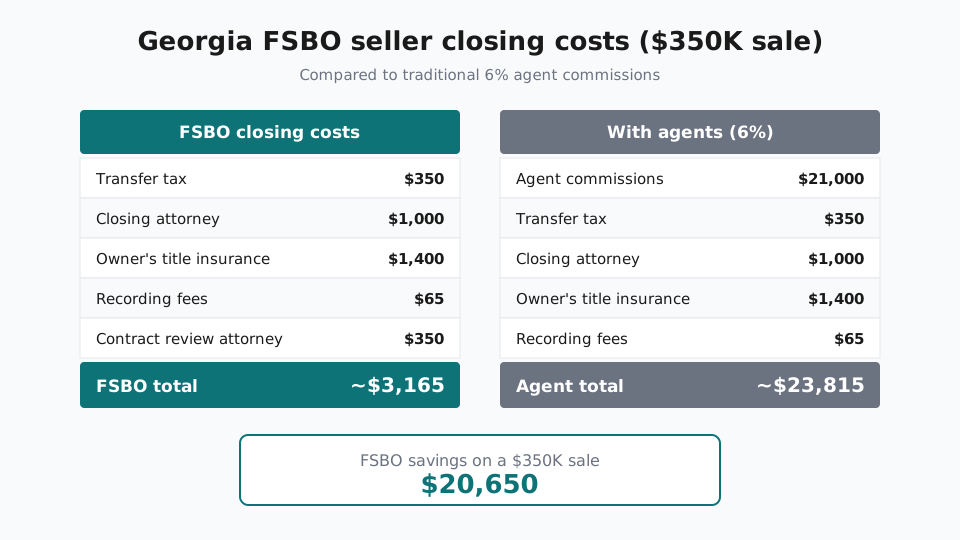
| Cost item | Typical amount ($350K sale) |
|---|---|
| Transfer tax | $350 |
| Closing attorney | $750 - $1,250 |
| Owner’s title insurance | $1,200 - $1,750 |
| Recording fees | $50 - $80 |
| Prorated taxes | Varies |
| Total (excluding payoff) | $2,350 - $3,430 |
The Georgia attorney advantage
Here’s something FSBO sellers in Georgia don’t always realize: the mandatory attorney requirement is actually a massive advantage for you.
In states that don’t require attorneys at closing, FSBO sellers often muddle through with a title company that processes paperwork but doesn’t give legal advice. If the contract has a problem, the title company won’t catch it. If a term is ambiguous, they won’t flag it. You’re on your own.
In Georgia, a licensed attorney reviews every closing document, explains what you’re signing, and makes sure the title is clean. That’s a safety net most FSBO sellers in other states have to pay extra for.
But here’s where sellers make a mistake: the closing attorney is usually chosen by the buyer (or the buyer’s lender), and they act as a neutral party. They’re not your advocate. They’re processing the transaction. If there’s a term in the contract that’s bad for you, the closing attorney isn’t required to tell you that.
That’s why I recommend hiring your own attorney to review the purchase agreement before you sign it, separate from the closing attorney. Yes, that means paying two attorneys. One to protect your interests in the contract ($200 to $500 for a review) and one to close the deal ($750 to $1,250). Even combined, you’re spending under $2,000 on legal help versus the $21,000 in commissions you’d hand over to agents. The math isn’t close.
Five mistakes Georgia FSBO sellers make
Using a random internet contract without legal review
Georgia’s Statute of Frauds requires a written contract, but it doesn’t say what the contract has to look like. So sellers grab a template from the first Google result, fill in the blanks, and sign it. The template might be designed for California. It might be missing a due diligence period (Georgia’s equivalent of an inspection contingency). It might have default remedies that don’t match Georgia law. Spend the money on a legal review. It’s the cheapest insurance you’ll buy in this process.
Treating “buyer beware” as a free pass
Georgia’s caveat emptor doctrine does not mean you can stay silent about everything. It means there’s no mandatory state disclosure form. Sellers who interpret this as “I don’t have to tell the buyer anything” are setting themselves up for a fraud lawsuit. If you know about a material defect and the buyer asks you about it, lying or dodging is illegal. If you know about a hidden problem that an inspection wouldn’t catch, concealing it is illegal. Disclose what you know. Put it in writing.
Skipping the due diligence period terms
The due diligence period is the most heavily negotiated part of a Georgia purchase agreement. If your contract doesn’t clearly define the start date, the end date, and the buyer’s rights during that window, you’re asking for a dispute. Be specific. “10 calendar days from the binding agreement date” is clear. “A reasonable period for inspection” is not.
Not verifying the buyer’s financing before going under contract
A buyer who says “I’m pre-approved” may be pre-qualified (meaning a lender looked at their stated income and credit score but didn’t verify anything). A pre-approval letter with specific loan terms, a lender’s name, and a dollar amount is what you want. For cash buyers, demand a bank statement or proof of funds letter dated within 30 days. Accepting a contract without proof of financial ability is one of the most expensive mistakes a FSBO seller can make, because you lose weeks of marketing time when the deal collapses.
Forgetting about the transfer tax
It’s only $1 per $1,000 of the sale price, so it’s not going to break you. But sellers who don’t know about it get surprised at the closing table when they see a line item they weren’t expecting. Budget for it. On a $350,000 sale, that’s $350. On a $500,000 sale, it’s $500. The closing attorney files the PT-61 form with the Georgia Superior Court Clerks Cooperative Authority, and the tax must be paid before your deed gets recorded.
After the contract: what happens at closing
Once you and the buyer have a signed purchase agreement and the due diligence period expires without termination, you’re headed to closing. In Georgia, that means sitting down at the closing attorney’s office (or doing a “mail-away” closing if one party can’t be there in person).
The closing attorney handles the title search, prepares the warranty deed, files the PT-61 transfer tax form, manages the escrow disbursements, and records the deed with the county. You’ll sign the deed, the closing disclosure (formerly the HUD-1 settlement statement), and any required affidavits. The buyer signs their mortgage docs if they’re financing.
Bring a valid photo ID. If you have an existing mortgage, make sure your payoff amount is current. The closing attorney will wire the payoff to your lender and wire your proceeds to you. Verify the wire instructions by phone. Wire fraud in real estate closings is a real problem, and Georgia is no exception.
For the full list of documents you’ll need, check the FSBO closing checklist.
How the NAR settlement affects Georgia FSBO sales
The 2024 NAR settlement changed how buyer agent commissions work across every state, including Georgia. The short version: buyer agent compensation can no longer be advertised on the MLS. Buyers must sign a written representation agreement with their agent before touring homes.
For FSBO sellers, this means you’ll face the question: “Are you offering buyer agent compensation?” The answer is entirely up to you. You’re not required to offer anything. If you do decide to offer compensation to attract represented buyers, you’ll need to advertise it off the MLS, on your yard sign, listing website, or in direct conversations with agents.
If you want to understand the full picture of how the settlement changed the rules, start with Selling FSBO after the NAR settlement and Do sellers have to pay the buyer’s agent?.
Your next step: call two or three real estate attorneys in your county. Ask what they charge for a flat-fee closing and whether they’ll draft your purchase agreement as part of the package. Get the contract ready before you have a buyer, so when one shows up, you’re not scrambling.
Keep reading

Best flat fee MLS services in Arizona (2026)
A side-by-side comparison of Arizona flat fee MLS companies, with real pricing, local MLS questions, and the fine print sellers miss.

Best flat fee MLS services in California (2026)
A side-by-side comparison of California flat fee MLS companies, with real pricing, local MLS coverage questions, and the closing-fee math sellers miss.
FSBO closing checklist: every document you need
The complete list of documents sellers need to gather, review, and sign at closing -- organized by who prepares what and when you need it.