Seller closing costs calculator: estimate your net proceeds
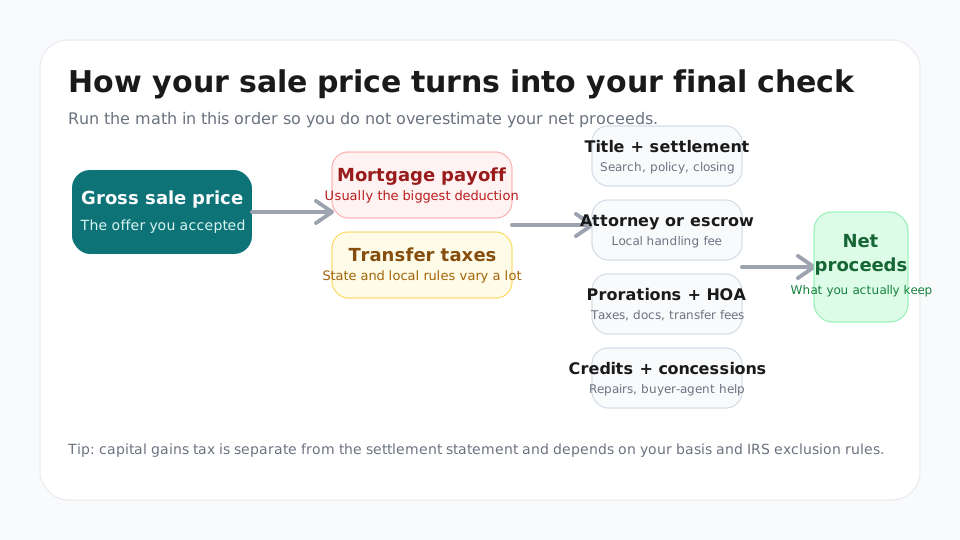
Most sellers underestimate closing because they focus on commission and forget the rest of the deductions. Your final wire usually gets hit by your mortgage payoff, transfer taxes, title and settlement charges, attorney or escrow fees, tax prorations, HOA paperwork, and any buyer credits or buyer-agent concession you agreed to. The calculator below lets you plug those numbers in before closing day so you know what you will actually keep.
New to FSBO? Start with the main FSBO guide. This post assumes you’re already pricing a real offer or preparing for closing.
The question most sellers really mean to ask is not “what are closing costs?” It is “what will actually hit my bank account after everyone else gets paid?”
That is the right question. Mortgage payoff is not technically a closing cost, but if you still owe money on the house, it absolutely belongs in your net-proceeds math. Same with buyer credits. Same with the buyer’s agent concession if you agreed to one.
What this calculator counts
The calculator below includes the line items that most often reduce a seller’s final check:
- Remaining mortgage payoff
- State transfer tax default, if your state charges one
- Title and settlement estimate
- Attorney or escrow estimate
- Property-tax proration
- HOA or document fees
- Seller credits or repair credits
- Optional buyer-agent concession
It does not try to calculate capital gains tax. That part depends on your cost basis, how long the home was your main residence, and whether you qualify for the IRS home-sale exclusion. If you owned and used the property as your main home and qualify, the IRS says you may be able to exclude up to $250,000 of gain, or up to $500,000 on a joint return with your spouse. That’s tax-return math, not settlement-statement math.
Seller closing costs calculator
The line items sellers miss most often
The first mistake is treating mortgage payoff like it has nothing to do with closing costs. Your lender payoff is not a tax or a fee, but it still comes straight off the top on closing day. If your sale price is $400,000 and you still owe $250,000, your real starting point is not $400,000. It is $150,000, before taxes and fees.
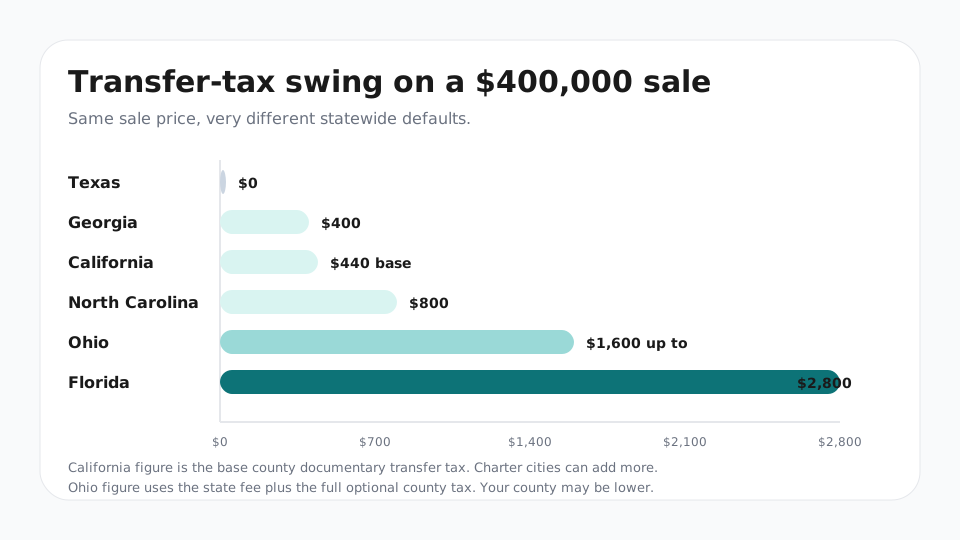
The second mistake is forgetting how state transfer taxes can swing the number fast. Texas is easy. The Texas Constitution bars a state transfer tax on fee simple conveyances, so the statewide transfer-tax line is zero. Florida is the opposite. The Florida Department of Revenue says documentary stamp tax on deeds is 70 cents per $100 outside Miami-Dade, which means $2,800 on a $400,000 sale before you even get to title charges.
North Carolina charges $1 per $500 of consideration, so a $400,000 sale produces an $800 excise-tax line. Georgia’s Department of Revenue says the transfer tax is $1 on the first $1,000 and 10 cents for each additional $100, which works out to about $400 on that same $400,000 sale. California counties can charge 55 cents per $500 under long-standing state law, and some charter cities layer on more. Ohio is messy: state law imposes a $1 per $1,000 conveyance fee, and counties can add up to another $3 per $1,000.
Title and settlement charges are the next surprise. The CFPB explains that title service fees include the title search, lender’s title insurance charges, and, in most states, the fee for conducting the closing. Owner’s title insurance is separate and negotiable. In plain English: ask your title company for the actual seller-side estimate instead of guessing from a blog post written in 2021.
Attorney or escrow fees matter too. In my experience, this is still one of the best places to spend money because a closing attorney or title company is doing real work that actually protects you. The PDF behind this site’s strategy notes attorney costs in the $600 to $1,500 range on the author’s own FSBO sales, which lines up with what many sellers still see for straightforward deals.
Then you have the smaller line items that are not small when they stack up. Property-tax proration. HOA estoppel letters and transfer packets. Recording fees. Courier fees. Repair credits you agreed to after the inspection. Any one of these looks manageable. Five of them together can wipe out another $1,500 to $4,000 from your check.
What counts as optional now
The buyer’s agent concession belongs in this calculator, but it does not belong in your head as an automatic 2.5% or 3% tax on selling your home.
That old assumption is dead. The MLS no longer requires sellers to advertise buyer-agent compensation, and you can negotiate it as part of the whole offer package. If you need a refresher, read how real estate commissions actually work and do sellers have to pay the buyer’s agent?.
This is where the scenario table in the calculator helps. On a $400,000 sale, the jump from a 1% concession to a 2.5% concession is $6,000. That’s real money. If two offers are otherwise close, your net sheet tells you which offer is actually better.
How to turn this estimate into a real number
Use the calculator before you accept an offer. Then do the grown-up version of the same exercise: send the draft terms to your title company or real estate attorney and ask for a seller net sheet.
That document is what matters. It should show your payoff, taxes, title charges, attorney or escrow fees, commission or concession if any, and your estimated proceeds. If the numbers on that sheet feel different from what you expected, good. You found the problem before closing day instead of at the table.
For the rest of the closing paperwork, here is the full FSBO closing checklist. And if you want the bigger timeline from accepted offer to keys, read the FSBO inspection and closing process.
Your next move is simple: run your current numbers, then ask for a real seller net sheet this week. Guessing is how people get blindsided at closing. Running the math is how you keep your equity.
Keep reading

Selling a House FSBO During Divorce: Legal Considerations
A practical, cautious framework for spouses considering a for-sale-by-owner home sale during divorce: authority, title, pricing, closing, taxes, and professional help.
Free FSBO purchase agreement template for Ohio
Ohio FSBO sellers don't need a Realtor's form to write a valid purchase contract -- here's which forms to use, what each section covers, and the regional quirks that trip sellers up.
Best flat fee MLS services in Ohio (2026)
A side-by-side comparison of Ohio flat fee MLS companies, with real pricing, local MLS coverage questions, and the closing-fee math sellers miss.