The FSBO Inspection and Closing Process: What to Expect
You’ve got an accepted offer on your home. Your family’s excited. Your friends are cautiously optimistic. And somewhere in the back of your mind, a voice is saying: “This is where it gets complicated.”
It doesn’t have to be. The stretch between an accepted offer and closing day follows a predictable pattern. There are a handful of milestones, each with a clear purpose, and your real estate attorney will be guiding you through every one of them.
Here’s exactly what happens, what it costs, and what you need to do at each step.
The timeline from offer to closing
A typical closing takes 30 to 45 days from the accepted offer. Cash deals can close in as little as two weeks. Financed purchases with complications can stretch to 60 days, though that’s rare.
Here’s the rough sequence:
Days 1-3: Earnest money deposit goes into escrow. Your attorney reviews the signed purchase agreement. The clock starts on contingency deadlines.
Days 5-14: Home inspection happens. The buyer schedules it and pays for it. You get the report and the buyer’s repair request list.
Days 7-21: If the buyer is financing, the lender orders an appraisal. This runs parallel to the inspection process.
Days 14-30: Title search and title insurance. The title company verifies there are no liens, judgments, or claims against your property.
Days 28-43: The buyer’s lender finalizes the loan (called “clear to close”). Final numbers are prepared.
Closing day: Everyone signs. Funds transfer. The deed records. You get your money.
Your attorney coordinates most of this behind the scenes. Your job is to stay responsive and keep your phone handy.
The home inspection
Within the first two weeks, the buyer will hire a licensed home inspector. This is standard. Don’t take it personally. For a detailed breakdown of exactly what inspectors look at, how to prepare, and what the report means, read what happens during a home inspection.
The inspector spends 2 to 4 hours going through your house. They check the roof, foundation, electrical, plumbing, HVAC, water heater, windows, appliances, and a hundred other things. They’re looking for anything broken, worn out, unsafe, or not up to code.
You don’t need to be home for the inspection. Most inspectors prefer you’re not there. The buyer and their agent will typically attend.
A few days later, the buyer sends you an inspection report. These reports are long. Don’t panic when you see 30 or 40 items listed. Inspectors document everything, including minor stuff like a missing outlet cover or a slow drain. The report is thorough by design, not because your house is falling apart.
Dealing with repair requests
After the inspection, the buyer sends a repair request. This is a list of items they want you to fix, credit money for, or address before closing. This is a negotiation, not a demand.
You have three options for each item:
Fix it. For genuine safety issues or material defects, fixing them is usually the right call. A broken furnace, a leaking roof, faulty wiring. These are real problems, and a reasonable buyer is right to flag them.
Offer a credit. Instead of making the repair yourself, you can offer the buyer a credit toward closing costs. This is often the cleaner path. It lets the buyer choose their own contractor and handle the work on their timeline. In my experience, buyers prefer credits for anything that isn’t urgent.
Push back. Some requests are cosmetic or wishful thinking. A buyer who asks you to replace a 10-year-old dishwasher that works fine is trying to get a freebie. You can say no. Your attorney will help you draft a response that’s firm but professional.
My general rule: fix safety items, offer credits for legitimate maintenance issues, and push back on everything else. The buyer expects some back-and-forth here. That’s how it works.
One thing to watch for: if the buyer’s repair request is wildly unreasonable (asking for $25,000 in credits on minor cosmetic items), they may be looking for a way to renegotiate the purchase price through the back door. Your attorney has seen this before and will know how to respond.
The appraisal
If the buyer is financing (most are), the lender orders an appraisal. This isn’t optional. The lender wants to make sure the home is worth what they’re lending against.
A licensed appraiser visits your home, measures the square footage, assesses the condition, and compares it to recent comparable sales. The visit takes about 30 minutes. The report usually comes back within a week.
If the appraisal comes in at or above the purchase price, you’re good. The process continues without a hitch.
If it comes in low, things get more interesting. Say your accepted offer is $400,000 but the appraiser values the home at $385,000. The lender won’t lend based on $400,000. Now you have three options:
The buyer covers the $15,000 gap with their own cash, on top of their down payment. Some buyers will do this if they really want the house.
You and the buyer renegotiate the price down to the appraised value or somewhere in between. This is the most common outcome.
Or the deal falls apart. If neither side budges, the appraisal contingency lets the buyer walk away with their earnest money.
If you priced your home using a solid comparative market analysis, a low appraisal is unlikely. The same comps you used to set your price are the same comps the appraiser uses. But it happens, and knowing your options ahead of time takes the panic out of it.
Title search and title insurance
While the inspection and appraisal are happening, the title company runs a title search on your property. They’re checking public records to make sure no one else has a claim to your home. Unpaid liens, tax debts, easements, boundary disputes, old mortgages that were never properly discharged.
Most title searches come back clean. If something turns up, your attorney works with the title company to resolve it before closing.
Title insurance is a one-time policy that protects the buyer (and the buyer’s lender) against any title issues that weren’t caught in the search. In most states, the seller pays for the owner’s title insurance policy. It’s a one-time cost at closing, typically $1,000 to $2,000 on a $400,000 sale.
Understanding your closing costs
Sellers have closing costs too. On a $400,000 sale, expect to pay somewhere between $5,000 and $15,000 depending on your state, your local taxes, and what you negotiated in the purchase agreement. Here’s what usually shows up:
Title insurance: $1,000 to $2,000. You’re typically paying for the buyer’s owner’s policy.
Transfer taxes and recording fees: These vary wildly by state and county. Some states charge a flat fee. Others charge a percentage of the sale price. In some counties this is a few hundred dollars. In others, several thousand.
Prorated property taxes: You owe taxes up through the day of closing. If you’ve prepaid for the year, you get a credit back. If you haven’t, it gets deducted from your proceeds.
Attorney fees: $500 to $3,000. You already know this is the best money you’ll spend on the entire transaction.
Buyer’s agent commission: Whatever you negotiated comes out of your proceeds at closing. If you got it down to 0.5-1%, you’re in great shape. Even at 2.5%, you’ve still saved the entire listing agent side.
HOA fees: If you’re in an HOA, there may be a transfer fee and document charges. Typically $200 to $500.
Your attorney and the title company will prepare a settlement statement a day or two before closing that shows every line item. Review it carefully. No surprises on closing day.
Your closing documents checklist
Before closing day, gather and organize these documents. Your attorney and title company will handle most of the preparation, but having your side ready prevents last-minute delays.
Documents you should have ready:
- Government-issued photo ID (driver’s license or passport)
- Your completed seller’s disclosure, signed and dated
- Keys, garage door openers, alarm codes, and any access devices for the buyer
- Receipts or documentation for any agreed-upon repairs
- Your mortgage payoff statement (your lender provides this; your attorney will request it)
- HOA documents and transfer paperwork (if applicable)
- Home warranty information if you’re providing one
- Any survey, permits, or property documentation the buyer requested
Documents your attorney and title company prepare:
- The deed (transferring ownership)
- Settlement statement (every dollar in and out)
- Affidavit of title (confirming your right to sell)
- Transfer tax declarations (varies by state)
- Mortgage payoff authorization
- 1099-S tax reporting form
Your attorney will walk you through each document before you sign, so you don’t need to become an expert on any of them. Just make sure you’ve gathered your items and reviewed the settlement statement at least a day before closing.
Closing day
Closing day itself is anticlimactic in the best way.
You meet at the title company’s office (or your attorney’s office, depending on your state). In some states, the buyer and seller close separately. In others, everyone sits around the same table.
Your attorney walks you through each document before you sign. The main ones:
The deed transfers ownership from you to the buyer. The settlement statement shows every dollar in and out. The affidavit of title confirms you have the right to sell and there are no undisclosed issues. If you have a mortgage, there’s a payoff authorization directing the title company to pay your lender from the proceeds.
Signing takes about an hour. The buyer’s side usually takes longer because they’re signing loan documents too.
After everyone signs, the title company disburses funds. Your mortgage gets paid off, closing costs get deducted, and the rest goes to you. Most sellers receive proceeds via wire transfer the same day or the next business day.
The deed gets recorded at the county recorder’s office, and the house officially belongs to the buyer.
That’s it. No drama. No mystery. Just a stack of paperwork, a wire transfer, and the satisfaction of knowing you kept your equity instead of handing tens of thousands to someone who posted your house on a website.
Your attorney handles the coordination. The title company handles the money. You handle the signatures. And at the end of it, you walk away with tens of thousands more than you would have if you’d hired an agent.
For the complete start-to-finish walkthrough, the FSBO guide covers every step from pricing to this moment. If you haven’t hired your attorney yet, that’s step one.
Keep reading
What is a buyer representation agreement (and why sellers should care)
Since August 2024, every buyer's agent must have a signed compensation agreement before showing homes. Here's what that agreement says, what it means for FSBO sellers, and how to handle it.
Free FSBO purchase agreement template for Texas
Texas FSBO sellers can use the TREC One to Four Family Residential Contract for free -- here's how to fill it out, what each section means, and where most sellers trip up.
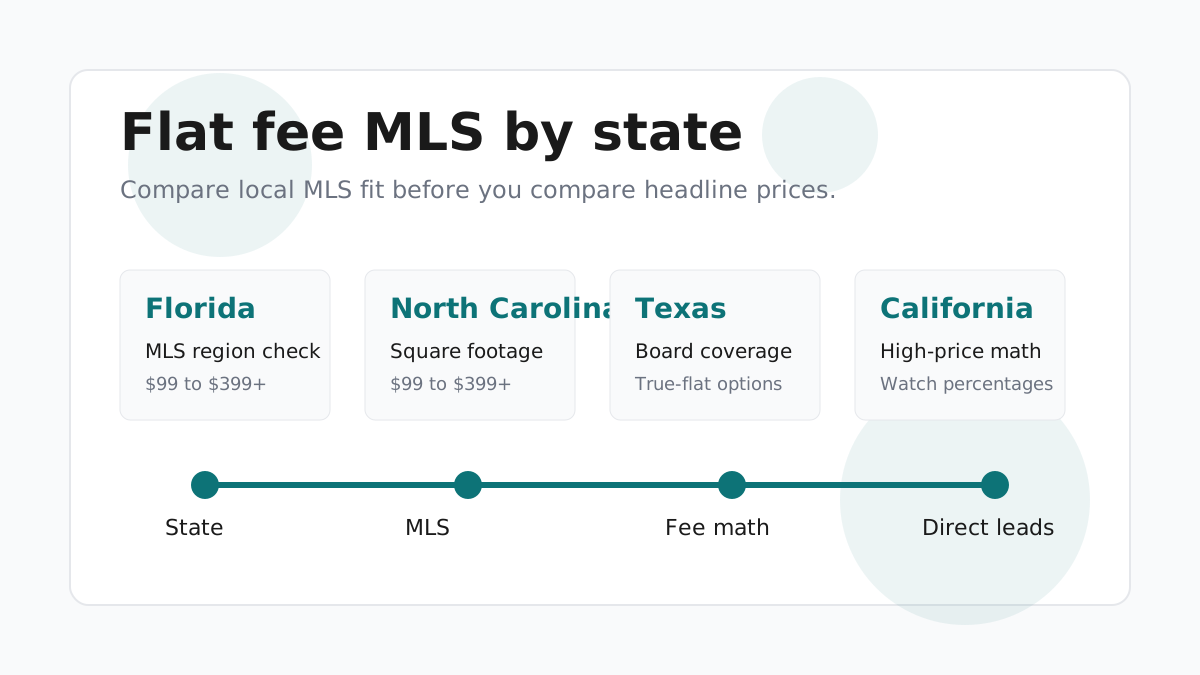
Best flat fee MLS services by state (2026)
A state-by-state flat fee MLS comparison hub for FSBO sellers who want the cheapest clean listing path without closing-fee surprises.