How to Handle Offers and Negotiate as a FSBO Seller
You’ve priced your home, built a listing that looks every bit as professional as what an agent would produce, and the showings are rolling in. Now someone wants to buy your house.
This is the moment people warned you about when you said you were selling FSBO. “Who’s going to negotiate for you?” “How will you know if an offer is any good?” “You’re going to get taken advantage of.”
Here’s what those people don’t understand: negotiating the sale of your own home isn’t some dark art reserved for licensed agents. It’s math, patience, and knowing what to look for. And because you’re the one with tens of thousands of dollars on the line — not an agent who earns an extra $150 whether you hold out for a better deal or not — you actually have more incentive to get this right than anyone you could hire.
What’s actually in an offer
When a buyer (or their agent) submits an offer on your home, it’s a formal document. If you’ve never seen one before, it can look intimidating. But there are really only a handful of things that matter.
Purchase price. The big number. What the buyer is willing to pay. This is the first thing you’ll look at, but it shouldn’t be the last.
Earnest money. A deposit the buyer puts down to show they’re serious. Typically 1-3% of the purchase price. This money goes into escrow and gets applied toward closing. If the buyer walks away for no valid reason, you may get to keep it. A larger earnest money deposit signals a more committed buyer.
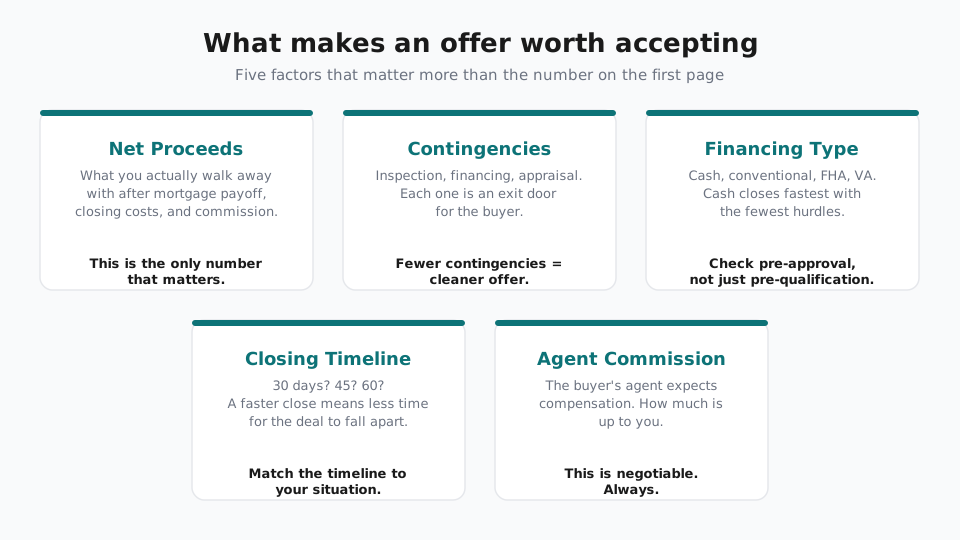
Contingencies. These are the “ifs” in the offer. The most common ones are inspection contingency (buyer can back out if the inspection turns up problems), financing contingency (the deal depends on the buyer getting approved for a mortgage), and appraisal contingency (the deal depends on the home appraising at or near the purchase price). Fewer contingencies means a cleaner offer with less risk of the deal falling apart.
Closing timeline. How quickly the buyer wants to close. A typical timeline is 30 to 45 days. If you need to move fast or need extra time, this matters.
Financing type. Cash, conventional mortgage, FHA, VA. Cash offers close faster and don’t have financing or appraisal contingencies. FHA and VA loans have specific requirements that can add steps to the process.
Your real estate attorney should review every offer before you respond to anything. That’s literally what you’re paying them for, and at $600 to $1,500 for the entire transaction, it’s one of the best deals in real estate.
Stop staring at the purchase price
The biggest mistake FSBO sellers make when evaluating offers is fixating on the top-line number. Two offers at $400,000 can put very different amounts of money in your pocket.
Here’s why: net proceeds are what matter. That’s the amount you actually walk away with after paying off your mortgage, covering closing costs, and handling any commission you’ve agreed to pay a buyer’s agent.
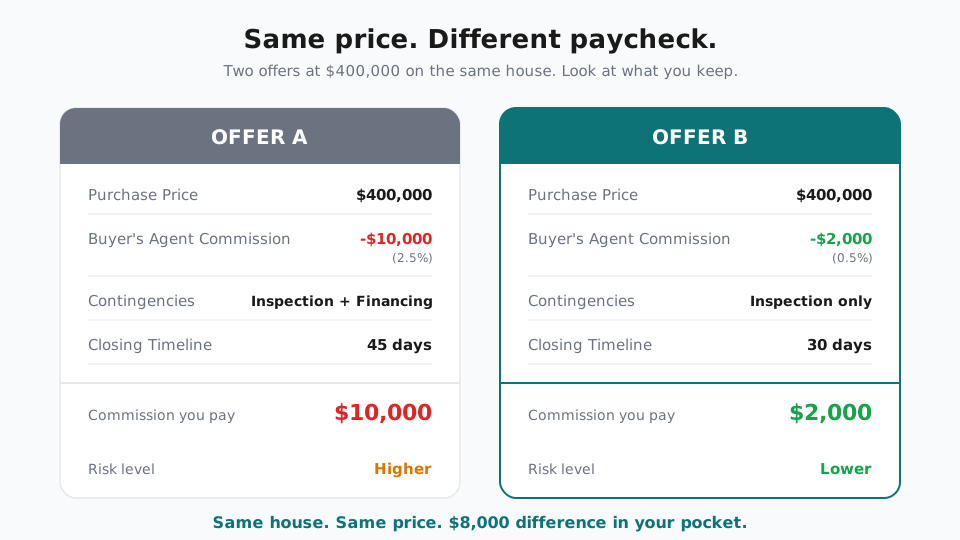
Say you get two offers, both at $400,000.
Offer A comes with a 2.5% buyer’s agent commission request, a financing contingency, an inspection contingency, and a 45-day close.
Offer B comes with a 0.5% buyer’s agent commission, an inspection contingency only (no financing contingency because the buyer is pre-approved with a strong lender), and a 30-day close.
The purchase price is identical. But Offer B puts $8,000 more in your pocket on the commission alone, has less risk of falling through because there’s no financing contingency, and closes two weeks sooner.
If you only looked at the first line, you’d think these offers were the same. They’re not even close.
When you price your home with a CMA, you figure out what the property is worth. When offers come in, you need to figure out what each offer is worth to you.
Working with buyer’s agents
According to a 2020 NAR survey, 86% of buyers purchase a home while working with an agent. That’s the reality. If you refuse to work with buyer’s agents, you’re cutting off 86% of your potential buyers. That’s not a negotiating strategy. That’s sabotage.
The good news: working with a buyer’s agent doesn’t cost you anything close to what you saved by not hiring a listing agent. And how you handle these agents will directly affect how many offers you get and how competitive they are.
If you followed the advice in the listing article, you already have “Buyer’s Agents Welcome” in your listing description. That one line does a lot of work. It tells agents that you’re a professional, cooperative seller who understands how the process works. Without it, some agents will steer their clients toward other listings because they assume dealing with a FSBO seller will be difficult or that their commission isn’t guaranteed.
When a buyer’s agent contacts you to schedule a showing, be responsive, be professional, and be organized. Have your lockbox ready. Respond to inquiries within the hour. Make it easy for them to show your home, and they’ll bring more clients through.
The commission conversation
Here’s where FSBO sellers get nervous, and where you can save the most money.
Since you’re selling without a listing agent, there’s no seller’s agent commission. That 2.5-3% is already in your pocket. But the buyer’s agent will expect to be compensated. The question is how much.
The traditional buyer’s agent commission is 2.5-3%. But “traditional” doesn’t mean “required.” There is no law or rule that says you have to pay a buyer’s agent 3%. Or 2.5%. Or anything, for that matter. The commission is negotiable. It always has been. And since the NAR settlement in 2024, the rules around commission have shifted even further in your favor.
Here’s how I handle it: I don’t specify a buyer’s agent commission in my listing. By leaving it out, I keep my options open. When an agent brings me an offer, the commission becomes part of the negotiation — not a predetermined cost I’ve locked myself into.
Some buyer’s agents will bring up their commission when they first call to schedule a showing. Others won’t mention it until they submit an offer. Either way, treat it as what it is: a negotiation. You’re not obligated to say yes to the first number they throw out.
How I paid 0.5% total commission on a $400,000 sale
The first time I sold a house FSBO, I received two offers at my asking price of $400,000. Both buyers loved the house. Both were pre-qualified. Both offers were clean.
The first buyer’s agent wanted a 2.5% commission. That’s $10,000 off the top of my proceeds.
The second buyer’s agent was willing to drop their commission to 0.5% to make their client’s offer more competitive. That’s $2,000.
Same house. Same sale price. An $8,000 difference based entirely on the buyer’s agent commission.
I went with the second offer. On that sale, I paid 0.5% in total commissions — compared to the 5-6% I would have paid if I’d listed with an agent. On a $400,000 home, that’s the difference between paying $2,000 and paying $24,000. That $22,000 I saved is real money. It wasn’t complicated. I didn’t need a certification or a license or a fancy negotiation course. I needed two offers and the willingness to compare them honestly.
Making counteroffers
You’re not required to accept or reject an offer outright. Counteroffers are normal. They’re expected.
If an offer is close but not quite right, counter it. Maybe the price is fine but you want a shorter closing timeline. Maybe the price is a bit low but everything else looks good. Maybe the buyer’s agent commission is higher than you’d like to pay.
A counteroffer is just a written response that says “I like the direction, but here’s what I need.” Your attorney can draft or review your counteroffers to make sure the language is right and you’re not accidentally agreeing to something you didn’t intend.
A few things I’ve learned about counteroffers:
Don’t counter with your absolute bottom line on the first round. Leave yourself room. If your list price is $400,000 and someone offers $380,000, countering at $395,000 gives you space to meet somewhere around $390,000 to $392,000 if needed.
Don’t get emotional. An offer $20,000 below your asking price isn’t an insult. It’s a starting point. The buyer who offered $380,000 on your $400,000 house is still interested enough to put down earnest money and write up a formal offer. Work with that.
Respond quickly. Momentum matters. A buyer who submitted an offer on Saturday and doesn’t hear back until Wednesday may have already moved on to another property. Get your counter back within 24 hours.
When you have multiple offers
Multiple offers are the best position you can be in as a seller, and a well-priced, well-marketed FSBO listing can absolutely get there.
When you have more than one offer on the table, you have options. You can accept the best one outright. You can counter one and hold the others. Or you can go back to all buyers and let them know you’ve received multiple offers and invite them to submit their best and final.
This is where all that work pays off — the CMA you did to price it right, the professional photos and listing, the Friday launch timing. A well-positioned listing creates competition, and competition gets you the best price and terms.
Compare every offer on net proceeds, not just purchase price. Factor in buyer’s agent commissions, contingencies, closing timeline, and financing risk. The highest offer isn’t always the best one.
Mistakes that cost FSBO sellers money
Getting emotional. Your house has memories. The buyer’s lowball offer isn’t a comment on those memories. It’s a negotiation tactic. Respond with numbers, not feelings.
Fixating on list price. You set a list price based on your CMA. That’s your starting point, not a magic number. If the market is telling you something different through the offers you’re receiving, listen. A house that’s priced right will attract offers near asking. If every offer is 10% below, your price might be off — not the buyers.
Ignoring contingencies. A $405,000 offer with an inspection contingency, a financing contingency, and an appraisal contingency is riskier than a $395,000 offer with only an inspection contingency. Any one of those contingencies can kill the deal weeks into the process, after you’ve taken your house off the market and turned away other buyers.
Skipping the attorney review. Every offer, every counteroffer, every addendum should go through your attorney before you sign. This is exactly why you hired one. Don’t save $600 on legal review and lose $6,000 on a contract term you didn’t understand.
You’ve got an accepted offer. The hard part is over, right? Not quite. The inspection is next, and that’s where deals get renegotiated — or fall apart. Read what happens during a home inspection to know exactly what inspectors look for, then the FSBO inspection and closing process for everything from repair negotiations through closing day.
We’ll be publishing free FSBO purchase agreement templates by state in the coming months — starting with Texas, Florida, California, Ohio, and Arizona. Your attorney should always review (or draft) your purchase agreement, but having a solid template to start from saves time and legal fees.
For the full process from start to finish, the complete FSBO guide walks through every step.
Keep reading
What Happens During a Home Inspection (A Seller's Perspective)
Home inspections are predictable if you know what's coming. Here's exactly what inspectors look for, how long it takes, and how to prepare as a FSBO seller.
Do sellers have to pay the buyer's agent? Not anymore.
Since August 2024, sellers are not legally required to pay the buyer's agent commission. Here's what changed, what most sellers still do, and how to handle it as a FSBO seller.
California FSBO disclosure requirements: what you must tell the buyer
California FSBO sellers usually need a TDS, NHD, tax notices, HOA documents, lead-paint paperwork, and newer 2025-2026 disclosures.