Free FSBO purchase agreement template for California
California doesn’t give FSBO sellers one obvious contract the way Texas does with the TREC form. The most common purchase agreement in the state is the CAR RPA, published by the California Association of Realtors, but it’s designed for agents and it’s not free. That leaves FSBO sellers with a choice: buy access to the CAR form, use an alternative contract built for owner-to-owner sales, or have an attorney draft one from scratch.
Here’s how to get the right contract, what the key sections mean, and where California’s disclosure requirements will bury you if you’re not prepared.
The CAR RPA: the standard form you probably can’t get for free
The California Residential Purchase Agreement and Joint Escrow Instructions (CAR RPA) is the dominant contract used in California residential transactions. It’s a 10 to 16 page document that serves double duty as both the purchase agreement and the joint escrow instructions, telling the escrow company how to handle funds, documents, and closing.
Licensed Realtors get the form through zipForm, CAR’s software platform. Non-members can technically purchase CAR forms through the CAR Business Products website, but they’re not free, and the forms are designed to be filled out by licensed professionals who know the provisions inside and out.
The most recent round of major changes came in June 2025, when CAR released 94 updated forms. The biggest revisions dealt with buyer’s broker compensation provisions in response to the NAR settlement. If you do get your hands on the CAR RPA, make sure you have the current version. An outdated form missing the new broker compensation language will raise red flags at escrow.
Better options for FSBO sellers
If you’re selling without an agent, you don’t need the CAR RPA. You have three solid alternatives.
RPI Form 150: built for FSBO
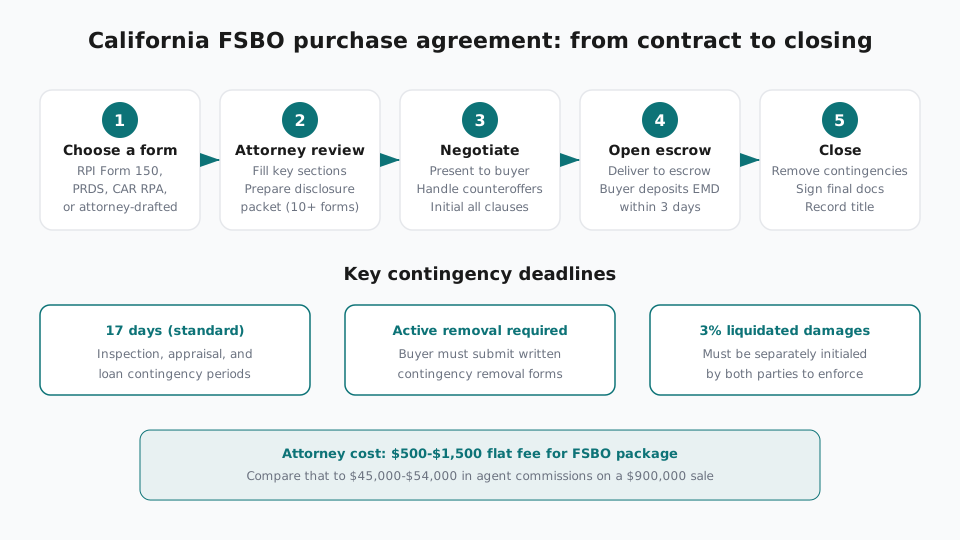
Realty Publications, Inc. (RPI) publishes a form called the “Purchase Agreement — One-to-Four Residential Units — Principal to Principal.” That last part is the key. It’s specifically designed for transactions where both buyer and seller are acting without agents. It covers identification information, good-faith deposit terms, property description, personal property inventory, payment and financing terms, and the standard contingency provisions you’d expect.
RPI forms are 100% legal for use in California. You can download them through firsttuesday.us. They’re straightforward, they’re written for non-agents, and they cost a fraction of what the CAR forms cost through the Business Products site.
PRDS forms (Bay Area)
If you’re in the San Francisco Bay Area, including Contra Costa, San Mateo, and Santa Clara counties, there’s another widely used alternative: the PRDS (Peninsula Regional Data Service) Purchase Agreement.
PRDS forms differ from CAR in a few ways that matter to sellers. PRDS defaults to requiring that major systems (electrical, plumbing, heating) be delivered in working order. CAR defaults to “as-is.” PRDS also requires repairs be done by a licensed contractor, while CAR just requires “workmanlike manner.” If you’re selling a well-maintained home, the PRDS approach can actually work in your favor because it signals to buyers that the property will be in solid shape.
Attorney-drafted contract
A California real estate attorney can draft a purchase agreement tailored to your transaction or customize an industry-standard form to fit your specific situation. Attorney rates in California run $217 to $384 per hour, but many offer flat-fee FSBO packages that bring the total cost well below what you’d pay in agent commissions. Your attorney will include every California-specific provision the transaction requires, which matters in a state with the most complex disclosure requirements in the country.
Do FSBO sellers have to use any specific form?
No. California law doesn’t mandate a particular contract form for residential real estate. You could write a purchase agreement on a bar napkin and it could hold up.
But the escrow company processing your transaction expects to see a contract that covers specific provisions: earnest money handling, contingency timelines, escrow instructions, disclosure acknowledgments, and broker compensation terms (even if there are no brokers). Walk in with a generic template you downloaded from a legal form site and the escrow officer will spend hours figuring out what’s missing. Walk in with a recognized California form and they know exactly where to look.
Use a form that’s built for California transactions. The RPI Form 150, the CAR RPA, or an attorney-drafted contract all work. A generic form from the internet does not.
The key sections and what they mean
Regardless of which form you use, every California purchase agreement covers the same core provisions. Here are the ones where mistakes cost money.
Purchase price and earnest money
The total price, how the buyer is paying (cash, financing, or a combination), and the earnest money deposit. In California, earnest money typically runs 1% to 3% of the purchase price. On a $900,000 home (close to the state median), that’s $9,000 to $27,000. The deposit goes into escrow within 3 business days of acceptance. It goes to the escrow company, not to you.
Contingencies (and why removal matters)
This is where California transactions differ from most other states, and where first-time FSBO sellers get burned.
The standard contingency periods are 17 days each for inspection, appraisal, and loan approval. During those 17 days, the buyer can cancel for reasons related to that contingency and get their deposit back.
Here’s the part most people miss: in California, contingencies are not automatically removed when the deadline passes. The buyer has to actively and in writing remove each contingency. If day 17 comes and goes and the buyer hasn’t submitted a written contingency removal form, the contingency is still in effect. The clock running out doesn’t help you. This is the opposite of how some other states handle it, and it catches FSBO sellers off guard constantly.
If the buyer hasn’t removed their contingencies and you want to force a decision, you can issue a “Notice to Buyer to Perform” giving them a specified number of days (typically 2) to either remove the contingency or cancel the contract. If they don’t respond, you can cancel the contract and potentially keep the deposit.
Liquidated damages
California Civil Code Section 1675 caps liquidated damages at 3% of the purchase price for residential properties (1-4 units) where the buyer intends to occupy. This provision must be separately initialed by both buyer and seller to be enforceable. If the buyer defaults and this clause is initialed, you keep the deposit up to that 3% cap. If it’s not initialed, you’re looking at a much more complicated process to recover damages.
Don’t skip this section. Don’t forget to initial it. Your attorney will make sure it’s handled, but know what it means.
Escrow and closing
California is an escrow state. Instead of attorneys handling closings like they do in New York or Georgia, a neutral third-party escrow company manages the transaction. The purchase agreement doubles as joint escrow instructions, telling the escrow company how to handle funds, documents, and the transfer.
There’s a regional split you need to know. In Southern California, title and escrow are typically handled by separate companies, and the seller customarily pays for the owner’s (CLTA) title insurance policy. In Northern California, the title company usually handles both title and escrow, and the buyer customarily pays for title insurance (or it’s split). Escrow fees are generally split 50/50, except in San Francisco, where buyers typically cover them.
All of this is negotiable. But know the customs in your area so you’re not caught off guard during negotiations.
Broker compensation (post-NAR settlement)
Even if there are no agents involved, the current CAR RPA includes provisions about buyer’s broker compensation. Under the NAR settlement and California’s AB 2992, buyer’s brokers must now have a written compensation agreement with their client before making an offer. The purchase agreement includes a section where the seller can agree to pay the buyer’s broker, and any such payment offsets what the buyer owes their agent under their own agreement.
As a FSBO seller, you might get offers from buyers represented by agents. If the buyer’s agent expects compensation from you, it’ll show up in this section. You are not required to pay it, but the buyer may factor your answer into their offer price. This is a negotiation point, not a requirement. For more on handling this, read our guide on working with buyer’s agents as a FSBO seller.
California’s disclosure requirements will make your head spin
This is the section that separates California from every other state. California requires more seller disclosures than anywhere else in the country. Missing even one can expose you to a lawsuit years after closing.
Transfer Disclosure Statement (TDS)
California Civil Code Section 1102 requires sellers of residential property (1-4 units) to complete a Transfer Disclosure Statement covering the property’s condition. You’re disclosing structural defects, environmental hazards, neighborhood issues, and anything else that could affect the property’s value.
The TDS applies even in “as-is” sales. Civil Code 1102.1 makes that explicit. Selling “as-is” means you won’t make repairs. It does not mean you can hide problems.
If the buyer receives the TDS after signing the purchase offer, they get 3 days to rescind if delivered in person, or 5 days if delivered by mail. Deliver it early. Read our full seller’s disclosure breakdown or the California disclosure guide for the state-specific version.
Natural Hazard Disclosure (NHD)
You’re required to provide a Natural Hazard Disclosure covering six hazard categories: earthquake fault zones, seismic hazard zones, fire hazard and wildland fire areas, flood hazard areas, and dam failure inundation zones.
Most California sellers order a third-party NHD report because it’s cheap, fast, and the cleanest way to document the maps. That’s the smart move. California law still puts the responsibility for furnishing the disclosure on the seller, though, so do not treat the report vendor like a substitute for paying attention. If you skip the NHD and the buyer discovers hazards after closing, you’re exposed.
Everything else
Beyond the TDS and NHD, California requires disclosure of Mello-Roos special taxes (if applicable), supplemental property tax bills, lead-based paint (pre-1978 homes, federal requirement), smoke detector compliance, carbon monoxide detector compliance, water heater earthquake strapping, and deaths on the property within the last 3 years.
That’s 10+ disclosure documents for a standard residential sale. Your attorney or escrow company will have the complete packet, but you need to know these exist and you need to fill them out honestly and completely.
California closing costs sellers should expect
County documentary transfer tax runs $1.10 per $1,000 of the sale price statewide. On a $900,000 home, that’s $990. Straightforward.
City transfer taxes are where it gets expensive. Los Angeles charges $4.50 per $1,000 (plus the ULA “mansion tax” for properties over $5.3 million). San Francisco charges $7.50 per $1,000. Oakland charges $10 to $25 per $1,000 depending on price tier. Berkeley charges 1.5% up to $1.6 million and 2.5% above that.
On a $900,000 home in Los Angeles, the combined county and city transfer taxes alone run about $5,040. In Oakland, they can hit $9,000 to $22,500. Check your city’s rate before you price your home. These taxes come straight off your proceeds.
Total seller closing costs in California average about 2.73% of the sale price, excluding any buyer’s agent commission. On a $900,000 home, that’s roughly $24,500. Compare that to the $45,000 to $54,000 you’d pay in agent commissions at 5-6%.
The five mistakes that cost California FSBO sellers money
Using a generic contract template. A purchase agreement you downloaded from a free legal form site almost certainly doesn’t include California-specific provisions for contingency removal, liquidated damages initials, NHD requirements, TDS timing, or the current broker compensation language. Using the wrong form is the single most common FSBO legal error.
Assuming contingencies expire automatically. They don’t. In California, the buyer must actively remove each contingency in writing. If you assume the inspection contingency expired on day 17 and start making plans, you’re wrong until you have the written removal in hand.
Incomplete disclosures. Disclosure-related disputes are among the top three reasons for post-sale lawsuits in California. Buyers have 3 years after discovering a nondisclosure issue to pursue legal action. The TDS, NHD, lead paint, Mello-Roos, supplemental taxes, smoke detectors, CO detectors, water heater strapping, and death disclosure all need to be completed accurately. Miss one and you’re exposed.
Skipping the NHD report. Some FSBO sellers try to save $100 by not ordering the third-party Natural Hazard Disclosure report. A third-party report is not the only legal way to furnish the disclosure, but it is usually the safest and simplest one. The cost of skipping it is measured in lawsuits, not dollars.
Not understanding regional closing cost customs. Who pays for title insurance, how escrow fees are split, and what city transfer taxes apply all vary by county and city. If you don’t know the customs in your area, you’ll either overpay or end up in a dispute at closing. Ask your escrow company what’s standard in your county before you negotiate.
Your attorney makes this manageable
California doesn’t require an attorney to close on a house. It’s an escrow state, and the escrow company handles the mechanics of closing. But when you’re doing this without an agent, an attorney is the difference between a smooth transaction and an expensive mistake.
A California real estate attorney will charge you $500 to $1,500 for a flat-fee FSBO package, depending on the complexity. Some charge hourly at $217 to $384 per hour. Either way, you’re paying a fraction of what you’d hand over in agent commissions, and unlike an agent, your attorney has a legal obligation to represent your interests and only your interests.
Get the RPI Form 150 or have your attorney draft a California-specific purchase agreement. Read through it once so you understand the structure. Then let your attorney fill in the provisions, prepare your disclosure packet, and coordinate with escrow. For the full document checklist you’ll need at closing, here’s the complete FSBO closing checklist.
Keep reading
Texas FSBO disclosure requirements: what you must tell the buyer
Texas Property Code Section 5.008 requires most sellers to complete a Seller's Disclosure Notice. Here's exactly what the form covers, who's exempt, and the mistakes that lead to lawsuits.
Seller closing costs calculator: estimate your net proceeds
Estimate your seller closing costs, mortgage payoff, and net proceeds with editable state transfer-tax presets and FSBO-specific line items.

How to Post Your Home on Zillow Without an Agent
Zillow gets more traffic than any real estate site in the country. Here's exactly how to get your FSBO listing in front of those buyers, step by step, no agent required.