Free FSBO purchase agreement template for Ohio
Ohio FSBO sellers don’t need a Realtor to get a solid purchase agreement. Unlike Texas, which has a single state-issued contract everyone uses, Ohio has multiple standard forms depending on where you live. The Columbus REALTORS form dominates Central Ohio. Cleveland-area boards have their own. And Ohio REALTORS publishes a statewide version. Any of them work for a FSBO transaction, and your real estate attorney can help you fill one out or draft a custom contract from scratch.
Here’s which form to use, what the key sections mean, and where Ohio FSBO sellers lose money.
Which purchase agreement form to use
Ohio doesn’t mandate a specific contract form for residential real estate sales. Agents use forms published by their local Realtor board or the statewide Ohio REALTORS association. As an unlicensed seller, you can use any of these forms or have your attorney draft one.
Here are your main options.
Columbus REALTORS Residential Purchase Contract
If you’re selling in Franklin County or the greater Columbus area, this is the form every title company expects to see. It’s 16 pages, covers financing contingencies, inspection periods, title insurance, and closing logistics. The Columbus REALTORS association updated it in February 2025, so make sure you’re working from the current version.
Over 95% of the contract is standardized language you don’t change. You’re really filling in a couple dozen boxes: purchase price, closing date, earnest money amount, inspection deadlines, and financing terms.
You can download a copy through your attorney or through the Columbus Bar Association. The annotated version (23 pages, with explanations alongside each section) is worth reading even if you don’t end up using it. It explains what each clause does in plain English.
Ohio REALTORS Residential Real Estate Purchase Contract
Ohio REALTORS publishes a statewide form that works anywhere in the state. It’s a solid option if you’re outside the Columbus metro or if your buyer’s agent (if they have one) doesn’t have a preferred local form. Your attorney will be familiar with it.
Cleveland-area board forms
If you’re selling in Cuyahoga County or the broader Northeast Ohio market, local Realtor boards have their own purchase agreements. These forms reflect regional customs around title insurance (split between buyer and seller in Northeast Ohio, unlike Central Ohio where the seller pays the full owner’s policy). Your attorney or title company will know which form is standard in your county.
Attorney-drafted contract
A real estate attorney can draft a purchase agreement from scratch or customize a standard form for your transaction. This is the safest route for FSBO sellers, especially if the deal has any wrinkles like seller financing, an as-is sale, or unusual contingencies. Ohio attorneys charge $159 to $318 per hour, but many offer flat-fee packages for FSBO closings in the $750 to $1,250 range.
Free online templates
Sites like eForms and Cleveland Home Title offer free Ohio residential purchase agreement templates. These are generic but legal. They cover the basics: parties, property description, price, earnest money, contingencies, and closing terms. They work in a pinch, but they won’t have the region-specific provisions (title insurance customs, conveyance fee splits, point-of-sale inspection language) that a local form includes.
My recommendation: get the standard form for your area from your attorney or title company. Read through it so you understand the structure. Then let your attorney fill in the parts that require legal judgment.
The key sections and what they mean
Regardless of which form you use, every Ohio purchase agreement covers the same core provisions. Here are the ones where mistakes cost money.
Parties and property description
Your legal name as the seller and the buyer’s legal name. These names have to match the deed. The property address and legal description go here too. The legal description is the formal language from your deed or county records, something like “Lot 45, Worthington Heights Subdivision, Plat Volume 12, Page 34, Franklin County, Ohio.” Get this from your deed, not from memory.
Purchase price and earnest money
The total price, how the buyer is paying (cash, conventional mortgage, FHA, VA), and the earnest money deposit. In Ohio, earnest money typically runs 1% to 2% of the purchase price. On a $250,000 house (close to the state median of $254,200), that’s $2,500 to $5,000.
The earnest money goes to the title company or your attorney’s escrow account, not directly to you. Ohio Revised Code Section 4735.24 governs how brokers handle earnest money, but in a FSBO transaction where there’s no broker, the contract specifies who holds it. The title company is the standard choice.
If the buyer backs out without a valid reason under the contract, you may be entitled to keep the earnest money as liquidated damages. But that clause has to be in the contract. Don’t assume it. Make sure your attorney includes it.
Financing contingency
If the buyer is getting a mortgage, this section is the one that protects you if their loan falls through.
The Columbus REALTORS form breaks financing into three deadlines. The mortgage pre-approval deadline (typically 2 to 3 days after contract acceptance) requires the buyer to provide proof they can actually get a loan. The loan application deadline (7 to 10 days) requires the buyer to formally apply. The loan commitment deadline (30 to 40 days) is when the lender must confirm the loan is approved.
If the buyer misses any of these deadlines and you want to enforce them, you typically need to give written notice. If financing falls through before the commitment deadline, the buyer can walk away and get their earnest money back. If it falls through after the deadline and the buyer didn’t notify you, their earnest money may be at risk.
Cash buyers skip this section. But demand proof of funds. A bank statement or a letter from their financial institution showing they have the money. “I’ve got the cash” isn’t a document.
Inspection contingency
The buyer gets a window, usually 10 to 15 days, to hire a home inspector and investigate the property. During this period, they can request repairs, ask for credits, or walk away entirely and get their deposit back.
Ohio doesn’t have a Texas-style “option period” where the buyer pays a separate fee for the right to terminate. In Ohio, the inspection contingency covers that territory. The buyer can cancel during the inspection period for any inspection-related reason.
After the inspection period expires, the buyer has accepted the property’s condition (subject to other contingencies). This is why you want the inspection period as short as the buyer will agree to. Fifteen days is standard. Ten is reasonable in a strong market.
If the buyer asks for repairs, you have three choices: make the repairs, offer a credit at closing, or refuse. If you refuse and the inspection period is still open, the buyer can cancel. If the period has expired, they’ve lost that leverage.
Title and deed
Ohio is a title insurance state. The seller typically provides a general warranty deed, which guarantees you have clear title to the property and the right to sell it. One Ohio-specific wrinkle: if you’re married, your spouse has dower rights and must also sign the deed, even if they’re not on the title. Skip this and the deed is defective.
The title company performs a title search to verify there are no liens, judgments, or other claims against the property. If there are title defects, you’re responsible for clearing them before closing. An old judgment, a mechanic’s lien from a contractor you forgot to pay, a missed mortgage satisfaction, any of these will show up and need to be resolved.
Who pays for title insurance varies by region. In Central Ohio (Columbus area), the seller customarily pays for the owner’s title insurance policy. In Northeast Ohio (Cleveland area), buyer and seller typically split it. In Northwest Ohio, the seller usually pays. These are customs, not laws. Everything is negotiable.
Closing date and logistics
The closing date, which title company handles the transaction, and how proceeds are delivered. Wire transfer is standard.
Ohio closings happen at the title company. Unlike some states that require an attorney at the closing table, Ohio doesn’t. But having your attorney review all the documents before you sign is still worth it. The title company is a neutral party. They’re not looking out for your interests specifically.
A warning you’ll hear from every title company in the state: verify wire instructions by phone before you wire any money. Wire fraud targeting real estate closings is a growing problem in Ohio, just like everywhere else. Never trust wire instructions sent by email without calling the title company directly to confirm.
Conveyance fee proration and tax adjustments
Property taxes in Ohio are paid in arrears, which means you’re paying for a period that already happened. At closing, the title company prorates the taxes between you and the buyer based on the closing date. If you haven’t paid the current tax bill, the amount owed comes out of your proceeds.
The conveyance fee (Ohio’s version of a transfer tax) is also settled at closing. More on that below.
The Ohio Residential Property Disclosure Form
Ohio Revised Code Section 5302.30 requires sellers of residential property (one to four units) to complete a Residential Property Disclosure Form and deliver it to the buyer before the sale. This is separate from the purchase agreement, but it’s required for nearly every residential transaction.
The disclosure form covers seven categories:
- Water supply and sewer — whether the property is on municipal water or a private well, and whether it has a public sewer connection or a septic system.
- Structural condition — the roof, foundation, walls, floors, and any structural modifications you’ve made.
- Mechanical systems — HVAC, electrical, plumbing, water heater, and built-in appliances.
- Hazardous materials — lead-based paint (federal requirement for pre-1978 homes), asbestos, urea-formaldehyde foam insulation, and radon. If you’ve had radon testing done, you must disclose the results. If you’ve never tested, you just say so.
- Flood and drainage — any history of water intrusion, flooding, or drainage issues.
- Property boundaries and HOA — boundary disputes, easements, encroachments, and homeowners association rules and fees.
- Other known defects — anything material that doesn’t fit the categories above.
Ohio’s standard is “actual knowledge.” You’re disclosing what you actually know about the property. You’re not required to hire an inspector or go looking for problems. But if you know about a leaking basement, a cracked foundation, or a history of radon readings above 4 pCi/L and you don’t disclose it, the buyer can come after you for damages.
One deadline to know: if the buyer doesn’t receive the disclosure form after making an offer, they have 30 days to rescind the purchase agreement. Deliver it early. Ideally before you accept any offers.
We’ve covered disclosures in more detail in our seller’s disclosure breakdown. Read it before you fill out the form.
Ohio closing costs sellers should expect
Ohio calls its transfer tax a “conveyance fee.” It’s a two-part charge: a state fee and a county fee.
State conveyance fee: $1 per $1,000 of the sale price. This is standard across all 88 counties.
County conveyance fee: Up to $3 per $1,000, depending on the county. Franklin County (Columbus) charges the maximum $3 per $1,000. Cuyahoga County (Cleveland) also charges $3. Hamilton County (Cincinnati) charges $3. Most urban counties charge the full $3.
On a $250,000 sale in Franklin County, the combined conveyance fee is $1,000 ($250 state + $750 county). That’s straightforward and relatively low compared to transfer taxes in California or Florida.
Owner’s title insurance. In Central Ohio, the seller pays for the owner’s policy. On a $250,000 property, expect $1,000 to $1,500. In Northeast Ohio, you’ll split this with the buyer.
Title company closing fees. The title company charges $400 to $800 for the title search, document preparation, and managing the closing.
Attorney fees. A real estate attorney in Ohio charges $750 to $1,250 for a flat-fee FSBO closing, or $159 to $318 per hour.
Prorated property taxes. Ohio property taxes vary widely by county. The effective rate across the state averages about 1.59%, which puts the annual bill on a $250,000 home at roughly $3,975. Your share depends on when you close relative to the tax billing cycle.
Add it all up and a FSBO seller in Central Ohio is looking at roughly $3,200 to $4,600 in closing costs on a $250,000 sale (excluding any buyer agent compensation you’ve agreed to). Compare that to $12,500 to $15,000 in agent commissions at 5% to 6%.
Ohio-specific quirks that catch FSBO sellers off guard
Point-of-sale inspections in Northeast Ohio
This is the one that surprises sellers from outside the Cleveland area. Dozens of cities in Cuyahoga County and surrounding areas require a point-of-sale (POS) inspection before you can transfer the property. The city sends an inspector to check for code violations, and you may need to fix violations or escrow funds for repairs before the sale can close.
Cleveland Heights charges $150 for the inspection and requires an escrow of at least $1,000 (or 125% of estimated repair costs) for certain violations. Lakewood requires POS inspections for non-owner-occupied properties. Parma, Garfield Heights, Euclid, and many other suburbs have their own requirements with different fees and standards.
If you’re selling in Northeast Ohio, check with your city’s building department before you list. A POS inspection can add weeks and unexpected costs to your timeline. Your title company will know whether your city requires one.
No attorney requirement, but get one anyway
Ohio law doesn’t require an attorney at closing. The title company handles the mechanics. But when you’re doing this without an agent, you need someone reviewing the contract, the disclosure, and the closing documents who has a legal obligation to represent your interests.
A real estate attorney for a FSBO closing in Ohio costs a fraction of what you’d hand over in agent commissions. And unlike an agent, your attorney has a legal obligation to represent your interests and only your interests.
Property tax arrears can surprise you
Ohio property taxes are paid in arrears, and the billing schedule is confusing. Taxes for the first half of the year are due in January or February of the following year. Taxes for the second half are due in June or July of the following year. This means you could close in March and still owe taxes from the prior year. The title company handles the proration, but understand that a chunk of your proceeds may go to cover unpaid property taxes.
The five mistakes that cost Ohio FSBO sellers money
Using a form from the wrong region. If you’re selling in Cleveland and you use the Columbus REALTORS form, the title insurance provisions won’t match local custom. If you’re in Columbus and use a generic form that doesn’t address conveyance fee splits, you’ll argue about it at closing. Use the form your local title company expects.
Skipping the Residential Property Disclosure Form. It’s required by Ohio law. If you sell without completing it, the buyer can rescind the contract or sue for damages after closing. Fill it out honestly and completely. The “actual knowledge” standard protects you from things you genuinely didn’t know, but it doesn’t protect you from things you should have disclosed.
Not checking for a point-of-sale inspection requirement. If your city requires a POS inspection and you don’t get one, the title company can’t transfer the deed. This will delay or kill your closing. Check before you list.
Ignoring the financing deadlines. The purchase contract includes specific deadlines for the buyer’s mortgage pre-approval, loan application, and loan commitment. If the buyer misses a deadline and you don’t enforce it, you’re stuck waiting. If financing falls through at week six because you never checked their pre-approval letter, that’s time and momentum you can’t get back.
Forgetting about the conveyance fee. It’s not a huge amount ($1,000 on a $250,000 sale in Franklin County), but it comes straight off your proceeds. Factor it into your net sheet so the closing numbers don’t surprise you.
Your attorney makes this manageable
Get the standard purchase agreement form for your area from your attorney or title company. The Columbus REALTORS form for Central Ohio, the appropriate board form for Northeast Ohio, or the statewide Ohio REALTORS form if neither applies. Read through it once so you understand the structure. Then let your attorney fill in the sections that require legal judgment.
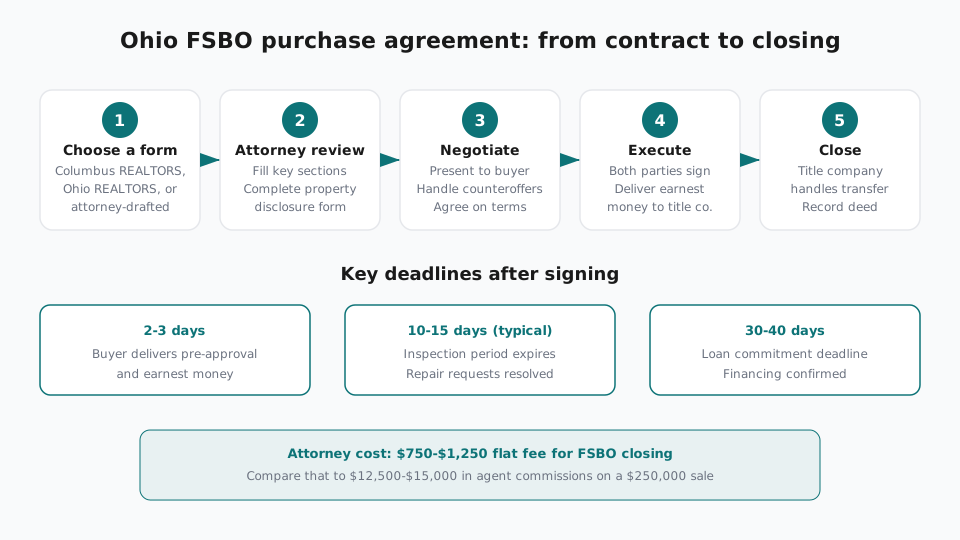
A real estate attorney in Ohio will cost you $750 to $1,250 for a flat-fee FSBO closing. That’s about 0.4% of the sale price on a $250,000 home. Compare that to the $12,500 to $15,000 you’d pay in agent commissions. For the full document checklist you’ll need at closing, here’s the complete FSBO closing checklist.
Keep reading

How Real Estate Agent Commissions Really Work
The commission structure is designed to benefit agents and brokerages, not you. Here's exactly how the money flows, who gets paid what, and why the math never favors sellers.
Counteroffer tactics for FSBO sellers
How to write a counteroffer that protects your equity, controls the negotiation, and doesn't leave money on the table when selling your house without an agent.

Skip the agent, hire an attorney
A real estate attorney costs $500-$3,000, handles the entire legal side of your sale, and has 7+ years of legal education. Your agent has a few months of coursework and charges $24,000. The choice isn't hard.