The Real Cost of Traditional Agent Commissions (Even After the NAR Lawsuit)
On a $400,000 home, a traditional agent commission runs $20,000 to $24,000. You may have seen headlines saying the old 6% standard was killed by the 2024 NAR settlement. Here’s the part those headlines leave out: agents are still charging similar amounts, just restructured. Listing commissions of 2.5-3% on one side. “Optional” buyer concessions they’ll suggest you offer on the other. Add them together and you’re back to the same number with different packaging.
The settlement changed the rules. It didn’t change the behavior.
But the number on your settlement statement — whatever it ends up being — is only the cost you see today. The real cost, the money that commission takes from your future, is far higher.
When you factor in what that money could have earned if you’d invested it, what you’ll pay in commissions across every home you sell in your lifetime, and the tax math that almost nobody explains, traditional agent commissions aren’t a $20,000-$24,000 problem. They’re a six-figure problem.
The number on paper
Here’s the commission at different price points. The first two columns show what sellers still pay under the traditional model — even post-settlement. Agents may split these fees into “listing side” and “buyer concession,” but the total out of your pocket is often the same.
| Home Price | 5% Total Commission | 6% Total Commission |
|---|---|---|
| $250,000 | $12,500 | $15,000 |
| $350,000 | $17,500 | $21,000 |
| $400,000 | $20,000 | $24,000 |
| $500,000 | $25,000 | $30,000 |
| $600,000 | $30,000 | $36,000 |
| $750,000 | $37,500 | $45,000 |
These are real dollars deducted from your proceeds at closing. For most people, this is the largest fee they’ll ever pay for a single service. And as the commission breakdown explains, that money gets chopped four ways — between two agents and two brokerages — before anyone does the actual legal work of selling your house.
The 2024 NAR settlement eliminated the requirement for sellers to offer buyer-agent compensation through the MLS. Sellers now have the right to pay less. But most still don’t, because no one in the industry is volunteering that information. “Standard” still gets quoted at 5-6%.
But this table only tells you what you lost on closing day. It doesn’t tell you what you lost over the next 30 years.
Money has a future
Here’s the part the real estate industry hopes you never think about.
That $24,000 didn’t just leave your bank account. It left your future. If you had kept that money and invested it — in an index fund, a retirement account, anything with compound returns — it would have grown. Substantially.
At a 7% average annual return, which is the historical inflation-adjusted average of the S&P 500:
| Years Invested | $24,000 Becomes |
|---|---|
| 10 years | $47,000 |
| 20 years | $93,000 |
| 30 years | $183,000 |
Read that last line. The commission you paid on one home sale, invested for 30 years in a basic index fund, would have grown into $183,000. That’s not aggressive speculation. It’s math applied to historical market returns. The kind of returns your 401(k) is banking on right now.
And you don’t need to do anything exotic. A Vanguard S&P 500 index fund. A target-date retirement fund. The same boring investments every financial advisor recommends. The only difference is whether you have that $24,000 to put in or whether you signed it over to two brokerages on closing day.
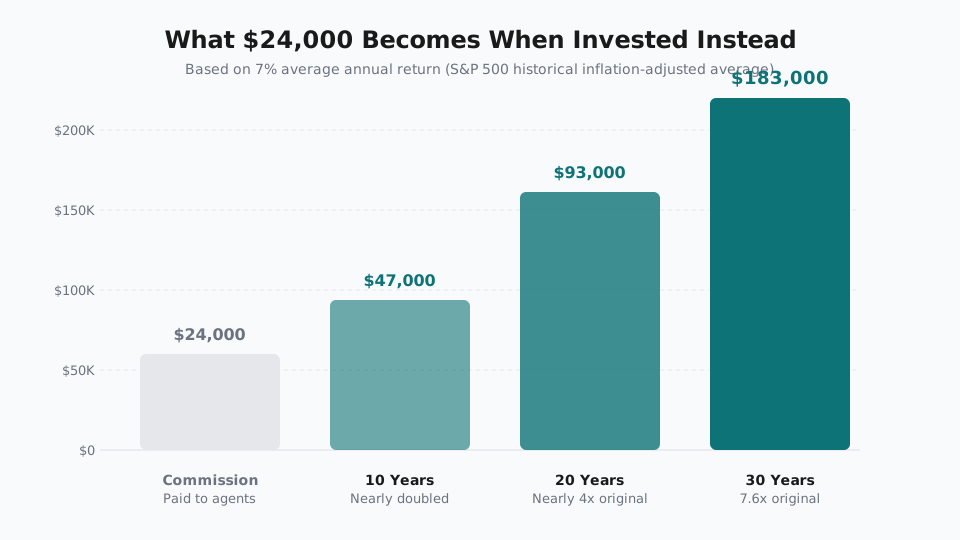
The commission didn’t cost you $24,000. It cost you $183,000. You just won’t feel it until retirement.
You’re not selling just one house
Most people don’t sell one home and live in the next one forever. According to National Association of Realtors data, the average American homeowner moves every 8 to 13 years. Over a 30-year stretch of adult life, that’s three to four home sales. And each sale tends to involve a more expensive home than the last, because you trade up as your income grows and equity builds.
Here’s what a lifetime of 6% commissions actually looks like for a typical family:
| Sale | Your Age | Home Price | 6% Commission | Cumulative |
|---|---|---|---|---|
| First home | ~30 | $300,000 | $18,000 | $18,000 |
| Second home | ~38 | $400,000 | $24,000 | $42,000 |
| Third home | ~48 | $525,000 | $31,500 | $73,500 |
| Fourth home | ~58 | $600,000 | $36,000 | $109,500 |
$109,500 in direct commissions. That’s not a real estate mogul flipping houses. That’s a regular person who bought a starter home, moved a few times as their family grew, and eventually downsized.
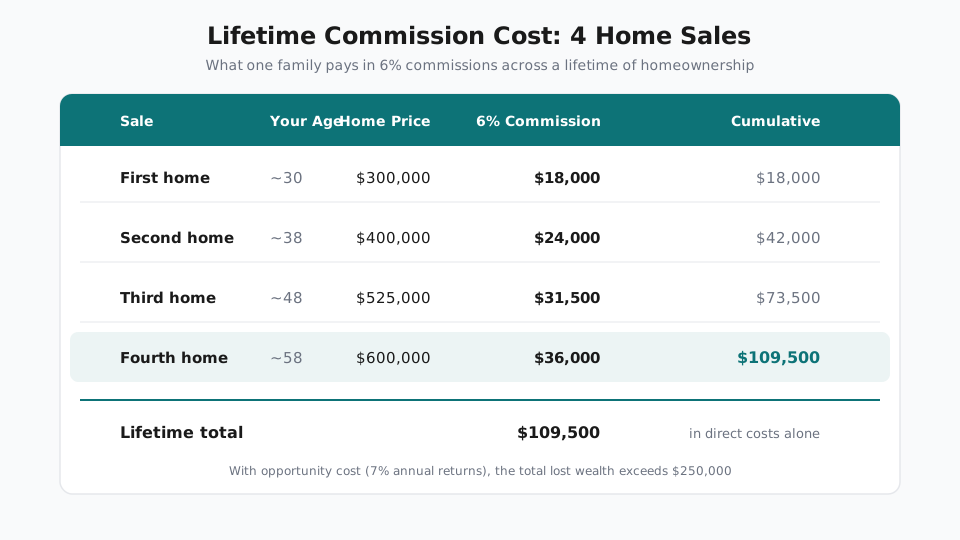
Now layer in the opportunity cost. That $18,000 from your first sale at age 30, invested at 7% until age 60, would have grown to roughly $137,000 on its own. Add up the compounded opportunity cost across all four sales and you’re looking at $250,000 to $350,000 in total lost wealth.
That’s not a cost of doing business. That’s a retirement account.
The tax angle almost nobody mentions
Here’s a detail that gets overlooked in nearly every commission conversation.
Real estate commissions are classified as a selling expense, which means they reduce your capital gain on the sale. That sounds like a tax benefit. It isn’t — at least not for most sellers.
The reason: the primary residence capital gains exclusion. If you’ve lived in your home for at least two of the last five years, you can exclude up to $250,000 in capital gains from taxes ($500,000 for married couples filing jointly). The vast majority of homeowners — even those who’ve seen significant appreciation — fall well under this threshold.
So the commission reduces a capital gain that was already tax-free. You get zero tax benefit from paying it. The “deduction” applies to money you wouldn’t have owed taxes on anyway.
Now consider where that commission money came from. Your equity was built with after-tax dollars. Every mortgage payment, every renovation, every improvement — you earned that income, paid taxes on it, and then used what was left to build equity in your home.
Then 6% of it went to agents and brokerages. And in a 30% combined tax bracket, you’d need to earn roughly $34,300 in gross income just to replace $24,000 in lost equity. That’s the true replacement cost of a 6% commission.
The hourly rate test
Let’s approach this from another angle. How much are you paying per hour of actual work?
Industry time-tracking data suggests a listing agent spends 30 to 50 hours on a typical residential sale. That includes listing prep, photography coordination, showings, open houses, offer negotiation, and closing coordination.
At $24,000 in total commission for roughly 40 hours of combined agent work, you’re paying $600 per hour. Even looking at just the listing agent’s share (about $12,000 before their brokerage split), that’s $300 per hour.
Compare that to other professionals who handle similar or harder work:
| Professional | Typical Rate | Education Required |
|---|---|---|
| Real estate attorney | $200-400/hr | Law degree + bar exam |
| CPA | $150-300/hr | Accounting degree + CPA exam |
| Financial advisor | $150-300/hr | Various certifications |
| Real estate agent | $300-600/hr | 60-90 hours of coursework |
Your real estate attorney went to law school, passed the bar, carries malpractice insurance, and has a legal fiduciary duty to protect your interests. They’ll handle your entire closing for $500 to $1,500. Your listing agent took a licensing course that averages less time than a single college semester.
The hourly rate you’re paying for a 6% commission doesn’t reflect the complexity of the work. It reflects a pricing model designed to extract the maximum amount from your equity.
Add it all up
Here’s the full picture for a family who sells four homes over 30 years.
Direct commissions paid: $109,500
Opportunity cost of those commissions invested at 7% through retirement: roughly $250,000 to $350,000 in lost wealth, depending on timing and market conditions.
Total lifetime cost: a quarter-million dollars or more in housing wealth that transferred to agents and brokerages instead of compounding in your investment accounts.
That’s a rental property generating passive income. It’s two years of retirement expenses. It’s the down payment on your children’s first homes. And every dollar of it was optional — a business arrangement you could have restructured by selling FSBO and hiring a $500-$1,500 attorney instead.
The NAR settlement changed the rules — agents found new ways to charge the same fees
The August 2024 NAR settlement removed the requirement for sellers to offer buyer’s agent compensation through the MLS. On paper, that’s a significant win for sellers. Commission is now explicitly negotiable. The old structural coercion is gone.
In practice, agents adapted quickly. Some still quote 5-6% as if nothing changed. Others now present it as two separate fees: “my listing commission is 2.5-3%, and then separately you might want to offer a buyer concession to attract more offers.” Same math. Different framing. The goal is the same: make the total commission feel inevitable.
It isn’t.
Sellers who go FSBO and negotiate the buyer’s agent commission down to 0.5-1% instead of the traditional 2.5-3% are saving even more than the tables above show. On a $400,000 house, paying 1% to the buyer’s agent instead of 3% saves you an additional $8,000 on top of the $12,000 you already saved by skipping the listing agent. Total savings: $20,000+ on a single sale.
Now apply that to the lifetime commission table above. Every one of those transactions is an opportunity to save $15,000-$30,000. The compounded wealth impact of consistently choosing FSBO over the traditional model is staggering — and it’s entirely within your control.
Run the numbers at your price point with the FSBO savings calculator — the post-settlement scenarios show exactly what you keep at every commission level.
The commission model survives because most sellers never run the numbers beyond closing day. They see $20,000-$24,000, grimace, and move on. But the real cost compounds silently across decades and multiple sales, turning a painful one-time fee into a wealth-eroding pattern.
For the full breakdown of where your commission dollars go and who actually benefits from the structure — including exactly what changed after August 2024 — read how real estate agent commissions really work. And when you’re ready to keep your equity instead of giving it away, the complete FSBO guide walks through every step.
Keep reading
Free FSBO purchase agreement template for Arizona
Arizona FSBO sellers can use the AAR Residential Resale Purchase Contract or a free alternative -- here's how the contract works, what the BINSR process means, and where sellers trip up.
Free FSBO purchase agreement template for California
California FSBO sellers have several contract options beyond the CAR RPA -- here's which form to use, what each section means, and the disclosure traps that sink deals.
Free FSBO purchase agreement template for Florida
Florida FSBO sellers can use the FAR/BAR contract for free -- here's how to get it, what each section means, and where sellers lose money.