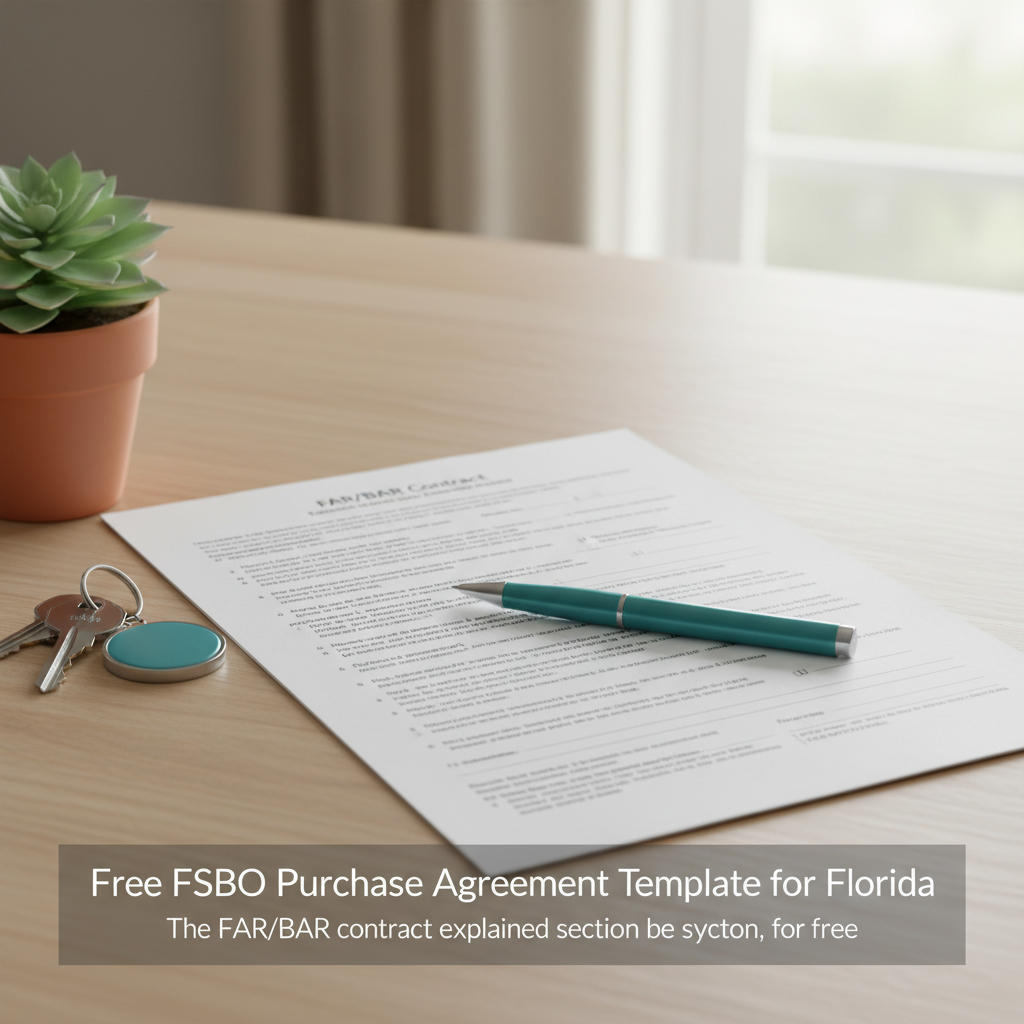
Free FSBO purchase agreement template for Florida
Florida doesn’t have a single state-mandated purchase agreement like Texas does. Instead, the standard contract used in almost every residential transaction is the FAR/BAR form, jointly created by Florida Realtors and The Florida Bar. Anyone can use it. You don’t need a license, you don’t need an agent, and you don’t need to pay for it through a third-party legal site.
Here’s where to get the contract, which version to use, how to fill it out, and the sections where FSBO sellers make the most expensive mistakes.
Where to get the FAR/BAR contract
The FAR/BAR contract is officially called the “Contract for Residential Sale and Purchase.” There are two versions:
- The Standard Contract (FR/BAR CRSP) — used when the seller is willing to make repairs up to a negotiated dollar amount.
- The “AS IS” Contract (FR/BAR ASIS) — used when the seller is selling the property in its current condition, with no repair obligations.
Most FSBO sellers use the “AS IS” version. It’s simpler, it limits your liability, and it gives you a cleaner transaction. The buyer still gets an inspection period to walk away. You just don’t have to fix anything.
You can access these forms through the Florida Realtors website (floridarealtors.org) or through your real estate attorney. Your attorney will almost certainly have the current version ready to go. If you want to read through it on your own first, search for “FAR/BAR AS IS Residential Contract” and download the latest version. The most recent update took effect December 31, 2024, so make sure you’re not looking at an older edition.
Do FSBO sellers have to use the FAR/BAR form?
No. Florida law doesn’t require anyone to use a specific contract form for residential real estate. You could technically write a purchase agreement on a napkin and it could be enforceable.
But here’s the reality: the FAR/BAR contract is what every title company, lender, and real estate attorney in Florida is built to process. It was designed by lawyers and real estate professionals to cover every common scenario in a Florida residential transaction. Walk into a title company with a contract from some random legal website and they’ll spend an hour figuring out what’s missing. Walk in with the FAR/BAR form and they know exactly where to look for every term.
Use the FAR/BAR form. It’s thorough, it’s recognized statewide, and it keeps the transaction moving.
Standard vs. “AS IS”: which one to use
This is the first decision you’ll make, and it matters.
The Standard Contract includes a repair clause (Section 9) that obligates you, the seller, to pay for repairs up to a negotiated dollar amount, typically 1% to 1.5% of the purchase price. If the buyer’s inspection turns up problems, you’re on the hook to fix them up to that cap. If the repair costs exceed the cap and neither side budges, the contract can be terminated.
The “AS IS” Contract removes that repair obligation entirely. You’re selling the property in its current condition. The buyer gets an inspection period (usually 10 to 15 days) to have the property checked out, and during that window they can cancel the contract for any reason, in their “sole discretion,” and get their deposit back. Once the inspection period expires, they’ve accepted the property’s condition.
My recommendation: use the “AS IS” version unless you have a newer home in great shape and want to use the repair willingness as a selling point. The “AS IS” contract is cleaner for FSBO sellers because it removes the back-and-forth negotiation over repairs. The buyer knows what they’re getting. You know what you’re giving up. The inspection period gives them a fair exit ramp.
One thing the “AS IS” contract does NOT do: it does not release you from your disclosure obligations. You still have to disclose known material defects. More on that below.
The key sections and what they mean
The FAR/BAR “AS IS” contract runs about 12 pages. Most of it is boilerplate language you don’t change. Here are the sections you fill in and the ones where mistakes cost money.
Section 1: parties and property
Your legal name as the seller and the buyer’s legal name. These names have to match what’s on the deed. The property’s street address and legal description go here too. The legal description is the formal description from your deed or tax records, something like “Lot 15, Block 2, Sunrise Estates, Plat Book 45, Page 112, Palm Beach County, Florida.” Get this from your deed, not from memory.
Section 2: purchase price and deposit
The total purchase price, broken into the deposit amount (escrow), additional deposits, and the balance due at closing. Florida doesn’t call it “earnest money” the way some states do. It’s an escrow deposit, and it goes to the escrow agent (usually the title company), not to you.
Typical escrow deposits in Florida run 1% to 3% of the purchase price. On a $400,000 house, that’s $4,000 to $12,000. The contract specifies when the deposit is due. Standard is within 3 days of the effective date (the date both parties sign). If the buyer doesn’t deliver the deposit on time, that’s a default, but you have to give written notice before you can act on it.
The 2025 contract update changed how closing costs work. Each party now covers their own closing services costs by default, which gives you more transparency over what you’re paying.
Section 3: time for acceptance and effective date
The effective date is when the last party signs (or initials) the contract. Every deadline in the contract runs from this date. If the buyer signs on Monday and you countersign on Wednesday, Wednesday is the effective date. Write it down. Every other date in the contract depends on it.
Section 4: closing
The closing date, which title company handles the transaction, and how proceeds are delivered. Wire transfer is standard. A warning you’ll hear from every real estate attorney in Florida: verify wire instructions by phone. Wire fraud targeting real estate closings is a serious and growing problem. Never trust wire instructions sent by email without calling the title company directly to confirm.
In most Florida counties (63 out of 67), the seller pays for the owner’s title insurance policy. The exceptions are Broward, Miami-Dade, Manatee, and Sarasota counties, where the buyer traditionally pays. This is negotiable, but know the custom in your county before you start talking numbers.
Section 5: financing
If the buyer is getting a mortgage, this section covers the loan terms, the deadline for loan approval, and what happens if financing falls through. The buyer has until a specified date to obtain a loan commitment. If they can’t get approved and they notify you before that deadline, they can cancel and get their deposit back.
If the buyer is paying cash, this section is much simpler. You’ll want proof of funds, not just a verbal promise. A bank statement or a letter from their financial institution showing they have the money.
Section 10: disclosure
This is the section that references your legal duty to disclose known defects. The contract states: “Seller knows of no facts materially affecting the value of the Real Property which are not readily observable and which have not been disclosed to Buyer.”
This language comes directly from a Florida Supreme Court case called Johnson v. Davis (1985). The court ruled that if you know about a defect that affects the property’s value, the defect isn’t obvious to a casual observer, and the buyer doesn’t already know about it, you have to disclose it. Period. This applies whether you’re selling with an agent or FSBO, and it applies even if you’re using the “AS IS” contract.
What does “material defect” mean in practice? A roof that leaks. A foundation crack you patched and painted over. A history of flooding in the backyard. Chinese drywall. Sinkholes. If you know about it and it affects the property’s value, disclose it. The penalty for hiding a known defect can be far worse than whatever price adjustment the disclosure might cause.
Florida doesn’t have a standardized state disclosure form the way some states do. But the FAR/BAR contract includes a seller’s disclosure section, and most attorneys will have you fill out a separate disclosure form as well. Do both.
Section 12: inspection period (the big one)
This is the most powerful section in the “AS IS” contract, and it’s the one FSBO sellers need to understand cold.
The buyer gets an inspection period, typically 10 to 15 days from the effective date. During this window, they can hire inspectors, get the roof checked, test for mold, check the septic system, whatever they want. And here’s the part that matters: they can cancel the contract during this period for any reason, “in Buyer’s sole discretion,” and get their full deposit back.
Read that again. Any reason. They don’t like the color of the carpet. They changed their mind. Their astrologer said Mercury is in retrograde. Doesn’t matter. During the inspection period, the buyer can walk and you can’t stop them.
This is why sellers want the inspection period as short as possible and buyers want it as long as possible. Fifteen days is common. Seven is aggressive but doable in some markets. Don’t agree to 30 days unless you have a very good reason.
Once the inspection period expires and the buyer hasn’t canceled, they’ve accepted the property’s condition. Their deposit is now at risk if they back out for reasons not covered by other contingencies (like financing).
Section 16: dispute resolution
Florida’s FAR/BAR contract includes provisions for mediation and, optionally, arbitration. If a dispute comes up, the contract requires mediation first. Litigation is the fallback if mediation doesn’t work. Your attorney will walk you through the specifics, but the short version: try to work things out before you end up in court.
Florida-specific costs sellers need to know
Florida has some cost items that catch first-time FSBO sellers off guard.
Documentary stamp tax. The seller typically pays this. The rate is $0.70 per $100 of the sale price. On a $400,000 sale, that’s $2,800. In Miami-Dade County, the rate is slightly different: $0.60 per $100 for single-family residences. This tax is non-negotiable. It’s collected at closing.
Owner’s title insurance. In most Florida counties, the seller pays for the buyer’s title insurance policy. On a $400,000 property, expect to pay around $2,000 to $2,400 for the policy. Again, in Broward, Miami-Dade, Manatee, and Sarasota counties, the buyer customarily pays.
Title search and closing fees. The title company or closing agent charges $500 to $975 for their services. This covers the title search, document preparation, and managing the closing.
Add it all up and a FSBO seller in Florida is looking at roughly $5,300 to $6,200 in closing costs on a $400,000 sale (excluding any buyer agent commission you’ve agreed to). Compare that to the $24,000 you’d hand over in a traditional 6% commission arrangement.
The five mistakes Florida FSBO sellers make
Ignoring the inspection period deadline
If the buyer’s inspection period is 15 days and you lose track of the calendar, you might not realize the period has expired. That matters because once it expires, the buyer’s deposit is at risk. Conversely, if the buyer tries to cancel on day 16, they may not be entitled to their deposit back. Track this date yourself. Put it on your phone. Don’t rely on anyone else to remind you.
Skipping the disclosure
Some FSBO sellers think the “AS IS” contract means they don’t have to disclose anything. Wrong. “AS IS” means you’re not required to make repairs. It does not mean you can hide defects. Johnson v. Davis applies regardless of the contract type. If you know about a problem and you don’t disclose it, the buyer can come after you for damages even after closing.
Using an outdated form
The FAR/BAR forms are updated regularly. The December 2024 update changed how closing costs are allocated and updated several other provisions. If you download an old version, you’re missing current terms that the title company expects to see. Always verify you have the most recent edition.
Not specifying who pays what
Florida custom varies by county. In most counties, the seller pays for title insurance. In four counties, the buyer pays. If you don’t specify in the contract, you’ll end up arguing about it at closing. Spell out every cost item before you sign.
Accepting a contract without proof of funds or pre-approval
A buyer who says “I have the money” or “my lender says I’m good” isn’t the same as a buyer who shows you a pre-approval letter or a bank statement. The FAR/BAR contract has sections for both financed and cash purchases. Make sure the financing section is filled out correctly, and demand documentation. An unqualified buyer who falls through at week six costs you time, momentum, and potentially other offers you turned down.
Your attorney makes this manageable
A Florida real estate attorney will charge you $750 to $1,250 for a flat-fee closing. Some charge hourly, averaging around $230 per hour. Either way, it’s a fraction of what you’d pay in agent commissions, and unlike an agent, your attorney has a legal obligation to represent your interests and only your interests.
Florida doesn’t require you to have an attorney to close on a house. But when you’re handling the transaction yourself, a real estate attorney is the single best investment you’ll make. They’ll review the contract, make sure the disclosure is airtight, coordinate with the title company, and catch problems before they become expensive.
Download the FAR/BAR “AS IS” contract from Florida Realtors or get it from your attorney. Read through it once so you know what you’re looking at. Then hand it to your attorney and let them handle the parts that matter. For the full document checklist you’ll need at closing, here’s the complete FSBO closing checklist.
Keep reading
Best flat fee MLS services in North Carolina (2026)
A refreshed side-by-side comparison of North Carolina flat fee MLS companies, with real pricing, local MLS warnings, and the closing-fee math most sellers miss.
What Happens During a Home Inspection (A Seller's Perspective)
Home inspections are predictable if you know what's coming. Here's exactly what inspectors look for, how long it takes, and how to prepare as a FSBO seller.

How to Work with Buyer's Agents When Selling FSBO
86% of buyers have agents. Here's how to work with them professionally, protect your proceeds, and make sure agent-represented buyers actually see your home.