Free FSBO purchase agreement template for North Carolina
North Carolina has one of the most seller-friendly contract structures in the country, but most FSBO sellers don’t realize it until someone explains the due diligence fee. Unlike almost every other state, NC lets the seller pocket a non-refundable fee from the buyer just for taking the house off the market. The buyer can still walk away during due diligence, but they pay for the privilege.
That’s the good news. The tricky part is that North Carolina’s standard purchase agreement — the Offer to Purchase and Contract, Form 2-T — was designed by the NC Association of Realtors and the NC Bar Association together. It’s well-drafted, it’s updated regularly (the 2025 revision shortened the form and moved key dates to page one), and every closing attorney in the state knows it by heart. You can use it whether you have an agent or not.
Here’s where to get the contract, what makes NC’s due diligence structure unique, and the mistakes that cost FSBO sellers the most money.
Where to get the Form 2-T
The Offer to Purchase and Contract (Form 2-T) is the standard residential purchase agreement in North Carolina. It’s jointly approved by the North Carolina Association of Realtors (NCAR) and the North Carolina Bar Association. Unlike Georgia’s GAR form, which is locked behind a Realtor membership, the NC Form 2-T is available to anyone.
Your options for getting the form:
Ask your closing attorney. North Carolina requires a licensed attorney to handle every real estate closing. Your closing attorney will have the current Form 2-T and can fill it out with you. This is the simplest path. Budget $500 to $1,000 for a flat-fee closing that includes contract preparation.
Download it from a free legal forms site. Sites like eForms and FreeFormsPDF offer North Carolina residential purchase agreement templates based on the Form 2-T structure. These are free. Download one, read through it, and have your attorney review it before anyone signs. A contract review runs $200 to $400.
Use a flat-fee MLS service that includes forms. Some flat-fee brokers in North Carolina give you access to the official NCAR forms as part of their package. If you’re already paying for MLS access, check whether forms are included.
The smart play: Get your attorney involved at the contract stage, not just at closing. Have them prepare a blank purchase agreement before you have a buyer. When someone makes an offer, you hand them a professional contract instead of scrambling to find a template. It signals that you know what you’re doing, and it puts you in control of the terms.
The due diligence fee: North Carolina’s secret weapon for sellers
This is the thing that makes North Carolina different from every other state, and it’s the most important concept for FSBO sellers to understand.
In most states, the buyer puts down earnest money that sits in escrow until closing. If the buyer backs out during the inspection period, they get it all back. The seller gets nothing for the weeks they spent off the market.
North Carolina splits this into two separate payments:
The due diligence fee goes directly to the seller when the contract is signed. It’s non-refundable in most cases. If the buyer walks away during due diligence for any reason — bad inspection, cold feet, didn’t like the neighbors — the seller keeps this money. Typical due diligence fees range from $500 to $2,000, though they can be higher in competitive markets or for expensive properties.
The earnest money deposit goes into an escrow account (usually held by the closing attorney or a broker’s trust account). If the buyer terminates during the due diligence period, they get the earnest money back. If they bail after due diligence expires, the seller keeps it. Earnest money in NC typically runs 1% to 2% of the purchase price.
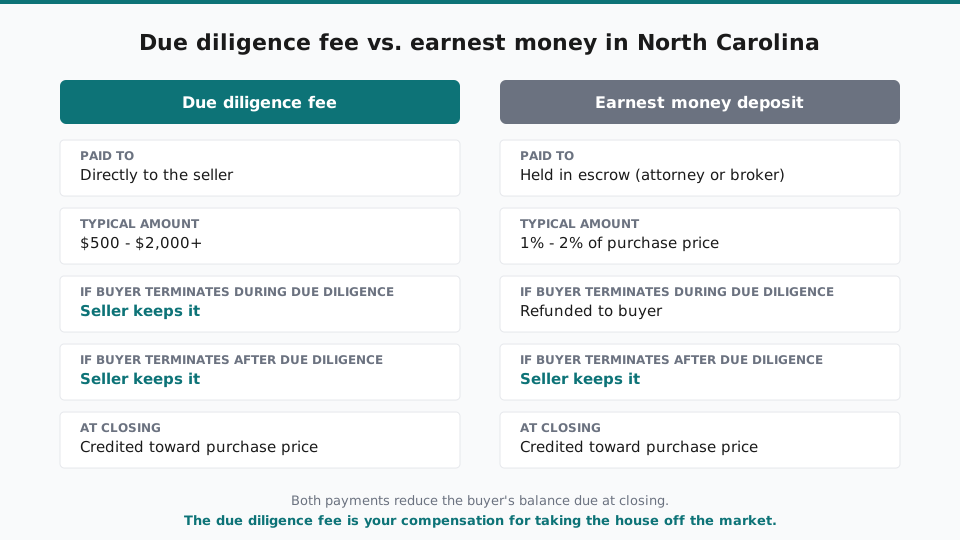
Both payments are credited toward the purchase price at closing. But the split structure means a FSBO seller in North Carolina always gets compensated when a buyer ties up their property and then walks away. That’s a protection sellers in most other states don’t have.
When the due diligence fee is refundable: The seller must return it if they materially breach the contract, if the buyer terminates under the seller obligations clause (Paragraph 8) or risk of loss clause (Paragraph 12), or per any addendum that specifically provides for a refund. Outside of those situations, the fee stays with the seller.
What your purchase agreement must include
North Carolina’s Statute of Frauds (N.C.G.S. 22-2) requires real estate contracts to be in writing and signed by the party being bound. The Form 2-T covers all the required elements, but if you’re working from a template or having your attorney draft from scratch, make sure your contract includes every one of these:
Parties and property
Full legal names of every buyer and seller. The property address plus the legal description from your deed, including the county, tax parcel ID, and plat reference. Your closing attorney needs the legal description to prepare the deed, so pull it from your current deed or tax records now.
Purchase price and payment breakdown
The total price, broken down into the due diligence fee, earnest money deposit, financing amount, and the balance due at closing. Be specific about when each payment is due. The due diligence fee is typically delivered within a day or two of the effective date. Earnest money is usually due within 5 days.
Due diligence period
The dates matter here. The due diligence period starts on the effective date of the contract (when both parties have signed) and runs to a specific date you negotiate. Typical periods range from 14 to 30 days.
During this window, the buyer can inspect the property, review documents, get appraisals, investigate HOA rules, test for radon, check for termites — anything they want. And they can terminate for any reason, or no reason at all. They don’t need your permission. They just send written notice before the deadline.
After the due diligence period expires, the buyer has accepted the property’s condition. Their earnest money is at risk if they back out (with exceptions for specific contingencies like financing).
Keep the due diligence period as short as the buyer will accept. Fourteen days is standard. Twenty-one is common for more complex deals. Don’t agree to 30+ days unless there’s a real reason, because every extra day is a day the buyer can walk away and you’ve lost marketing time.
Financing contingency
If the buyer is getting a mortgage, the contract should specify the loan type (conventional, FHA, VA), the maximum interest rate, the loan amount, and the deadline for obtaining a loan commitment. If the buyer can’t get financing by the deadline and terminates in writing, they get their earnest money back.
For cash buyers, demand a proof of funds letter or recent bank statement showing liquid assets equal to or greater than the purchase price. Don’t accept “I have the money” as proof.
Closing date and possession
North Carolina closings are handled by a licensed attorney. The contract should specify the closing date (typically 30 to 45 days from the effective date), who selects the closing attorney (usually the buyer), and when the buyer takes possession. Most NC transactions hand over possession at closing, but spell it out.
Settlement costs and who pays what
The 2025 Form 2-T revision made this clearer by putting key financial terms on page one. Specify who pays the excise tax (seller, by custom), who pays for the owner’s title insurance (negotiable in NC), and any other cost allocations.
North Carolina’s disclosure requirements
North Carolina is a mandatory disclosure state. You must provide two disclosure forms before the buyer makes an offer:
The Residential Property and Owners’ Association Disclosure Statement (RPOADS). This is the big one. It covers structural condition, water and sewer, plumbing, HVAC, electrical, environmental issues (lead paint, asbestos, radon, underground storage tanks), and more.
Here’s the catch: for every question on the form, you can answer “Yes,” “No,” or “No Representation.” Choosing “No Representation” means you’re not making any statement about that item one way or the other. It’s legal, and sellers use it often. But here’s my advice: don’t check “No Representation” on things you actually know about. If your roof is 15 years old and you know it, say so. Selective use of “No Representation” looks evasive to buyers and their agents, and it won’t protect you if a court decides you knew about a defect and hid behind the checkbox.
The Mineral and Oil and Gas Rights Mandatory Disclosure Statement (MOGS). North Carolina requires a separate disclosure about whether mineral, oil, or gas rights have been severed from the property. Most residential sellers check “no” and move on, but if your property has severed mineral rights (more common in the western counties), you need to disclose that.
Federal lead-paint disclosure. If your home was built before 1978, federal law requires you to disclose known lead-based paint hazards, provide any existing reports, hand over the EPA pamphlet, and give the buyer 10 days to get a lead inspection. This applies in every state.
Timing matters. Under N.C.G.S. 47E-5, you must deliver the RPOADS before the buyer makes an offer. If you fail to deliver it on time, the buyer can rescind the contract within three calendar days of receiving the disclosure or three days after signing the contract, whichever comes later.
For a deeper look at what disclosures to include and how to fill them out, see the seller’s disclosure guide.
North Carolina closing costs for sellers
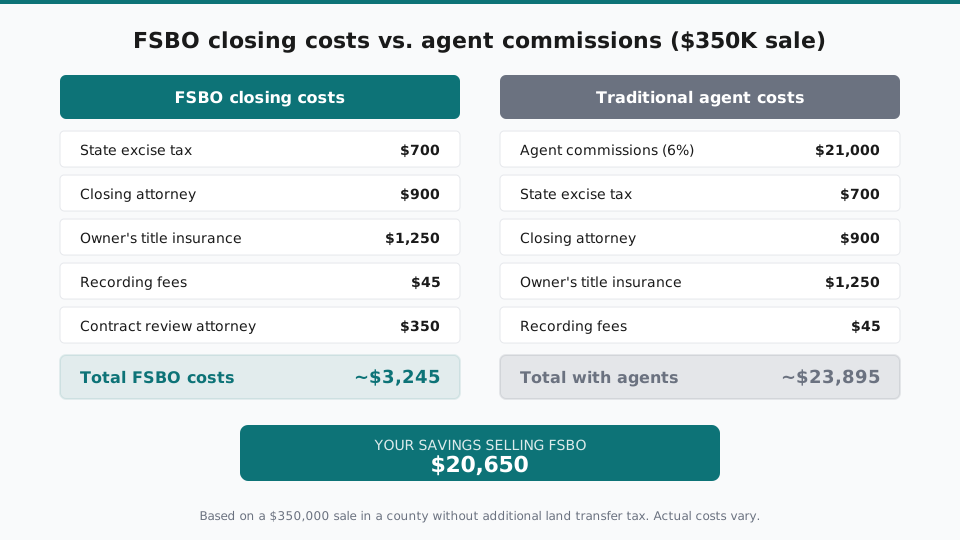
North Carolina’s closing costs are reasonable, and the excise tax is modest. Here’s what a FSBO seller should budget on a $350,000 sale:
Excise tax (revenue stamps): $700. North Carolina charges $1 per $500 of the sale price. On a $350,000 sale, that’s $700. The seller pays this by default. The closing attorney collects it and records the deed.
County land transfer tax (7 counties only): up to $3,500. If your property is in Camden, Chowan, Currituck, Dare, Pasquotank, Perquimans, or Washington County, you’ll pay an additional 1% land transfer tax ($1 per $100 of the sale price). On a $350,000 sale in Dare County, that adds $3,500. This catches Outer Banks sellers off guard. If your property isn’t in one of these seven counties, you don’t owe this tax.
Closing attorney fees: $600 to $1,200. The buyer typically selects the closing attorney, but the seller has costs too. If you hire your own attorney to review the contract (recommended), budget $200 to $500 for the review plus $600 to $1,200 if you want your own representation at closing.
Owner’s title insurance: $1,000 to $1,500. In North Carolina, who pays for the owner’s title insurance policy is negotiable. In many parts of the state, the seller pays. In others, the buyer covers it. Know your local custom and negotiate accordingly.
Prorated property taxes. You pay your share of property taxes through the closing date. North Carolina property taxes are billed in arrears, so you may owe a prorated amount for the current tax year.
Recording fees. Small but present: typically $26 for the first page and $4 for each additional page.
| Cost item | Typical amount ($350K sale) |
|---|---|
| State excise tax | $700 |
| County land transfer tax | $0 (most counties) - $3,500 (7 counties) |
| Closing attorney | $600 - $1,200 |
| Owner’s title insurance | $1,000 - $1,500 |
| Recording fees | $30 - $60 |
| Prorated taxes | Varies |
| Total (excluding payoff) | $2,330 - $6,960 |
Even on the high end (Outer Banks with county transfer tax), your total closing costs are a fraction of the $21,000 you’d hand over in agent commissions at 6% on a $350,000 sale.
Five mistakes North Carolina FSBO sellers make
Undervaluing the due diligence fee
The due diligence fee is your compensation for taking your home off the market. Don’t set it at $100 just to be friendly. A low due diligence fee tells the buyer they can tie up your house for three weeks and walk away having barely spent anything. On a $350,000 house, $1,000 to $2,000 is reasonable. In a hot market, push higher. The fee is credited to the buyer at closing, so it doesn’t change their total cost. It only changes how much they lose if they waste your time.
Skipping the RPOADS or checking “No Representation” on everything
Some sellers hear that you can check “No Representation” on every line of the disclosure form and treat it like a get-out-of-jail-free card. It’s not. If a buyer discovers a defect you clearly knew about and you checked “No Representation,” that looks like concealment. A judge will ask why you marked “No Representation” on a leaking basement you’ve been patching for five years. Fill out the form honestly. Disclose what you know. It protects you more than silence does.
Using an out-of-state contract template
North Carolina’s contract structure is genuinely unusual. The due diligence fee, the separation of due diligence and earnest money, the specific disclosure forms — these don’t exist in most other states. A generic internet template from a national forms site won’t include a due diligence fee provision, won’t reference the RPOADS, and won’t align with how NC closing attorneys process transactions. Use the Form 2-T or have a North Carolina attorney draft your contract.
Not understanding who the closing attorney represents
The buyer typically picks the closing attorney in North Carolina. That attorney handles the title search, prepares documents, and processes the closing. But they’re acting as a neutral party — they’re not your advocate. If the contract has a term that’s bad for you, the closing attorney isn’t required to point it out. That’s why hiring your own attorney to review the purchase agreement before you sign it is worth the $200 to $500. One attorney protects your interests in the contract. The other processes the closing. Even combined, you’re spending under $2,000 on legal help versus the $21,000 in agent commissions.
Forgetting the Outer Banks transfer tax
If you’re selling in Dare, Currituck, or any of the other five northeastern counties that levy a local land transfer tax, that 1% hits on top of the state excise tax. On a $500,000 beach house, the county transfer tax alone is $5,000. Budget for it. Your closing attorney will calculate it, but don’t let it surprise you at the closing table.
How the NAR settlement affects North Carolina FSBO sales
The 2024 NAR settlement changed how buyer agent commissions work in North Carolina, just like everywhere else. Buyer agent compensation can no longer be listed on the MLS. Buyers must sign a written representation agreement with their agent before touring homes.
For FSBO sellers, this means you’ll hear the question: “Are you offering buyer agent compensation?” You’re not required to offer anything. If you decide to offer compensation to attract represented buyers, you’ll need to advertise it off the MLS — on your yard sign, property website, or in direct conversations with agents.
If an unrepresented buyer shows up (and more will, now that buyers are on the hook for their agent’s fee), you’ll want a plan for handling that transaction without agents on either side.
For the full picture of how the settlement changed the rules, read Selling FSBO after the NAR settlement and Do sellers have to pay the buyer’s agent?.
After the contract: what happens at closing
Once you and the buyer sign the purchase agreement and the due diligence period expires without termination, you’re headed to closing. In North Carolina, that means a licensed attorney handles the entire process.
The closing attorney conducts the title search, prepares the general warranty deed, calculates the excise tax, manages the escrow account, and records the deed with the county register of deeds. You’ll sign the deed, the closing disclosure, and any required affidavits. The buyer signs their mortgage documents if they’re financing.
Bring a valid photo ID and your most recent mortgage payoff statement. The closing attorney will wire the payoff to your lender and wire your proceeds to you. Verify the wire instructions by phone before the closing date — wire fraud in real estate closings is a growing problem, and North Carolina is no exception.
For the full list of documents you’ll need at closing, check the FSBO closing checklist.
Your next step: call two or three real estate attorneys in your county. Ask what they charge for a flat-fee closing and whether they’ll prepare your purchase agreement as part of the package. Get the contract ready before a buyer shows up, and you’ll be the FSBO seller who looks like they’ve done this before.
Keep reading
How to advertise buyer agent compensation off the MLS
The NAR settlement banned compensation offers on the MLS, but you can still advertise what you're willing to pay buyer's agents through six other channels. Here's how.

How to find and hire a real estate attorney for your home sale
A step-by-step guide to finding, vetting, and hiring a real estate attorney for your FSBO sale -- where to search, what to ask, and red flags to watch for.

How to handle unrepresented buyers when selling FSBO
More buyers are ditching agents after the NAR settlement. Here's how to sell your home directly to an unrepresented buyer, what paperwork you need, and why this is the best deal a FSBO seller can get.