How to handle unrepresented buyers when selling FSBO
An unrepresented buyer is someone purchasing a home without a real estate agent. No buyer’s agent, no representation agreement, no commission owed to anyone on the buy side. For a FSBO seller, this is the cleanest, cheapest transaction you can close.
Since the NAR settlement took effect in August 2024, more buyers are showing up without agents. Not a flood, but a steady trickle that benefits you directly. Here’s how to handle the transaction, protect yourself legally, and close the deal without giving away a dollar more than necessary.
Why unrepresented buyers are increasing
The NAR settlement changed the economics of buyer representation. Before August 2024, buyers could work with agents for months without ever discussing compensation. The seller paid the buyer’s agent through the MLS, and the buyer never saw a bill.
Now buyers must sign a written representation agreement with their agent before touring any property. That agreement puts a specific dollar amount or percentage on the agent’s fee. When a first-time buyer who’s already scraping together a down payment sees “2.5% of the purchase price” on a binding contract, some of them do the math and walk away.
On a $400,000 home, 2.5% is $10,000. That’s on top of the down payment, closing costs, inspection fees, and moving expenses. For a buyer stretching to qualify, that number can be the breaking point.
NAR’s own 2025 Profile of Home Buyers and Sellers shows 88% of buyers still use agents. That means 12% don’t. The Duarte and Zhang study published in 2025 confirmed the increase in unrepresented buyers is real but modest. The trend is early and growing.
Why this is your best-case scenario
A FSBO seller dealing with an unrepresented buyer is the zero-commission transaction. No listing agent. No buyer’s agent. Your costs are:
- Flat-fee MLS listing: $300-$500 (if you used one)
- Real estate attorney: $500-$3,000 depending on your state and the complexity
- Photography and marketing: $200-$500
- Title insurance and closing costs: varies by state, typically 1-2% of the sale price
On a $400,000 home, your total transaction costs run roughly $1,300-$4,400 plus standard closing costs. Compare that to the traditional model where you’d pay $20,000-$24,000 in agent commissions alone.
That’s the math. The difference between $4,000 and $24,000 is a car. It’s a year of your kid’s college tuition. It’s your equity, and nobody on either side of the transaction is taking a cut.
The real risks (and how to handle them)
Let’s be honest about the downsides, because the real estate industry loves to scare FSBO sellers about unrepresented buyers.
The industry line goes like this: unrepresented buyers don’t know what they’re doing, they’ll miss deadlines, they’ll get cold feet, the deal will fall apart. One real estate coaching company claims that 70% of deals with unrepresented buyers fail. That number comes from one agent’s internal team data, not a peer-reviewed study, and it conveniently supports the conclusion that everyone needs an agent.
Here’s what’s actually true: an unrepresented buyer who doesn’t have professional guidance is more likely to make mistakes with paperwork and miss contingency deadlines. That’s a real risk. But the fix isn’t refusing to sell to them. The fix is having the right professional on your side.
Your attorney is the backstop
This is where your real estate attorney earns their fee. When the buyer has no agent, your attorney becomes even more important. They’ll:
- Draft or review the purchase agreement and make sure every clause protects you
- Set clear deadlines for earnest money, inspections, financing contingencies, and closing
- Handle all the disclosure paperwork your state requires
- Coordinate with the title company and the buyer’s lender
- Flag problems before they become deal-killers
An attorney charges $500-$3,000 for the entire transaction. That’s the cost of the safety net. You’re not flying blind.
The buyer needs their own professional too
Here’s something you should do that may surprise you: tell the unrepresented buyer to hire their own attorney.
You’re not being nice. You’re protecting yourself. If a buyer signs a purchase agreement without independent legal advice and the deal goes sideways, they could argue they didn’t understand what they signed. Their attorney reviews their side. Your attorney reviews yours. Nobody can claim later that the contract was one-sided or that they were taken advantage of.
A simple sentence does the job: “I recommend you have your own real estate attorney review this agreement before you sign. My attorney represents me, not you.”
Say it once. Put it in writing. Move on.
The paperwork when neither side has an agent
The paperwork for a sale to an unrepresented buyer is the same as any other FSBO sale. Nothing changes because the buyer doesn’t have an agent. Your attorney handles it regardless.
Here’s what you need:
Purchase agreement. This is the contract. It covers the sale price, earnest money deposit, financing terms, contingencies (inspection, appraisal, financing), closing date, and what’s included in the sale. Your attorney drafts it or reviews a standard form. If you’re in Texas, it’s the TREC form. In California, it’s the CAR form. Your state has its own version. We have free FSBO purchase agreement templates for several states.
Seller’s disclosure. Every state requires some form of disclosure about the property’s condition. What you know about the roof, foundation, plumbing, electrical, past repairs, environmental hazards. Fill it out completely and honestly. An incomplete disclosure is a lawsuit waiting to happen. The disclosure guide walks through exactly what to include.
Lead-based paint disclosure. Federal requirement if your home was built before 1978. Non-negotiable.
Title work. The title company runs a search to verify you can sell the property free and clear. Title insurance protects the buyer (and their lender) against any claims that surface after closing.
Closing documents. The settlement statement, deed, transfer tax forms, and any state-specific documents. Your attorney and the title company handle these.
If you’ve read the FSBO closing checklist, you already know the full document list. Nothing on it changes when the buyer is unrepresented. The agent’s job in a traditional transaction was to coordinate this paperwork. Your attorney does the same thing, with a law degree and a fiduciary duty that agents don’t have.
How the showing and offer process works
Without a buyer’s agent in the picture, the communication is direct. The buyer contacts you, you show the house, they make an offer. No intermediary, no game of telephone.
Showings
An unrepresented buyer will reach out through Zillow, your yard sign, your property website, or word of mouth. Schedule the showing just like you would for anyone else. If you have a lockbox, give them the code and a time window. If you prefer to be present, pick a time that works.
One difference: when a buyer’s agent schedules a showing, they typically do a quick pre-qualification check on their client. You don’t have that filter. Before investing time in showings, ask a couple of basic questions:
- “Are you pre-approved for a mortgage, or are you purchasing with cash?”
- “What’s your timeline for buying?”
You’re not being rude. You’re confirming the person walking through your house can actually buy it. A pre-approval letter or proof of funds should come before any serious negotiation begins.
The offer
An unrepresented buyer may not know how to write a formal purchase offer. That’s fine. Here are two ways to handle it:
Option 1: your attorney prepares the contract. The buyer tells you their offer terms (price, contingencies, timeline). You relay those to your attorney, who drafts the purchase agreement. The buyer reviews it with their own attorney, negotiates any changes, and both sides sign. This is the cleanest approach.
Option 2: the buyer writes a letter of intent. The buyer puts their offer in writing informally: “I’d like to purchase your home at [address] for $X, with the following terms…” Your attorney then converts that into a binding purchase agreement. This works well when the buyer is motivated but doesn’t know the formal process.
Either way, your attorney is drafting or reviewing the actual contract. The buyer’s informal offer is just the starting point for negotiation.
Negotiating without agents in the room
When there’s no agent on either side, the negotiation is between you and the buyer. Some FSBO sellers find this intimidating. It’s actually simpler.
With agents, every communication passes through two intermediaries who each have their own financial incentives. The buyer’s agent wants the deal to close (that’s how they get paid). Your listing agent, if you had one, would want the same thing. Both agents are incentivized to push you toward a middle ground, even if that middle ground isn’t in your best interest.
Without agents, you talk to the buyer directly. You hear their actual concerns, not a filtered version. You can respond in real time instead of waiting for callbacks. And you can negotiate creatively in ways that agents often don’t suggest.
A few tips that work well in direct negotiations:
Focus on net proceeds, not sale price. A buyer offering $395,000 with zero commission costs you less than a buyer offering $405,000 with a 2.5% commission request. Always run the math through the FSBO savings calculator.
Be flexible on closing timeline. Unrepresented buyers often have more flexibility on timing. If they can close faster or slower to accommodate your needs, that flexibility has real value even if the price is slightly lower.
Don’t negotiate against yourself. State your asking price. Let the buyer make the first offer. Respond with a counteroffer if needed. The offers and negotiation guide has the full playbook for evaluating and responding to purchase offers.
Keep emotions out of it. Without agents as buffers, conversations can get personal. Stay professional. If the negotiation gets tense, take a beat and respond the next day. Your attorney can handle the back-and-forth if you prefer not to do it directly.
The anti-FSBO clause you need to know about
Professor Tanya Monestier at the University at Buffalo Law School reviewed buyer representation agreements from 19 state Realtor associations after the NAR settlement. She found that at least two forms include clauses allowing agents to charge buyers an extra fee when purchasing from an unrepresented seller (like a FSBO).
Think about what that means. A buyer’s agent can charge their client more for buying your house specifically because you don’t have a listing agent. Monestier called these provisions “intended to discourage buyers from purchasing property from sellers who have not hired a listing agent.”
This matters because some buyers who might otherwise go unrepresented will sign a buyer representation agreement that penalizes them for buying FSBO. If a buyer mentions they’re considering hiring an agent because “it’s cheaper that way,” the anti-FSBO surcharge might be the reason.
You can’t control what’s in someone else’s contract. But you can make your listing so attractive and your process so professional that buyers choose to come to you directly rather than through an agent who charges them a premium for the privilege.
Open houses are your direct pipeline to unrepresented buyers
Buyers do not need a signed representation agreement to attend an open house. NAR’s own FAQ confirms this. The agreement requirement kicks in when an agent schedules a private showing or provides services beyond the open house.
This means every open house you hold is a chance for unrepresented buyers to see your home with zero commission pressure. No agent in the picture. No representation agreement. Just you and a potential buyer walking through your house.
Hold open houses regularly. Post the times on Zillow, on your property website, on social media, and on a yard sign. Put out a sign-in sheet so you capture contact information for follow-up.
When an unrepresented buyer walks through your open house and says “I love this house,” you’re one conversation away from the best deal either of you will ever get on a real estate transaction.
State-specific rules that matter
Some states have specific requirements when one or both parties are unrepresented:
Attorney states. In states like Massachusetts, Connecticut, New York, New Jersey, Georgia, and South Carolina, an attorney is typically required or strongly customary for real estate closings. If you’re in one of these states, you and the buyer will each have an attorney regardless of agent involvement. The infrastructure already exists for agent-free transactions.
Disclosure requirements. Every state has seller disclosure requirements, and they don’t change based on whether the buyer has an agent. But the practical implication is different. When a buyer has an agent, the agent explains the disclosures. When the buyer is unrepresented, they’re reading your disclosures cold. Make them thorough, honest, and clear. Your attorney can review them before you hand them over.
Dual agency concerns. If you used a flat-fee MLS service, you technically have a listing broker. In some states, if that broker also works with the buyer, it could create a dual agency situation. This isn’t common in FSBO transactions, but ask your attorney about your state’s rules. The simpler path: have the buyer hire their own attorney and skip the brokerage relationship entirely.
What to watch out for
Unrepresented buyers are great for your bottom line, but a few situations require extra attention:
The buyer who can’t get financing. Without an agent pre-qualifying them, you need to verify the buyer’s financial ability yourself. Ask for a mortgage pre-approval letter (not a pre-qualification, which is weaker) or proof of funds for cash purchases. Don’t take the house off the market or turn away other buyers until you’ve seen documentation.
The buyer who wants you to do their agent’s job. Some unrepresented buyers will ask you questions about the buying process, the neighborhood, schools, taxes, and comparable sales. Answer what you’re comfortable with, but be clear: “I’m the seller, not your advisor. I’d recommend talking to a real estate attorney or doing your own research on those questions.” You have no obligation to educate the buyer, and giving advice about things like property values or neighborhood trends could create liability.
The buyer who ghosts after the inspection. This happens with represented buyers too, but unrepresented buyers may be more likely to get spooked by inspection findings because nobody is there to put the results in context. You can reduce this risk by getting a pre-listing inspection so you know what’s coming and can address issues before they become negotiation leverage.
The verbal agreement. Nothing counts until it’s in writing. If a buyer says “I’ll take it” at a showing, thank them and say: “Let’s put that in writing. I’ll have my attorney send over a purchase agreement this week.” Handshake deals are not real estate transactions.
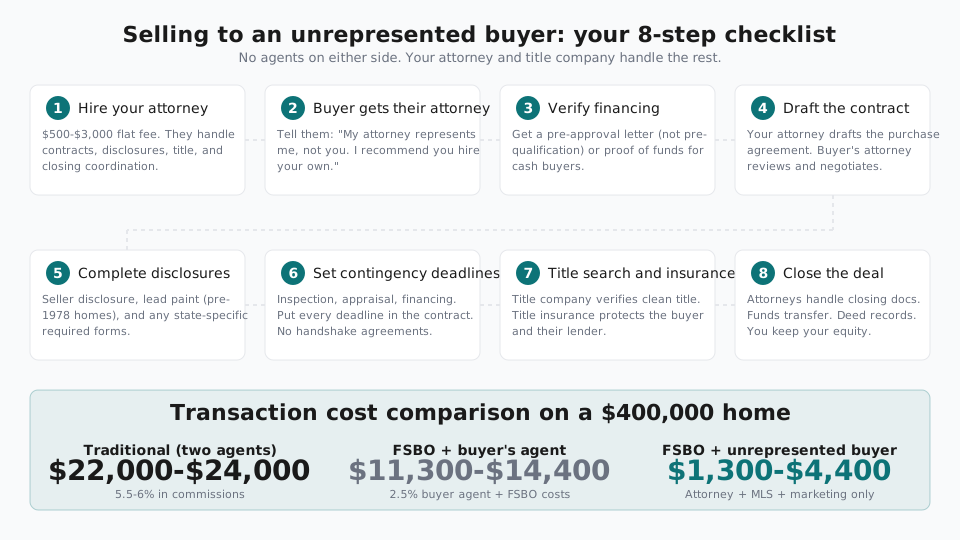
Your checklist for selling to an unrepresented buyer
- Hire a real estate attorney before you list
- Tell the buyer to get their own attorney
- Verify financing (pre-approval letter or proof of funds)
- Have your attorney draft the purchase agreement
- Provide complete seller disclosures and lead paint disclosure
- Set clear deadlines for every contingency
- Coordinate with the title company for title search and insurance
- Let the attorneys handle the closing
That’s it. Eight steps. No agents, no commissions, no six-figure middleman fees.
Your next move: if you haven’t hired an attorney yet, the attorney guide explains how to find one, what to ask, and what to pay. Then read the full NAR settlement breakdown so you understand the rules that are sending more unrepresented buyers your way. The rules shifted in your favor. Take advantage of it.
Keep reading
Best flat fee MLS services in Arizona (2026)
A side-by-side comparison of Arizona flat fee MLS companies, with real pricing, local MLS questions, and the fine print sellers miss.
Free FSBO purchase agreement template for Georgia
Georgia FSBO sellers can't use the GAR form -- here's how to get a solid purchase agreement, what it must include, and the Georgia-specific traps that cost sellers money.
How to advertise buyer agent compensation off the MLS
The NAR settlement banned compensation offers on the MLS, but you can still advertise what you're willing to pay buyer's agents through six other channels. Here's how.