Selling FSBO after the NAR settlement: what changed in 2024 and 2025
In August 2024, the biggest change to real estate commissions in decades went into effect. The National Association of Realtors settled a $418 million antitrust lawsuit, and the terms rewrote how agents get paid. If you’re selling your house FSBO, this is the best thing that’s happened to you in 40 years.
But you probably haven’t heard much about it. Agents aren’t advertising it. The old commission structure is still the default at most brokerages. And the media coverage mostly focused on what the settlement means for buyers, not sellers.
So here’s the short version: the MLS no longer requires you to offer a dime to the buyer’s agent. That field is gone. Deleted. Buyers now sign written agreements with their agents that spell out exactly what the agent earns and who pays for it. The “standard” 5-6% commission was always a norm, not a law, and the structural mechanisms that enforced it just got dismantled by a federal court.
For FSBO sellers, that changes the math on every part of the transaction.
What the lawsuit was actually about
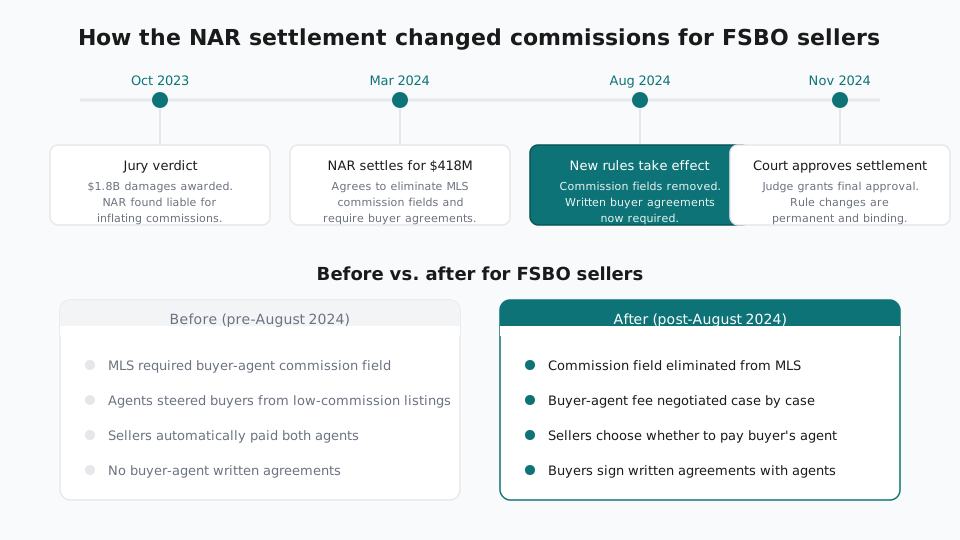
In October 2023, a federal jury in Kansas City found NAR, HomeServices of America (a Berkshire Hathaway subsidiary), and Keller Williams liable for conspiring to inflate real estate commissions. The jury deliberated for about two and a half hours before returning a unanimous verdict. The damages: $1.8 billion, which under antitrust law would be tripled to $5.36 billion.
The core issue was something called “cooperative compensation.” For decades, NAR’s MLS rules required that when a seller listed a home, the listing agent had to specify what commission the buyer’s agent would receive. Typically 2.5% to 3%. The seller paid it, but the buyer’s agent got the money. The buyer never negotiated the fee. The seller never chose the amount. It was just baked into the system.
The jury said that amounted to price-fixing. More than 260,000 home sellers in Missouri, Kansas, and Illinois were part of the class. NAR settled in March 2024 for $418 million rather than face the trebled verdict. The practice changes took effect August 17, 2024. Final court approval came in November 2024.
The three rules that changed
Three specific changes went into effect on August 17, 2024. Each one matters for FSBO sellers.
1. No more commission offers on the MLS
The commission field that buyer’s agents used to rely on is gone. Sellers and listing agents cannot advertise, display, or communicate buyer-agent compensation through any MLS platform. Period.
Before this rule, FSBO sellers who used a flat-fee MLS service to get listed were essentially forced to fill in that buyer-agent commission field. You could technically put 0%, but agents would steer buyers away from your listing. The field itself created an expectation.
That field no longer exists. If a buyer’s agent wants to know what you’re offering, they have to call and ask. And you don’t have to answer with a number.
You can still offer buyer-agent compensation off the MLS. Through your listing description on Zillow, through flyers, through direct communication. But the structural pressure to put a number in a box on the MLS is gone.
2. Buyers must sign written agreements with their agents
Before the settlement, buyers could work with agents for months without any written agreement about compensation. The agent’s payment was built into the MLS listing, paid by the seller. Nobody questioned it.
Now, buyers must sign a written “buyer representation agreement” before their agent can show them any property. Not after they find a house they like. Before the first tour. That agreement has to spell out exactly what the agent earns, in a specific dollar amount, percentage, or hourly rate. It has to include a statement that the fee is negotiable and not set by law. And it has to prohibit the agent from receiving more than the agreed-upon amount from any source.
Why does this matter for you? Because the buyer’s agent compensation is now a matter between the buyer and their agent. They work it out before they ever contact you. You are not automatically a party to their arrangement.
3. Commissions are formally “decoupled”
The old system tied the listing-side commission to the buyer-side commission. You signed one listing agreement, and it covered both agents’ fees. That connection has been severed.
Sellers are no longer required to pay the buyer’s agent. Full stop. You can offer compensation to buyer’s agents if you want to (many sellers still do, for strategic reasons I’ll explain below). But it’s now a choice, not a structural requirement baked into the MLS.
What this means if you’re selling FSBO
If you’re already skipping the listing agent, the settlement hands you a second advantage. You were saving 2.5-3% by not hiring a listing agent. Now you have real leverage on the buyer’s agent side too.
Here’s the practical difference. Before August 2024, buyer’s agents could see your commission offer (or lack of one) on the MLS before scheduling a showing. If you offered 0% or 1%, many agents would quietly steer their buyers to other listings. You’d never know it happened.
Now they can’t see any commission offer on the MLS because that information isn’t there. Buyer’s agents who want to bring clients to your home must already have a signed agreement with their buyer covering compensation. Their fee is handled. When they call you asking about commission, they’re asking if you’ll sweeten the deal, not demanding payment you owe.
The negotiation script from the buyer’s agent guide works perfectly here: “I evaluate compensation as part of the full offer. If your buyer loves the house, let’s talk numbers once we see the complete terms.”
That script didn’t carry the same weight before August 2024. Now it does. Because the structural expectation behind the agent’s ask has been removed. You’re negotiating, not complying.
The honest truth: commissions haven’t actually dropped
Here’s where I have to be straight with you, because I don’t think other FSBO sites are being honest about this.
Commission rates have not dropped since the settlement. They’ve gone up slightly.
Redfin’s data shows the average buyer’s agent commission was 2.36% when the new rules took effect in Q3 2024. By Q3 2025, it was 2.42%. The average total commission (listing agent + buyer’s agent) rose from 5.32% to 5.44% over the same period.
The Federal Reserve published a detailed analysis in May 2025 and concluded that the buyer representation agreement requirement “may end up having no effect on commission rates.” The modest downward trend in rates over the past two decades? That was driven by rising home prices, not competitive pressure. When the Fed controlled for home prices, the downward trend disappeared.
So if you were expecting the settlement to magically cut commissions in half, that hasn’t happened. Not yet, anyway.
Why commissions are sticky
Three reasons. First, most sellers still offer buyer-agent compensation because they’re afraid of shrinking their buyer pool. In a market with elevated inventory, that’s a rational fear. Second, agents adapted quickly. They moved their commission conversations off the MLS and into phone calls, emails, and websites. The information still flows, just through different channels. Third, inertia. Sellers on the Bogleheads financial forum reported interviewing agents in late 2024 who recommended offering 2.5-2.8% to buyer’s agents “as if the settlement had never happened.”
But that doesn’t mean nothing changed for you
The settlement didn’t cut commissions. What it did was give you permission, backed by federal court order, to negotiate. Before August 2024, offering below 2.5% to a buyer’s agent carried real risk of your listing being quietly blackballed. That risk is sharply reduced now. The structural mechanism that made blackballing easy (the MLS commission field) doesn’t exist anymore.
And the long-term trajectory matters. The Brookings Institution projects that if true decoupling takes hold, commissions could eventually drop by “at least half.” The DOJ has made clear the settlement is not an “antitrust shield” and future enforcement actions remain possible. Massachusetts already passed state-level broker-fee legislation. Oregon enacted its own written buyer agreement requirements. More states will follow.
The settlement cracked the dam. The flood hasn’t arrived yet, but the water is moving.
What to actually offer buyer’s agents
This is the question every FSBO seller asks. The answer depends on your market, your timeline, and how much you want to maximize your buyer pool versus your net proceeds.
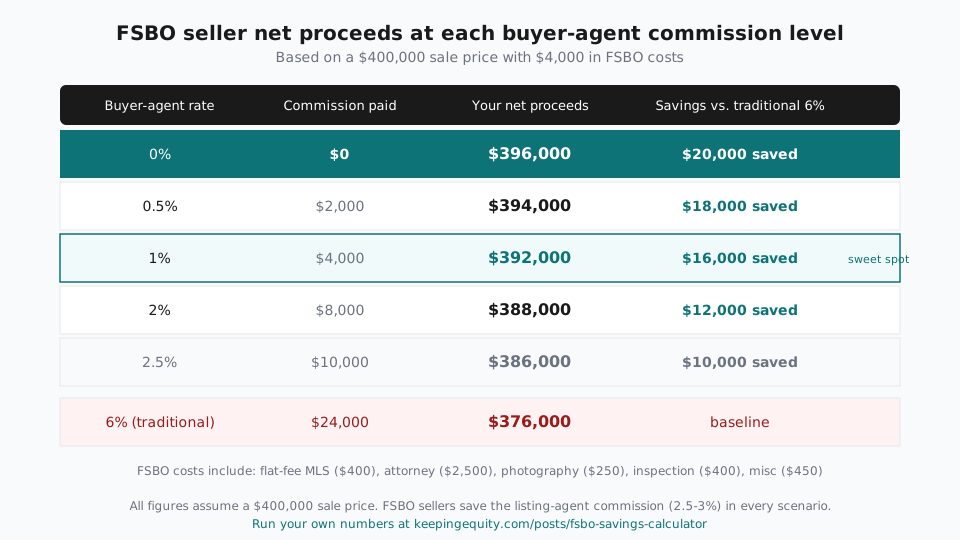
On a $400,000 home, here’s what each level means:
0% (buyer pays their own agent). You keep every dollar of the sale price minus your own FSBO costs. More buyers are going unrepresented post-settlement, especially those who negotiated flat-fee or hourly arrangements with their agents. This works best in hot markets where buyers are competing for homes.
1% ($4,000). A reasonable middle ground that shows good faith. You still save $8,000 compared to the old 2.5% standard. Many post-settlement negotiations are landing here.
2% ($8,000). Generous by post-settlement standards. Use this as a counteroffer when an agent asks for 3%. You save $4,000 compared to the traditional rate, and most agents will take the deal.
2.5-3% ($10,000-$12,000). The pre-settlement “standard.” Nothing requires you to offer this. But if a buyer’s offer is strong enough (above asking, minimal contingencies, fast close), the commission might be worth it when you look at total net proceeds.
The math that matters: a buyer offering $410,000 with a 2.5% commission request puts more in your pocket than a buyer offering $395,000 with zero commission. Always run the numbers. The FSBO savings calculator makes this comparison easy.
The unrepresented buyer is your best friend
Here’s a trend the settlement accelerated that most FSBO sites aren’t talking about.
When buyers have to sign a written agreement with their agent specifying exactly what the agent earns, some buyers look at that number and decide they’d rather handle things themselves. Especially first-time buyers stretching to afford a home in the first place. Paying an agent 2.5% out of pocket on top of the down payment, closing costs, and inspection fees? That’s a tough sell.
The settlement didn’t require buyers to have agents. It required that if they use an agent, the compensation terms be explicit and agreed upon in writing. Some buyers are reading that agreement and walking away from the relationship.
For FSBO sellers, an unrepresented buyer is the cleanest transaction you can get. No agent commission on either side. Your costs are a flat-fee MLS listing ($300-500), a real estate attorney ($500-$3,000), and whatever you spend on photography and inspections. Total: $1,300 to $4,400 on a $400,000 sale, instead of $20,000+ in the traditional model.
You don’t need to do anything special to attract unrepresented buyers. They find your listing on Zillow the same way everyone else does. But you should know that the buyer representation agreement requirement has made some percentage of buyers more open to buying directly. This trend benefits FSBO sellers more than anyone else in the market.
What about the NAR settlement payout?
If you sold a home between October 2017 and October 2025 and paid a commission, you might be eligible for a payout from the settlement fund. Nearly 500,000 people filed claims. But don’t expect a windfall. Estimates range from $13 to $50 per claimant. The $418 million sounds like a lot until you divide it among hundreds of thousands of sellers and subtract legal fees.
The real value of the settlement isn’t the check. It’s the rule changes. The structural advantage you now have as a FSBO seller is worth far more than whatever lands in your mailbox.
The five things you should do differently now
1. Stop defaulting to 2.5% buyer-agent offers. The “standard” is dead. Start at 0% or 1% and negotiate from there. You can always go up. You can’t go down.
2. Use the offer stage for commission negotiations. When a buyer’s agent calls and asks what you’re offering, defer to the written offer. “I evaluate compensation as part of the full terms.” Don’t commit to a number before you see the purchase price, contingencies, and timeline.
3. Price your home right. The settlement gave you negotiating power on commissions. It didn’t change the fact that overpriced homes sit on the market regardless of the commission structure. Read the pricing guide and do the work.
4. Have an attorney, not an agent. A real estate attorney handles contracts, disclosures, title review, and closing for a flat fee. That’s the legal work. An agent charges tens of thousands for the same work plus marketing you can do yourself. Post-settlement, the attorney-plus-FSBO model is stronger than ever. Here’s how to find and hire one.
5. Know your state’s rules. Massachusetts, Oregon, Colorado, Washington, and North Carolina have all enacted additional requirements around buyer representation agreements. Your state may have specific disclosure or agreement requirements beyond the federal settlement terms. Check with your real estate attorney.
Where this goes from here
The DOJ isn’t done. They filed a Statement of Interest in November 2024 warning that the buyer representation agreement requirement “may harm buyers and limit how brokers compete for clients.” They explicitly stated the settlement is not an antitrust shield and future enforcement actions remain possible. In December 2025, they weighed in on yet another commissions lawsuit.
Commission rates haven’t dropped yet. But the structural foundation that propped up the 5-6% norm for decades has been demolished. FSBO sellers are the biggest beneficiaries of that demolition, because you were already operating outside the traditional system. The settlement just leveled the playing field.
Your next step: if you haven’t read how commissions actually work, start there. It explains the four-way split, the incentive misalignment, and why the percentage model never made sense. Then run the numbers through the savings calculator to see exactly what you keep under the new commission reality.
The old system charged you $24,000 for services you can handle yourself. The new system says you don’t even have to pay the buyer’s agent unless you choose to. That’s your equity. Keep it.
Keep reading
How to Create a FSBO Listing That Attracts Serious Buyers
Your listing does the job you'd otherwise pay an agent $24,000 for. Here's exactly how to get the photography, description, platform, and timing right.

Best flat fee MLS services in Arizona (2026)
A side-by-side comparison of Arizona flat fee MLS companies, with real pricing, local MLS questions, and the fine print sellers miss.
The FSBO Savings Calculator: How Much Will You Actually Keep?
At 6% commission, a $400,000 sale costs you $24,000. Here's the real math on what you save selling FSBO, including the costs you'll still have.