
5 FSBO Myths That Keep You Paying Listing Commissions
The moment you tell someone you’re selling your house without an agent, you’ll hear the same five objections. Your brother-in-law will say it at Thanksgiving. Your coworker will forward you some article a Realtor wrote. Your mom will call, genuinely worried you’re about to lose your biggest asset.
I heard every single one of these before I sold my first house FSBO. I almost talked myself out of it. And if I had, I would have handed over $21,000 in commissions on a $350,000 house for services I ended up doing myself in about 15 hours of actual work.
The landscape has shifted since the August 2024 NAR settlement. The old “standard 6%” is no longer a fixed reality — that cooperative commission structure was dismantled. But the myths haven’t caught up. Agents have adapted: fees are now decoupled, creatively structured, and presented as inevitable. The assumption you’re supposed to absorb is that agents always deserve their full asking commission, whatever form it takes. That assumption is still wrong.
Let’s go through them one at a time.
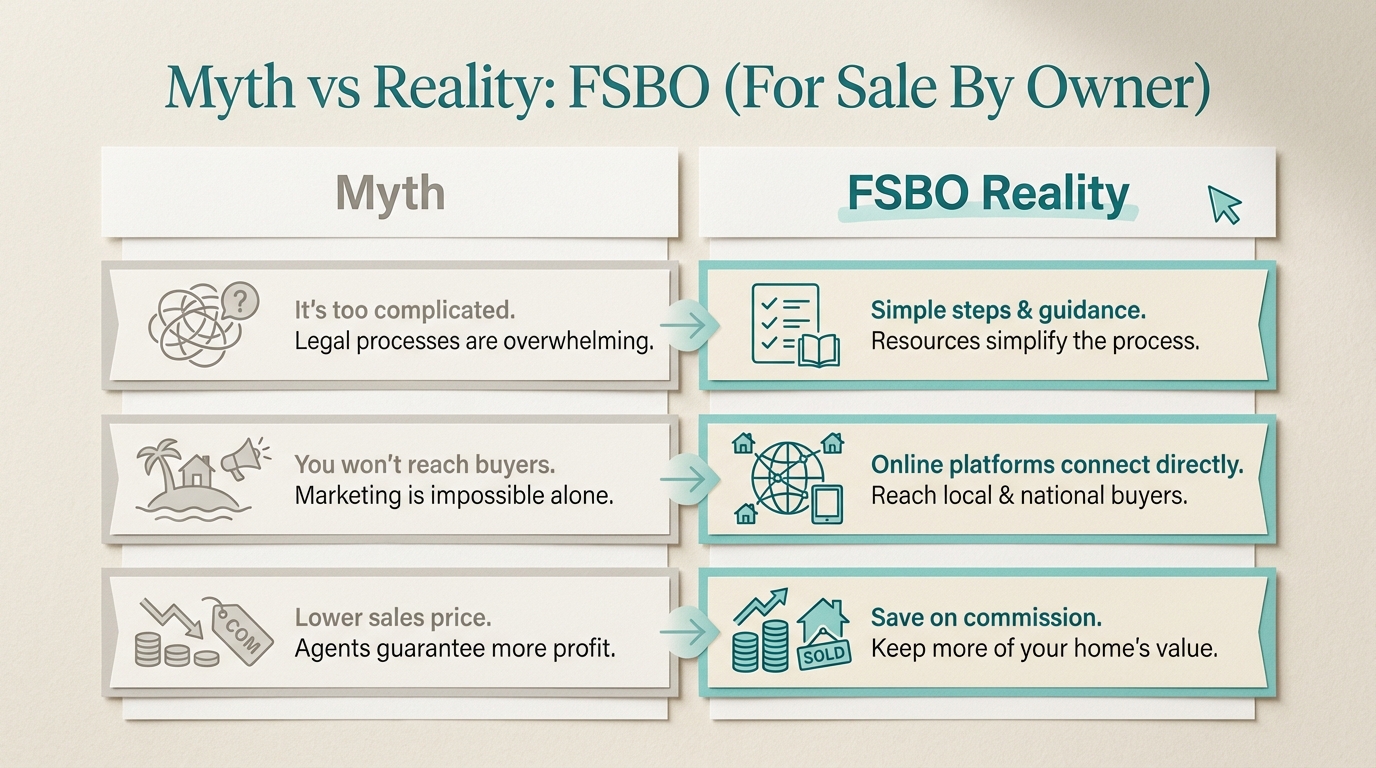
Myth #1: Buyer’s agents won’t show your home
This is the one Realtors love to throw around because it sounds scary. The implication is that if you don’t list with an agent, buyer’s agents will steer their clients away from your house and you’ll sit on the market forever.
Here’s what actually happens. After the NAR settlement, buyers sign agreements with their agents that spell out exactly how the agent gets paid. The buyer’s agent’s commission is handled between the buyer and their agent. It’s not your problem. And those agents are contractually obligated to show properties their clients want to see — that’s literally their fiduciary duty.
But here’s the bigger point everyone misses: buyers don’t need their agent to find your house anymore. They find it on Zillow. They find it on Realtor.com. They find it scrolling their phone at 11pm. The National Association of Realtors’ own data shows that 97% of homebuyers use the internet in their home search. Your buyer is going to find your listing online, and then either call you directly or tell their agent they want to see it.
An agent who refuses to show a buyer a home the buyer wants to see? That agent is about to lose a client.
Myth #2: You’ll get lowballed by unqualified buyers
The fear here is that without an agent standing guard, you’ll be flooded with tire-kickers and people offering $50,000 below asking because they think FSBO sellers are desperate.
Real talk — you might get the occasional lowball. Agents get them too. That’s just how real estate works. You counter or you ignore it.
As for unqualified buyers, there’s a dead-simple fix: require a mortgage pre-qualification letter with every offer. This is exactly what listing agents do. It takes zero special training. When someone submits an offer, you say, “Great, please include your pre-qualification letter from your lender.” If they can’t produce one, you don’t entertain the offer. Done.
You can also require proof of funds for cash offers. A bank statement or a letter from their financial institution showing they actually have the money. Three sentences in an email is all it takes.
The idea that only a licensed Realtor can ask for these documents is absurd. You’re the homeowner. It’s your house. You set the terms.
Myth #3: Agent-listed homes sell for more money
This is the big one. The real estate industry has spent decades hammering this into people’s heads — that agents get you a higher sale price, and that the higher price more than covers their commission. It sounds logical. It’s also not supported by the research.
Researchers at Stanford looked at this exact question. Their finding? “No evidence that the use of a broker significantly affects either the selling price or the initial asking price.” Not “some evidence.” Not “mixed results.” No evidence.
A separate study out of Northwestern came to a similar conclusion. When you control for the characteristics of the home, agent-listed and FSBO homes sell for comparable prices.
Think about why this makes sense. The buyer doesn’t care whether you have an agent. The buyer cares about the house, the location, and the price. If your house is priced right based on comps — which you can absolutely figure out yourself — it’s going to attract offers in the same range regardless of who listed it.
Now factor in the commission. Even if an agent somehow squeezed out an extra 1-2% on your sale price (which the research says they don’t), you’re paying 5-6% in commissions. You’re still losing money. On a $400,000 house, traditional agent commissions run $20,000–$24,000. Even an unlikely 2% boost in sale price only gets you an extra $8,000. You’d still be in the hole by $12,000 or more.
The math doesn’t work in the agent’s favor no matter how you run it.
Myth #4: The legal paperwork is too complicated
I get why this one sticks. Selling a house involves contracts, disclosures, title work, and a closing process. It sounds like you’d need a law degree.
You don’t need a law degree. You need a real estate attorney.
A real estate attorney will draft or review your purchase and sale agreement, handle the title search, prepare the closing documents, and make sure everything is legally airtight. They do this all day, every day. They carry malpractice insurance. And unlike an agent, they have a legal fiduciary duty to protect your interests — not just an ethical guideline, an actual legal obligation.
What does this cost? Between $500 and $3,000 for a typical residential transaction, depending on your state and the complexity of the deal. Most straightforward sales land in the $500-$1,500 range.
Compare that to $24,000 in agent commissions on a $400,000 sale. You’re getting actual legal protection — from someone who went to law school — for about 4% of what you’d pay two agents who took a licensing course.
Here’s something most people don’t know: in some states, like New York and Massachusetts, you’re already required to have an attorney involved in the transaction whether you have an agent or not. The attorney is doing the legal work regardless. The agent is just the middleman.
Myth #5: You can’t figure out the right list price
This one was my biggest fear when I sold my first house. I was convinced I’d either overprice it and sit on the market for months, or underprice it and leave $30,000 on the table.
Then I spent about two hours on Zillow and Redfin looking at comparable sales in my neighborhood, and I realized something: the data agents use to price homes is the same data that’s free online. All of it.
When an agent does a Comparative Market Analysis — a CMA — they’re pulling recent sales of similar homes in your area and adjusting for differences like square footage, lot size, condition, and upgrades. You can do the exact same thing. Zillow, Redfin, and Realtor.com all show you recently sold homes, sale prices, days on market, and property details.
Pull 5-6 comparable sales from the last 3-6 months within a mile or two of your house. Adjust up or down for obvious differences — your house has a renovated kitchen and the comp didn’t, add some value; the comp had a bigger lot, subtract some. You’re not trying to nail it to the dollar. You’re trying to land in the right range, and the market will tell you the rest.
If you price a little high, you’ll know within two weeks because you won’t get showings. Drop the price 2-3% and watch what happens. This isn’t brain surgery. It’s pattern matching with freely available data.
And if you really want a professional opinion without signing away a listing commission, some appraisers offer pre-listing appraisals for $300-$500. That gives you an independent, certified valuation with zero strings attached.
Bonus myth: “The NAR settlement makes FSBO harder”
This one started circulating after the 2024 NAR settlement, and it’s backwards. Some agents have been telling sellers that the new commission rules make FSBO sales more complicated because “now you have to figure out buyer-agent compensation on your own.”
Here’s the truth: the settlement removed the requirement for sellers to offer buyer’s agent compensation through the MLS. That was a rule that forced sellers to subsidize the buyer’s agent’s fee as a condition of listing. Removing it gives you more control, not less.
Before the settlement, if you listed on the MLS, you had to offer 2.5-3% to the buyer’s agent or risk having agents steer buyers away from your property. The old “standard 6%” was baked into the MLS system itself — sellers were structurally coerced into paying both sides. Now? That MLS compensation field is gone. Buyers sign written agreements with their agents that spell out how the agent gets paid. The buyer handles their own agent’s compensation. You can offer 0%, 0.5%, 1%, or whatever makes sense as part of the negotiation.
Watch for agents who frame this differently. Some now present a “listing-side only” commission of 2.5-3% and tell you the buyer-side fee is “separate” — as if you’re getting a discount. You’re not. Any fee a seller pays is still your equity leaving the table. The 6% standard was dismantled, but agents have found new ways to dress up the same extraction. Don’t let the packaging confuse the math.
The settlement didn’t make FSBO harder. It removed one of the structural advantages the traditional model had over FSBO sellers. The commissions breakdown covers the full impact, and the savings calculator lets you model different post-settlement commission scenarios.
The pattern here is obvious
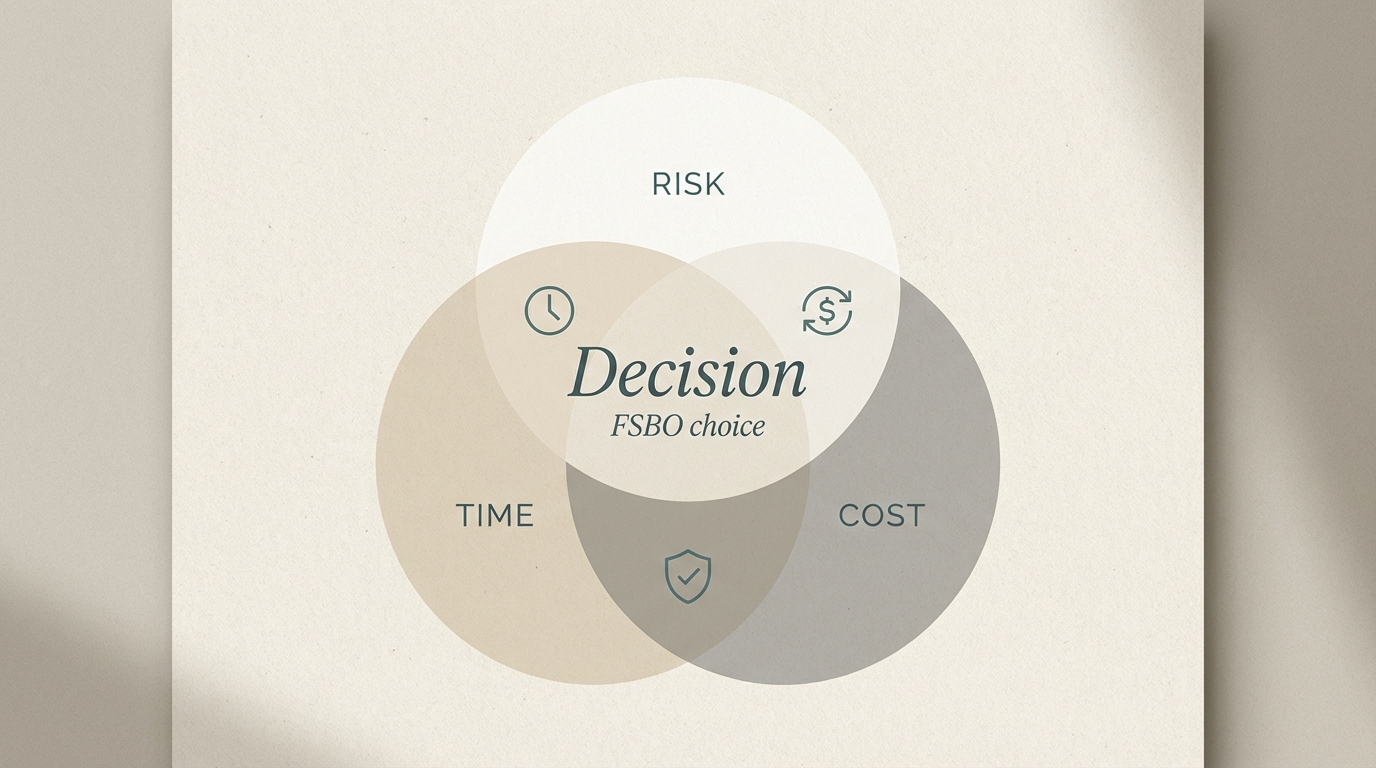
Every single one of these myths has the same structure. Someone tells you that a specific part of selling a house is too hard or too scary to do without paying an agent $15,000-$30,000 in listing commissions. Then you look into it and discover that the actual solution costs somewhere between free and $1,500.
Your next step: pick the myth that’s been holding you back the most and go research it yourself for 30 minutes. Look at comps on Zillow. Call a real estate attorney and ask what they charge for a FSBO closing. Read your state’s seller disclosure requirements. The information is out there, it’s free, and it’s yours — just like the equity you’re about to keep.
Keep reading
Free FSBO purchase agreement template for Arizona
Arizona FSBO sellers can use the AAR Residential Resale Purchase Contract or a free alternative -- here's how the contract works, what the BINSR process means, and where sellers trip up.
Selling FSBO after the NAR settlement: what changed in 2024 and 2025
The NAR commission lawsuit settlement eliminated mandatory buyer-agent fees on the MLS and gave FSBO sellers real negotiating power. Here's what actually changed and what it means for your sale.
Free FSBO purchase agreement template for Georgia
Georgia FSBO sellers can't use the GAR form -- here's how to get a solid purchase agreement, what it must include, and the Georgia-specific traps that cost sellers money.