How to advertise buyer agent compensation off the MLS
The MLS compensation field is gone. Since August 17, 2024, no seller or listing agent can advertise buyer-agent compensation on any MLS in the country. That field was deleted as part of the NAR settlement, and it’s not coming back.
But here’s what a lot of FSBO sellers don’t realize: you can still advertise what you’re willing to pay a buyer’s agent. You just can’t do it on the MLS. The settlement banned one specific channel. It left every other channel wide open.
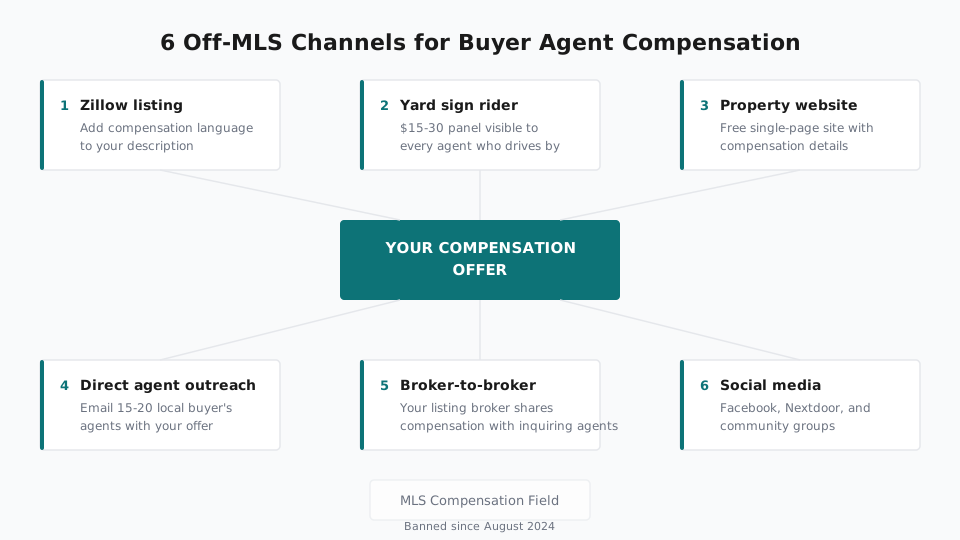
If you want buyer’s agents to know you’re offering compensation (and there are good strategic reasons to do that), you have six ways to get the word out. Some are free. Some take five minutes. And all of them are perfectly legal under the settlement terms.
Why you’d advertise compensation at all
Before I get into the how, let’s address the why. If the whole point of selling FSBO is keeping your equity, why would you voluntarily offer to pay a buyer’s agent?
Because about 88% of buyers still work with agents. That’s NAR’s own data from 2024, and the number hasn’t dropped meaningfully since the settlement. If you offer zero compensation and don’t communicate that strategically, some buyer’s agents will quietly deprioritize your listing. They can’t see compensation on the MLS anymore, so they don’t know what you’re offering. Uncertainty makes agents cautious, and cautious agents show other houses first.
Advertising your compensation offer off the MLS solves that problem. Agents know what to expect before they call. You control the message. And you can offer whatever amount makes sense for your market and timeline, whether that’s 0%, 1%, 2%, or anything else.
The full breakdown of what to offer at each level covers the math. This article is about getting your offer in front of the right people.
Channel 1: your property listing on Zillow
Zillow is where buyers start their search. It’s also where many buyer’s agents first encounter your listing. And unlike the MLS, Zillow has no ban on mentioning compensation.
In your Zillow listing description, add a line near the bottom:
“Seller is willing to discuss buyer-agent compensation as part of a competitive offer. Contact [your phone number] for details.”
Or if you want to name a specific number:
“Seller offering 2% buyer-agent compensation. Contact [your phone number] to schedule a showing.”
That’s it. A single sentence in the listing description. Every buyer’s agent who pulls up your listing on Zillow will see it. You can update or remove it anytime.
If you listed through a flat fee MLS service, your listing syndicates to Zillow, Realtor.com, Trulia, and Redfin automatically. But the description fields on these sites vary. Check your live listing on each platform to make sure the compensation language appears. Some syndication services strip or truncate listing descriptions.
One thing to watch for: in some MLS regions, including Houston’s HAR, listing descriptions that mention broker compensation can trigger fines (HAR’s is $500). Since a flat fee MLS listing originates on the MLS before syndicating to Zillow, make sure your compensation language is in the Zillow-specific description field, not the MLS remarks field. Your flat fee service can help you separate the two.
Channel 2: yard sign riders
A yard sign rider is that little extra panel you hang above or below your main “For Sale” sign. They cost $15 to $30 from Amazon or your local sign shop. And they’re one of the most effective ways to communicate with agents who drive neighborhoods looking for listings.
Print one that says:
“Buyer’s Agent Comp Offered — Call for Details”
Or:
“2% Buyer Agent Compensation”
Every agent who drives by your house sees the message. Buyers see it too, which normalizes the idea that commission is part of the negotiation. A sign rider stays up 24/7, it’s visible from the street, and it requires no technology.
Keep it short. Three to five words on the rider, plus your phone number. “BUYER’S AGENT WELCOME — 2% — CALL 555-1234” covers everything an agent needs to know.
Channel 3: your own property website
A single-page property website takes 30 minutes to set up and costs nothing. Use a free site builder (Carrd, Google Sites, or even a simple Notion page). Include your listing photos, property details, and a section that says:
“Buyer’s agent compensation: Seller is offering [X]% to the buyer’s agent upon successful closing. Contact [name] at [phone/email] for a showing or to submit an offer.”
Put the website URL on your yard sign, in your Zillow description, and in every email you send to agents. The property website becomes your single source of truth for compensation information. When agents have a URL they can check, they stop calling to ask.
This is also where you can include details that don’t fit in an MLS description: your pre-inspection report, your CMA comps, your disclosure documents, even a virtual tour. The more information you put in one place, the more professional you look, and the fewer back-and-forth calls you’ll field.
Channel 4: direct outreach to buyer’s agents
This is the most underused channel, and it’s free.
Pull up Zillow, Realtor.com, or Redfin and look at recent sales in your neighborhood. Specifically, look at the buyer’s agents who closed deals in the last 6 months within a mile of your house. These agents have clients who already want to live in your area.
Send a short email:
“Hi [Agent Name], I’m selling my home at [address] FSBO. The home is [brief highlights: beds, baths, square footage, key features]. I’m offering [X]% buyer-agent compensation upon closing. If you have a client who might be interested, I’d love to schedule a showing. Full listing details and photos are at [property website URL]. Thanks, [Your Name], [Phone].”
Send 15 to 20 of these. It takes an hour. You’re not spamming. You’re giving agents a reason to show your house to their active buyers. Most agents won’t respond, but the ones who do are the ones with motivated clients in your area.
The buyer’s agent guide has the full playbook on how to work with agents who respond to your outreach.
Channel 5: broker-to-broker compensation agreements
If you used a flat fee MLS service to list your home, your listing broker can communicate your compensation offer to buyer’s brokers directly. This is one of the channels the NAR settlement explicitly allows.
Here’s how it works. You tell your listing broker: “I’m willing to offer X% to the buyer’s agent.” Your broker then communicates that to any buyer’s broker who asks. The offer can be posted on your listing broker’s website, shared via email, or discussed by phone. It just can’t appear on the MLS itself.
Some flat fee services have built-in tools for this. Brokerless, for example, lets sellers set a compensation amount that the broker shares with inquiring buyer’s agents. Other services handle it manually. When you sign up for your flat fee MLS listing, ask: “How do you communicate my buyer-agent compensation offer to buyer’s brokers?” If they can’t answer clearly, that’s a reason to pick a different service.
If you’re not using a flat fee MLS service (maybe you listed directly on Zillow or your state doesn’t require MLS listing), this channel doesn’t apply to you. Skip to the next one.
Channel 6: social media and community groups
Facebook Marketplace, local neighborhood groups, and Nextdoor are all places where FSBO listings get traction. When you post your listing, include your compensation offer in the post.
“4BR/2BA home for sale by owner at [address]. [Price]. Buyer’s agent compensation offered. Full details at [property website URL].”
You don’t need to post the specific percentage publicly. “Buyer’s agent compensation offered” is enough to get agents to click. The details live on your property website.
Don’t overlook the power of these channels. Buyer’s agents monitor neighborhood Facebook groups. A well-photographed listing post with a clear “agents welcome” message will reach local agents who specialize in your area.
The seller concession workaround (and its limits)
You may have heard about the MLS “Seller May Contribute to Buyer Expenses Up To” field. This field survived the settlement and lets you signal willingness to help with buyer costs.
But here’s the catch: seller concessions on the MLS cannot be conditioned on paying a buyer’s agent. NAR’s rules are explicit about this. You can offer to contribute $10,000 toward a buyer’s closing costs. The buyer can then choose to apply that money however they want, including toward their agent’s fee. But you cannot put “$10,000 toward buyer’s agent commission” in the MLS concession field.
In practice, buyers and their agents know how to use seller concessions to cover agent fees. It’s become a common workaround. But if you structure it as a condition (pay the agent or lose the concession), you’re violating the settlement terms, and your listing could be flagged.
The cleaner approach: use the off-MLS channels above to advertise your compensation offer directly, and leave the MLS concession field for actual buyer expenses like closing costs or rate buydowns. Keep the two separate.
What to actually put in writing
When you and a buyer agree on compensation as part of the deal, it needs to be documented. There are two common approaches.
Option 1: include it in the purchase agreement. Most state purchase contracts have a section for seller concessions or buyer-agent compensation. In Texas, the TREC contract forms include this. Your real estate attorney can add a compensation clause to the purchase agreement if the standard form doesn’t cover it.
Option 2: use a separate compensation agreement. Some buyer’s agents will bring a one-page “Seller Payment to Buyer’s Broker” agreement for you to sign. Read it carefully. It should state the specific amount or percentage, that payment is contingent on closing, and that it only applies to this transaction. Don’t sign anything that locks you into paying compensation if the deal falls through.
Either way, get your attorney to review it before you sign. The compensation agreement is a contract. Treat it like one.
Related: The buyer’s agent already has a signed representation agreement with their buyer. That agreement spells out the agent’s fee. If you agree to contribute toward that fee, your payment reduces what the buyer owes their agent. The buyer’s agent cannot receive more from all sources combined than what their representation agreement specifies. This is a settlement rule. If an agent tries to collect 2.5% from you on top of what the buyer is already paying them, they’re violating their own agreement.
The strategy that puts it all together
Here’s the play-by-play for a FSBO seller who wants to advertise compensation strategically:
Week 1: set your number. Run the math through the FSBO savings calculator at 0%, 1%, and 2% buyer-agent compensation. Decide what you’re willing to offer based on your market conditions and how quickly you need to sell.
Week 1: set up your channels. Create your property website with compensation details. Order a yard sign rider. Write your Zillow listing description with compensation language. Draft your agent outreach email.
Week 2: go live. List your home on the MLS through a flat fee service. Set up the broker-to-broker compensation channel with your listing broker. Post on social media. Send 15-20 emails to local buyer’s agents.
Ongoing: adjust as needed. If showings are strong, you might lower your offer. If showings are slow after three weeks, bump it up. Because your compensation information lives on channels you control (your website, your sign rider, your Zillow description), you can change the number in an afternoon.
The advantage of advertising off the MLS is that you’re in control. The old system forced a number into a box that every agent could see before they ever contacted you. The new system lets you choose the message, the channel, and the audience. For FSBO sellers who know their numbers, that’s a better deal.
Your next step: decide your compensation number using the savings calculator, then read the buyer’s agent guide for scripts on handling agents who call to discuss commission. And if you haven’t read what the NAR settlement actually changed, start there. The rules behind everything in this article are explained in full.
Keep reading
Free FSBO purchase agreement template for New York
New York FSBO sellers need an attorney to draft their purchase contract -- here's what the standard bar association form covers, what the 2024 PCDS changes mean for you, and how to close without an agent.
What is a buyer representation agreement (and why sellers should care)
Since August 2024, every buyer's agent must have a signed compensation agreement before showing homes. Here's what that agreement says, what it means for FSBO sellers, and how to handle it.
The FSBO Inspection and Closing Process: What to Expect
From accepted offer to keys in the buyer's hand, here's every step of the inspection and closing process when you're selling FSBO.