Do sellers have to pay the buyer's agent? Not anymore.
No. Since August 17, 2024, sellers are not legally required to pay the buyer’s agent commission. The NAR settlement eliminated the MLS rule that forced sellers to offer buyer-agent compensation as a condition of listing. You can offer 0%, and no field on the MLS exists to say otherwise.
That’s the legal answer. The market answer is more complicated, and it’s the reason most FSBO sellers still hand over money they don’t have to.
What the NAR settlement actually changed
The NAR settlement article covers the full history, but here’s the part that matters for this question.
For decades, listing a home on any MLS required filling in a “buyer-agent compensation” field. Typically 2.5% to 3%. Sellers paid it automatically. Buyers never saw it. The entire system was designed so that no one questioned the fee, and a federal jury in 2023 called it price-fixing.
Three things changed on August 17, 2024:
- The MLS compensation field was deleted. Sellers can no longer offer buyer-agent compensation through the MLS. The field doesn’t exist.
- Buyers must sign written agreements with their agents before touring any property. That agreement spells out what the agent earns and who pays.
- Commissions are formally decoupled. The seller’s listing agreement and the buyer’s agent agreement are now separate transactions. You’re not automatically a party to the buyer’s side.
The short version: the structural mechanism that made seller-paid buyer commissions the default was dismantled by a federal court. What remains is a market norm that agents are working hard to preserve.
Most sellers are still paying. Here’s why.
If sellers don’t have to pay the buyer’s agent, why are most of them still doing it?
A HomeLight survey of agents found that 73% named offering buyer-agent compensation as the top seller incentive in 2025. Redfin’s data shows the average buyer’s agent commission actually rose from 2.36% when the new rules took effect to 2.75% by mid-2025. Total commissions hit 5.57%, the highest since 2021.
That’s not a typo. Commissions went up after the settlement that was supposed to bring them down.
Three forces explain it.
Fear of a smaller buyer pool. Agents tell sellers that refusing to pay the buyer’s agent will shrink the number of people who see the home. There’s a kernel of truth here. About 90% of buyers still work with agents, and some of those buyers can’t afford to pay their agent’s commission out of pocket on top of a down payment, closing costs, and moving expenses. In a market with high inventory, sellers worry about scaring off agent-represented buyers.
Agent inertia. Sellers who hire listing agents are being advised to offer 2.5-3% to buyer’s agents “as a competitive standard.” On the Bogleheads financial forum, a high-volume agent posted in late 2024 that sellers should “still expect to pay 5 to 6% commission for selling the house.” The settlement changed the rules, but most agents haven’t changed their pitch.
Buyer-agent pressure. Buyer’s agents can’t see compensation on the MLS anymore, so they call sellers directly and ask. When you’re a seller sitting in your living room and a professional agent asks “what are you offering?” on the phone, the social pressure to name a number is real. The old system automated the payment. The new system just moved the negotiation to a phone call.
None of these forces are legal requirements. They’re market dynamics. And if you’re selling FSBO, you have more leverage over them than a seller who hired a listing agent.
The FSBO advantage on buyer-agent commissions
Here’s why this matters more for FSBO sellers than anyone else in the market.
A seller who hires a listing agent is already paying 2.5-3% on the listing side. Their agent handles the buyer’s agent question and typically recommends offering another 2.5-3% because that’s how the agent’s own business model works. The listing agent has zero incentive to help you reduce the buyer’s side, because their colleagues are buyer’s agents.
You don’t have a listing agent. You’re already saving that 2.5-3%. So the buyer’s agent commission is the only commission question you need to deal with, and you get to answer it yourself instead of having an agent answer it for you.
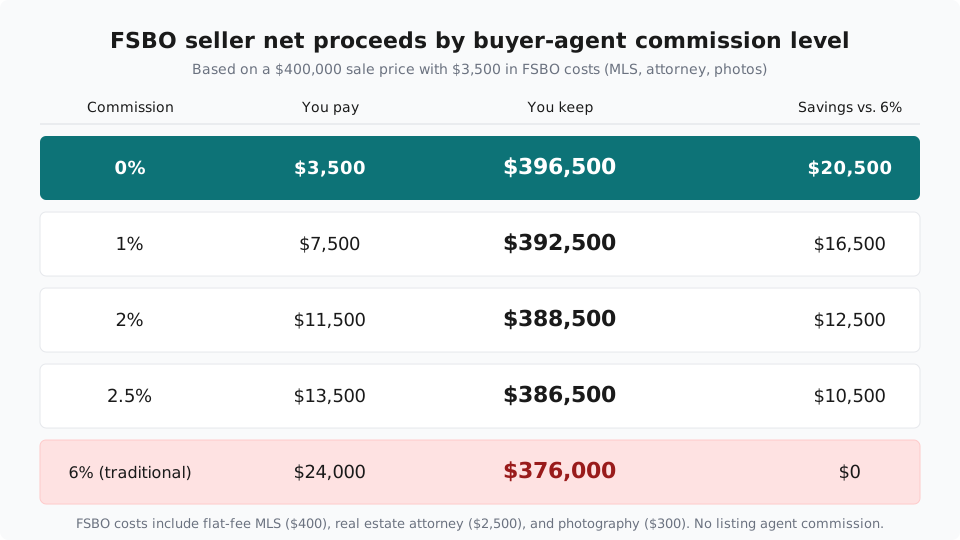
On a $400,000 sale, here’s what each choice looks like:
Offer 0%. You keep every dollar minus your FSBO costs (flat-fee MLS listing, attorney, photography). Total costs: roughly $1,300-$4,400. Net savings vs. traditional 6% commission: $19,600-$22,700. This works best in hot markets or when selling to unrepresented buyers.
Offer 1% ($4,000). A reasonable middle ground that signals good faith. You still save $8,000 compared to the old 2.5% standard. A lot of post-settlement negotiations are landing right around here.
Offer 2% ($8,000). Generous by post-settlement standards. Good as a counteroffer when an agent asks for 3%.
Offer 2.5-3% ($10,000-$12,000). The pre-settlement default. Nothing requires it. But if a buyer’s offer is strong enough on price and terms, the commission might make sense when you calculate your total net proceeds.
The FSBO savings calculator lets you model each scenario on your actual sale price.
The negotiation script that works
When a buyer’s agent calls and asks “What are you offering for buyer-agent compensation?”, don’t answer with a number. Defer to the full offer.
“I evaluate compensation as part of each offer. Let’s get your buyer through the door first. If they love the house, we’ll find terms that work for everyone.”
That script is covered in detail in the buyer’s agent guide, along with responses for every follow-up an agent might throw at you. The key insight: since the settlement, buyer’s agents know they can’t see compensation on the MLS. They’re calling to test you. A confident, professional response signals that you know the rules and you’re not going to be pressured into a number before you see the offer.
If an agent says “my client’s buyer representation agreement says I earn 2.5%,” the answer is: “That’s between you and your client. I’m happy to discuss whether I can contribute to that as part of a written offer.”
You’re not refusing to cooperate. You’re refusing to negotiate commission in isolation from the total deal.
What about VA and FHA buyers?
This is where the “just offer 0%” advice falls apart for some sellers, and it’s worth understanding why.
VA loans. Until August 2024, VA buyers literally could not pay their own agent’s commission. The VA prohibited it. That created a real problem: if the seller offered 0%, VA buyers couldn’t buy the house. The VA changed this rule in August 2024, and the VA Home Loan Program Reform Act of 2025 made it permanent. Veterans can now pay buyer-agent fees. But they can’t finance those fees into the loan. That means the buyer needs extra cash at closing, on top of the down payment and closing costs. For a veteran stretching to buy a $350,000 home, paying their agent 2.5% ($8,750) out of pocket might be a dealbreaker.
FHA loans. FHA allows seller concessions up to 6% of the purchase price. Buyer-agent commissions paid by the seller generally don’t count against that 6% cap. So a seller can offer to pay the buyer’s agent and contribute to closing costs without hitting the limit. For FHA buyers, the question is whether the seller is willing to use some of their proceeds to cover the buyer’s agent as part of the overall deal.
The practical takeaway: if a VA or FHA buyer submits an offer that includes a request for you to pay their agent’s commission, don’t reflexively say no. Run the numbers. A VA buyer offering $405,000 and asking you to pay 2% ($8,100) to their agent still nets you more than a conventional buyer offering $390,000 with no commission request. Always calculate net proceeds, not percentages.
The unrepresented buyer trend
A Duarte and Zhang study published in 2025 found that more than 90% of buyers still use agents. The increase in unrepresented buyers after the settlement is real but small.
The dynamic works like this: buyers now have to sign a written agreement with their agent before touring homes. That agreement puts a specific dollar amount or percentage on the agent’s compensation. Some buyers, especially first-time buyers already stretched thin on cash, look at that number and decide they’d rather handle the purchase themselves.
For FSBO sellers, an unrepresented buyer is the cleanest deal you’ll ever close. No commission on either side. Your attorney handles the contract, title, and closing. Total transaction costs: a fraction of what you’d pay in any commission arrangement.
You don’t need to actively seek out unrepresented buyers. They find your listing on Zillow the same way everyone else does. But know that the settlement has nudged some buyers toward going it alone, and that trend favors FSBO sellers.
State rules that matter
The federal settlement sets the floor, but some states have added their own requirements.
Oregon passed House Bill 4058, effective January 1, 2025. It requires written buyer representation agreements, caps agreement terms at 24 months, and mandates that any cooperative compensation be disclosed to all parties before agents agree to it.
Massachusetts requires buyer’s agents to sign formal agreements with clients before touring. The state also passed a home inspection law effective June 2025 that ensures all buyers (especially FHA/VA buyers) have fair opportunity for inspection before closing.
Colorado requires signed buyer-broker agreements before touring. Fees are explicitly 100% negotiable. The agreements can specify flat fees, capped percentages, or other models.
More states will follow. The trend is toward explicit written agreements, full disclosure of compensation terms, and formal acknowledgment that commissions are negotiable. Check with your real estate attorney about your state’s specific requirements.
The DOJ isn’t finished
The Department of Justice has not backed down on real estate commissions. In December 2025, the DOJ filed a Statement of Interest in yet another commissions lawsuit, signaling ongoing scrutiny. In March 2025, they filed in the Nosalek case in Massachusetts, confirming the agency is watching the industry regardless of which administration occupies the White House.
The DOJ has specifically flagged the buyer representation agreement requirement as potentially anticompetitive, stating it “may harm buyers and limit how brokers compete for clients.” The settlement was not designed to be the final word. It was designed to crack the structural foundation, and future enforcement actions are explicitly on the table.
For FSBO sellers, this means the leverage you have today is likely to grow. The legal and regulatory environment is moving in your direction, not away from it.
The bottom line
No law in any state requires you to pay the buyer’s agent. The MLS rule that enforced it for decades is gone. The settlement that killed it is final.
What remains is market pressure from agents who benefit from the old system. And that pressure is something you can handle with a good negotiation script, a clear understanding of your net proceeds at each commission level, and a real estate attorney who works for you instead of a brokerage.
Your next move: run the numbers through the savings calculator at 0%, 1%, and 2% buyer-agent commission. See what you keep at each level. Then read the full NAR settlement breakdown so you understand the rules before a buyer’s agent calls to test you on them.
The old system took $24,000 from your equity and split it four ways without asking your permission. The new system says you decide. That’s the whole point.
Keep reading
Free FSBO purchase agreement template for Texas
Texas FSBO sellers can use the TREC One to Four Family Residential Contract for free -- here's how to fill it out, what each section means, and where most sellers trip up.

Best flat fee MLS services in California (2026)
A side-by-side comparison of California flat fee MLS companies, with real pricing, local MLS coverage questions, and the closing-fee math sellers miss.

Selling a House FSBO During Divorce: Legal Considerations
A practical, cautious framework for spouses considering a for-sale-by-owner home sale during divorce: authority, title, pricing, closing, taxes, and professional help.