What is a buyer representation agreement (and why sellers should care)
A buyer representation agreement is a written contract between a buyer and their real estate agent. It spells out what the agent will do, how long the relationship lasts, and exactly how much the agent gets paid. Since August 17, 2024, every buyer’s agent must have one signed before they can show a buyer any property. No exceptions.
Why should you, the seller, care about a contract you didn’t sign? Because the compensation number inside that agreement is going to land on your kitchen table during negotiations. The buyer’s agent will ask you to pay it. And if you don’t understand what the agreement says, how it works, and what you’re actually obligated to pay (spoiler: nothing), you’ll get talked into writing a check you never owed.
What the agreement actually says
The NAR settlement that took effect in August 2024 requires every buyer representation agreement to include four things:
A specific compensation amount. Not “whatever the seller offers.” Not “to be determined.” A dollar amount, a percentage, or an hourly rate. The buyer and agent have to agree on a number before the agent shows them a single house.
A cap on total compensation. The agreement must prevent the agent from collecting more than the agreed amount from all sources combined. If the buyer’s agreement says 2.5% and you offer 2.5%, the agent can’t pocket 5%. The cap exists to prevent double-dipping.
A statement that fees are negotiable. Every agreement must include a conspicuous disclosure that agent commissions are not set by law and are fully negotiable. Buyers are supposed to see this and understand they can negotiate the rate before signing.
No open-ended compensation. The amount can’t be tied to whatever the seller or listing broker offers. It has to be an independent number that the buyer and agent agreed on between themselves.
That’s the theory. The reality, as you might expect, is messier.
What these agreements actually look like in practice
The Consumer Federation of America reviewed buyer representation agreements from multiple state Realtor associations and found that many of them are “virtually unreadable.” The California Association of Realtors’ version was called out specifically.
Professor Tanya Monestier at the University at Buffalo Law School went further. She analyzed forms from state Realtor associations across the country and found provisions designed to get around the settlement’s intent. Some forms let agents collect more compensation than the stated amount under certain circumstances. Others use scare tactics. Minnesota’s Realtor form warns buyers about their compensation obligations in all caps, as if signing a buyer agreement is like defusing a bomb.
The Bogleheads financial forum, where people tend to read the fine print, has an extensive thread on post-settlement experiences. Users report that 2.5% is the common starting ask from agents, typically with a six-month exclusivity clause. But here’s the good news: forum members who pushed back got rates down to 1.5-2.0%. The number on the paper is a negotiation opener, not a final answer.
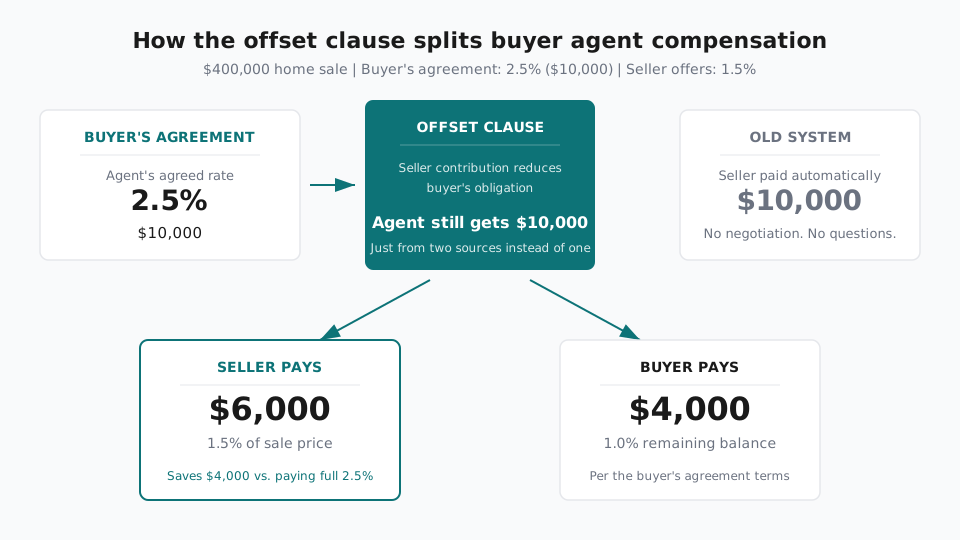
Most agreements also include an “offset clause.” That clause says if the seller pays the buyer’s agent commission, the buyer doesn’t have to pay it again on top. So the buyer’s obligation is reduced by whatever you contribute. This matters when we get to how it affects your negotiation.
The three types of agreements (and which one you’ll see most)
Not all buyer representation agreements are the same. There are three flavors.
Exclusive right to represent. The most common and the most restrictive. The buyer commits to one agent for a set period, and that agent gets paid no matter who finds the property. Even if the buyer finds a FSBO listing on Zillow by themselves, the agent is still owed the commission under this agreement. This is the one most buyer’s agents push.
Exclusive agency. Similar to above, but with a key difference: if the buyer finds a property on their own without the agent’s involvement, no commission is owed. This is a middle ground that protects the agent’s work while giving the buyer an out for self-sourced deals.
Non-exclusive (open). The buyer can work with multiple agents at the same time. Only the agent who actually finds the property the buyer purchases gets paid. This is the least common because agents don’t like it, but it’s the most buyer-friendly option.
There’s also a newer creature called a “touring agreement.” More on that in a minute, because it’s directly relevant to FSBO sellers.
Why this matters when you’re selling FSBO
Here’s the scenario. A buyer’s agent calls you to schedule a showing. The buyer has already signed a representation agreement with the agent, probably at 2.5%. The agent shows your house, the buyer loves it, and an offer comes in.
Somewhere in that offer, the agent’s commission shows up. Either as a line item requesting you pay 2.5%, or baked into a higher purchase price with a seller concession covering the agent’s fee. Either way, you’re being asked to pay for a contract you never signed.
You are not legally obligated to pay it. The buyer representation agreement is between the buyer and their agent. You are not a party to it. No law in any state requires a FSBO seller to pay a buyer’s agent commission. This was true before the settlement. It’s still true.
But refusing isn’t as simple as saying “not my problem.” If you refuse entirely, you may lose buyers whose agents won’t show your home. About 88% of buyers still work with agents. That’s NAR’s own data. If you want access to that buyer pool, you need a strategy for handling the commission conversation.
The complete breakdown of what to offer at each level covers the math. The short version: offer 0% in hot markets or when dealing with unrepresented buyers. Offer 1-2% in balanced markets where you want agents to bring their clients. And evaluate every offer on total net proceeds, not commission percentage.
The “offset clause” is your friend
Most buyer representation agreements include language saying the agent will first seek compensation from the seller, and the buyer is responsible only for any shortfall. This is the offset clause, and it changes the negotiation dynamic in your favor.
Say the buyer signed an agreement at 2.5% on a $400,000 home. That’s $10,000 the agent expects to earn. You offer to pay 1.5% ($6,000) as part of the deal. With the offset clause, the buyer owes the remaining 1% ($4,000) to their agent. The agent still gets their $10,000. You paid $6,000 instead of $10,000. The buyer paid $4,000 instead of $10,000.
Compare that to the old system where you’d pay the full 2.5-3% automatically through the MLS, no negotiation, no questions asked. The buyer representation agreement, for all its problems, actually gives you a mechanism to split the cost.
When a buyer’s agent pushes you to cover the full amount, ask: “Does your buyer’s agreement include an offset clause?” It almost certainly does. That question alone reframes the conversation from “you owe us 2.5%” to “let’s figure out who pays what.”
Touring agreements: the lightweight workaround
Some agents try to sidestep the full buyer representation agreement by using a “touring agreement.” This is a stripped-down version that covers only the showing itself. It’s typically limited to one day or one property, carries no exclusivity, and often specifies zero compensation.
Zillow created one. Several brokerages have their own versions. The idea is to let the agent and buyer walk through a house without committing to anything. The full compensation terms get negotiated later, once the buyer wants to make an offer.
Whether touring agreements actually comply with the NAR settlement is an open legal question. The settlement refers to “the agreement” in the singular, which some attorneys argue means one comprehensive document, not a two-step process. Legal academics have warned that touring agreements “may not abide by NAR settlement terms” because they let agents bypass the compensation disclosure requirement until the buyer is already emotionally committed to a property. Plaintiff attorneys from the original lawsuit are actively investigating.
For FSBO sellers, this matters because a buyer who shows up with only a touring agreement hasn’t locked in a commission number yet. The compensation conversation is still open. You might see a full buyer representation agreement appear later with a specific percentage, and at that point, the negotiation plays out the same way.
What the DOJ thinks about all this
The Department of Justice isn’t a fan of buyer representation agreements. In November 2024, two days before the settlement received final court approval, the DOJ filed a Statement of Interest calling the buyer agreement requirement something that “may harm buyers and limit how brokers compete for clients.” They compared it to “prior restrictions among competitors that courts have found to violate the antitrust laws.”
The DOJ recommended either eliminating the requirement entirely or clarifying that the settlement doesn’t give it antitrust immunity. The court approved the settlement anyway, buyer agreement requirement and all. But the DOJ reserved the right to take future enforcement action.
What does this mean for you? The buyer representation agreement might not be permanent. The DOJ has signaled it’s watching, and if the requirement ends up propping up commissions instead of creating competition, more lawsuits or regulatory action could follow. The full NAR settlement breakdown covers the DOJ’s ongoing involvement.
In the meantime, the agreements exist and you’ll encounter them. Treat them as a negotiation tool, not an obligation.
How to handle a buyer’s agent who brings a BRA to your door
When a buyer’s agent contacts you about a showing, expect the commission question early. Here’s the playbook.
If the agent asks “what commission are you offering?” on the first call: Defer. “I evaluate compensation as part of each written offer. Let’s get your buyer through the door first.” Don’t commit to a number before you’ve seen the offer’s full terms. Price, contingencies, timeline, and commission should all be on the table at once.
If the agent says “my client’s agreement says I earn 2.5%”: Acknowledge it without accepting it. “That’s between you and your client. I’m happy to discuss a contribution toward your compensation as part of a written offer. What purchase price is your client thinking?”
If the agent asks you to sign a separate compensation agreement before showing: Read it carefully, but you’re under no obligation to sign anything before seeing a written offer. If the agent insists, suggest including the compensation terms in the purchase agreement instead, where your real estate attorney can review everything in context.
If the agent refuses to show without a commission guarantee: That’s their choice. Remind them that their buyer is also welcome to contact you directly or attend an open house. Under the buyer representation agreement, the agent has a fiduciary duty to show their client homes the client wants to see. An agent who refuses to show your house because of commission is prioritizing their paycheck over their client’s interests.
The buyer’s agent guide has the complete script library for every variation of this conversation, plus the negotiation approach that landed me a 0.5% total commission on my last sale.
Open houses are your secret weapon
Here’s a detail most FSBO sellers miss: buyers do not need a signed buyer representation agreement to attend an open house. NAR’s own FAQ confirms this. The agreement requirement kicks in when an agent schedules a private showing or provides services beyond the open house.
This is a genuine advantage. An open house lets buyers see your home with no commission conversation attached. If a buyer walks through your open house and falls in love, they might decide to make an offer without involving an agent. Or they might bring their agent into the deal later, but at that point the buyer already knows they want the house. The agent’s leverage is lower when the buyer found the property themselves.
Hold open houses. Make them easy to attend. Post the times on Zillow, on your property website, on social media, and on a yard sign rider. Every buyer who walks through your door without an agent attached is a potential commission-free transaction.
The bottom line for FSBO sellers
The buyer representation agreement is a contract between the buyer and their agent. You didn’t sign it. You don’t owe anything under it. But you’ll be asked to contribute to it on nearly every deal where a buyer’s agent is involved.
Your job isn’t to refuse on principle. It’s to negotiate. Use the offset clause. Evaluate commission as part of the total offer, not in isolation. Know that the number on the buyer’s agreement is a starting point, not a fixed cost. And keep an eye on the DOJ, because the entire requirement might not survive the next round of antitrust scrutiny.
Your next move: read how to advertise your compensation offer off the MLS so agents know what to expect before they call. Then run the numbers through the savings calculator at different commission levels to see what each scenario does to your net proceeds. The math will tell you exactly how much flexibility you have.
Keep reading
Free FSBO purchase agreement template for Florida
Florida FSBO sellers can use the FAR/BAR contract for free -- here's how to get it, what each section means, and where sellers lose money.
Arizona FSBO disclosure requirements: what you must tell the buyer
Arizona sellers must disclose known material facts, deliver the SPDS fast, and handle HOA, well, septic, and lead paperwork correctly.
Free FSBO purchase agreement template for Texas
Texas FSBO sellers can use the TREC One to Four Family Residential Contract for free -- here's how to fill it out, what each section means, and where most sellers trip up.