
How to Price Your Home Without a Realtor: The FSBO CMA Guide
Pricing is the part of selling FSBO that makes people nervous. More than the paperwork, more than the negotiations, the question that keeps sellers up at night is: “What if I price it wrong?”
Here’s the thing. Real estate agents don’t have a magic formula for pricing your home. They have a process called a comparative market analysis — a CMA — and it takes about two hours to do yourself. You compare your home against similar homes that sold recently, adjust for differences, and land on a number. That’s it. That’s the entire secret behind the pricing “expertise” that agents charge 5-6% of your sale price to provide.
I priced my own home using this exact process. Our CMA took a Saturday morning, and the house sold within 3% of our asking price. The process I’m about to walk you through is the same one agents use. The only difference is you’re not paying someone a percentage of your home’s value to do it.
What a CMA is (and what it isn’t)
A comparative market analysis is exactly what it sounds like: you compare your home to similar properties that recently sold in your area, and use those sale prices to figure out what yours is worth.
It is not an appraisal. An appraisal is a formal valuation done by a licensed appraiser, usually ordered by a lender as part of the mortgage process. Appraisals cost $300 to $500 and involve a physical inspection. You don’t need one to set your listing price. The buyer’s lender will order one later.
A CMA is a research project. You’re gathering data, making reasonable adjustments, and arriving at a price range. Agents do this constantly. There is nothing about it that requires a real estate license.
Find your comparable sales
The entire CMA depends on finding good comps. A “comp” is a recently sold home that’s similar enough to yours that its sale price tells you something useful about what your home is worth.
Here’s where to find them.
Zillow’s “Recently Sold” filter. Go to Zillow, search your address, then click “Recently Sold” on the map. You’ll see every home that’s closed in your area with the sale price, date, square footage, and photos. This is your primary research tool.
Redfin. Same concept, slightly different data presentation. Redfin tends to have more detailed property histories and sometimes catches sales that Zillow misses.
Realtor.com. Another solid source. Cross-referencing across all three sites helps you catch any gaps.
Your county assessor’s website. Every county maintains public records of property transfers. The data is less user-friendly than Zillow, but it’s the most authoritative source. Search “[your county] property records” or “[your county] assessor” to find it.
Not every recently sold home is a good comp. You’re looking for properties that match yours on five criteria:
- Sold within the past 6 months. Three months is even better. Real estate markets move fast, and a sale from a year ago may not reflect current conditions.
- Within 1 mile of your home. Same neighborhood is ideal. A house across town in a different school district isn’t a useful comparison even if the square footage matches.
- Similar size. Within about 200 square feet of your home. A 1,200-square-foot ranch and a 2,400-square-foot colonial aren’t comparable no matter how close they are.
- Same style. Ranch to ranch, two-story to two-story. Different home styles sell at different price points even at the same square footage.
- Same school district. School districts drive home values more than almost any other single factor. A comp in a different district can throw off your entire analysis.
Find at least three comps that hit all five criteria. Five is better. If you can’t find three within a mile, expand to two miles, but note that you’re loosening your criteria and the data gets less reliable the wider you go.
Build your CMA spreadsheet
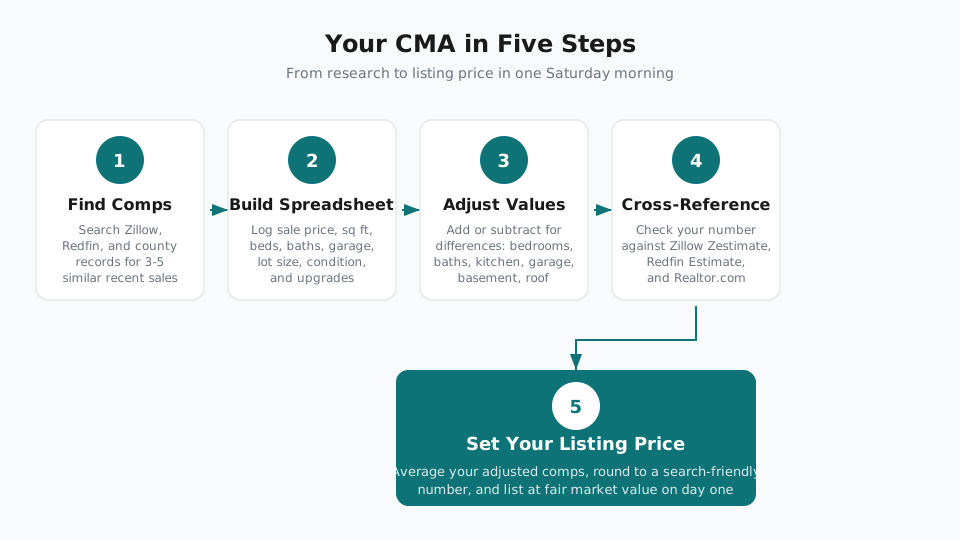
Open a spreadsheet — Google Sheets, Excel, whatever you’ve got — and create columns for each comp:
- Address
- Sale price
- Sale date
- Square footage
- Bedrooms
- Bathrooms
- Garage (number of bays)
- Lot size
- Condition (updated, original, renovated)
- Major upgrades (new roof, remodeled kitchen, finished basement)
Fill in the data for each comp. Most of this information is on Zillow’s listing page for the sold property. For anything Zillow doesn’t show, check the county assessor’s records.
Then add a row for your own home with the same data points. Leave the sale price blank. That’s what you’re solving for.
Here’s an example. Say you’re pricing a 3-bedroom, 2-bath ranch with a 2-car garage, 1,400 square feet, updated kitchen, on a quarter-acre lot:
| Comp 1 | Comp 2 | Comp 3 | Your Home | |
|---|---|---|---|---|
| Sale price | $385,000 | $395,000 | $378,000 | ? |
| Sq ft | 1,350 | 1,500 | 1,380 | 1,400 |
| Beds/Baths | 3/2 | 3/2 | 3/1.5 | 3/2 |
| Garage | 2-car | 2-car | 1-car | 2-car |
| Lot | 0.25 ac | 0.30 ac | 0.20 ac | 0.25 ac |
| Kitchen | Original | Updated | Original | Updated |
With the raw data in front of you, the story starts to tell itself. But these homes aren’t identical to yours. That’s where adjustments come in.
Adjust for differences
No two homes are exactly the same. The point of adjustments is to answer one question: if this comp were identical to my home, what would it have sold for?
If a comp has something your home doesn’t, you adjust its sale price down. If your home has something the comp doesn’t, you adjust the comp’s price up. You’re always adjusting the comp to match your home, not the other way around.
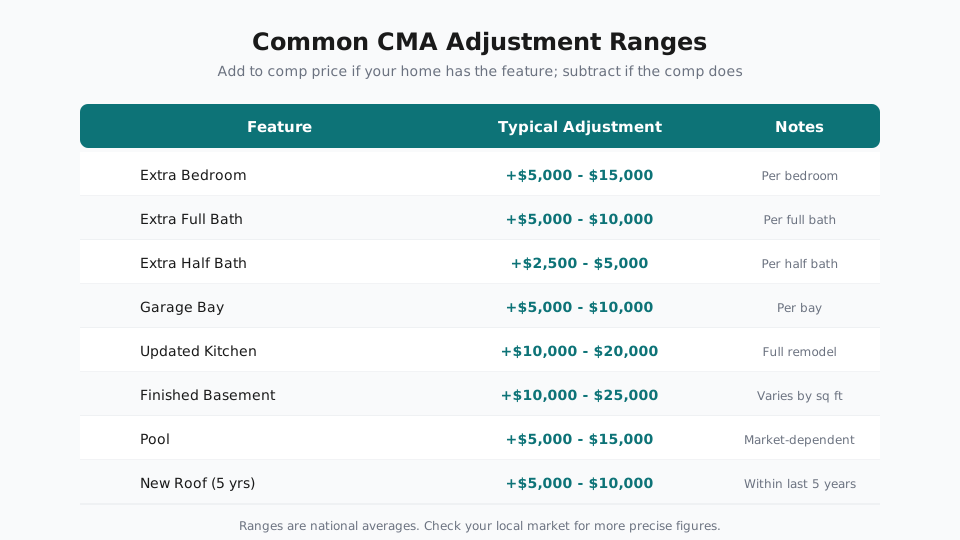
Here are typical adjustment ranges. These vary by market, but they give you a reasonable starting point:
- Extra bedroom: $5,000 to $15,000
- Extra full bathroom: $5,000 to $10,000
- Extra half bathroom: $2,500 to $5,000
- Garage bay: $5,000 to $10,000
- Updated kitchen: $10,000 to $20,000
- Finished basement: $10,000 to $25,000
- Pool: $5,000 to $15,000 (highly market-dependent)
- New roof (within 5 years): $5,000 to $10,000
Let’s apply this to the example. Comp 3 sold for $378,000 but only has 1.5 bathrooms and a 1-car garage compared to your 2 full baths and 2-car garage. And the kitchen is original while yours is updated.
Adjustments for Comp 3:
- Half bath to full bath: +$5,000
- 1-car to 2-car garage: +$7,500
- Original to updated kitchen: +$15,000
- Adjusted price: $405,500
Run the same exercise for every comp. When you’re done, you’ll have an adjusted sale price for each one that represents what that home would have sold for if it were identical to yours.
Using the example:
- Comp 1 (original kitchen, yours is updated): $385,000 + $15,000 = $400,000
- Comp 2 (100 sq ft larger, slightly bigger lot): $395,000 - $5,000 = $390,000
- Comp 3 (adjusted above): $405,500
Average those adjusted values: ($400,000 + $390,000 + $405,500) / 3 = $398,500
That’s your CMA-derived price. You now have a data-backed number instead of a guess.
Cross-reference with free valuation tools
Your CMA is your primary pricing tool. But spend 10 minutes checking your number against a few free online estimates. Not because they’re more accurate — they’re not — but because buyers will check these tools, and you should know what they’re seeing.
Zillow Zestimate. Zillow’s automated valuation model updates regularly based on public data and user submissions. The national median error rate sits around 2%, but it can be much higher in areas with fewer recent sales. If your CMA says $398,000 and the Zestimate says $385,000, that’s worth investigating. Maybe there’s a comp you missed, or maybe the algorithm doesn’t know about your kitchen renovation.
Redfin Estimate. Similar concept, different algorithm. Redfin claims a slightly lower error rate than Zillow in some markets. Check both.
Realtor.com “My Home.” Create a free account and claim your property to see their valuation. It also shows data on nearby active listings, which helps you size up your competition.
None of these tools should override your CMA. They don’t know your home’s condition, the quality of your upgrades, or whether your backyard faces a park or a highway. But if your CMA and all three tools land within 3-5% of each other, your number is solid. If there’s a big gap, dig into why before you list.
Price per square foot: useful but limited
You’ll see “price per square foot” thrown around constantly in real estate conversations. Divide the sale price by the home’s square footage: a 1,500-square-foot home that sold for $375,000 works out to $250 per square foot.
It’s a decent sanity check. If similar homes in your neighborhood are selling between $240 and $260 per square foot and your CMA puts you at $285, something might be off.
But don’t price your home based on price per square foot alone. A gut-renovated home and an identical floor plan with 1985 finishes have the same square footage and wildly different values. A home on a half-acre lot is worth more than the same house on a tenth of an acre. Price per square foot doesn’t see any of that.
Use it as one data point alongside your CMA. Not instead of it.
Set your listing price strategically
You’ve done the analysis. Your adjusted comp average says roughly $398,500. Now you need to turn that into a listing price, and a little strategy goes a long way.
Round to a search-friendly number. Most buyers search in round-number increments: under $400,000, under $350,000, under $500,000. If your CMA says $398,500, listing at $399,900 keeps you in the “under $400K” search results. Listing at $405,000 means every buyer filtering at $400,000 never sees your home. That one decision can cost you a meaningful chunk of your buyer pool.
Don’t overprice “to leave room for negotiation.” This is the most common pricing mistake FSBO sellers make. The logic sounds reasonable — list high so you have room to come down. In practice, it backfires badly. Overpriced homes sit on the market. Homes that sit get stigmatized. Buyers and their agents start wondering what’s wrong with it. After 30 days, you’ll end up cutting your price below where you should have listed in the first place.
The first two weeks your home is on the market are the highest-traffic period. Price it right from day one and capitalize on that initial surge of interest. You will get more showings, more competition, and a better final price by listing at fair market value than by listing 5% high and waiting.
Watch your active competition. Check what’s currently listed in your area at your price point. If three similar homes are sitting unsold at $410,000, that tells you something about where the ceiling is. Your CMA tells you what homes have actually sold for. Active listings tell you what homes are failing to sell for. Both matter.
When your CMA and your gut disagree
Sometimes the numbers say one thing and your instinct says another. Maybe your CMA says $395,000 but you “feel” the house is worth $420,000 because of the new deck, the location, or the 15 years of memories in that kitchen.
Trust the CMA. Your emotional attachment to your home is real, but buyers don’t share it. They’re comparing your home against every other option on the market, and they’re making decisions based on the same data you used. If the comps say $395,000, that’s what the market will pay.
The one exception: if you have a feature that genuinely has no comparable in your comp set — say you’re the only home in the neighborhood with a legal accessory dwelling unit or a detached workshop — you may be justified in pricing above your comps. But be honest about whether the feature actually adds market value or just adds personal value. A $40,000 custom wine cellar doesn’t add $40,000 to your home’s resale price.
Your CMA is done, your price is set, and you’ve got a number backed by data instead of guesswork. That’s more than most agents hand their clients — they just don’t show you the spreadsheet.
If you want to understand the theory behind what you just did, what is a comparative market analysis covers the concept and how it compares to a formal appraisal. To see exactly how much you’ll save at your price point, run the numbers through the FSBO savings calculator.
If you haven’t picked your real estate attorney yet, that’s a good next step. And for the full walkthrough of every stage of selling FSBO, the complete guide has you covered.
Keep reading

How to Handle Offers and Negotiate as a FSBO Seller
Offers are where your FSBO savings are won or lost. Here's how to evaluate what an offer is really worth, work with buyer's agents, and negotiate commissions on your terms.
Free FSBO purchase agreement template for Arizona
Arizona FSBO sellers can use the AAR Residential Resale Purchase Contract or a free alternative -- here's how the contract works, what the BINSR process means, and where sellers trip up.

Selling FSBO after the NAR settlement: what changed in 2024 and 2025
The NAR commission lawsuit settlement eliminated mandatory buyer-agent fees on the MLS and gave FSBO sellers real negotiating power. Here's what actually changed and what it means for your sale.