How to Create a FSBO Listing That Attracts Serious Buyers
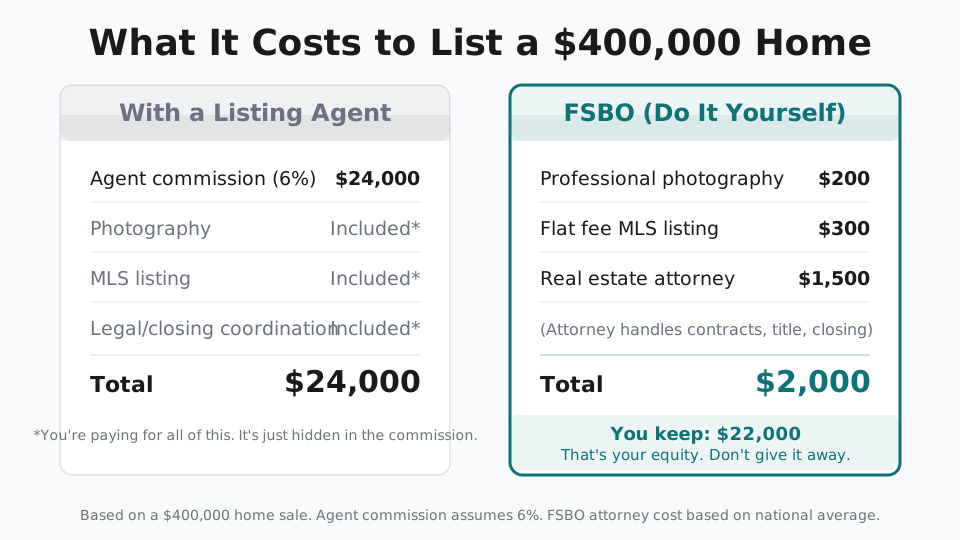
When you sell FSBO, your listing does the job you’d otherwise pay an agent $24,000 to do. The photos, the description, the platform you choose, the day you go live — that’s your entire marketing strategy. And unlike an agent who’d charge you 5-6% of your sale price for the privilege, you can put together a listing that’s just as professional for about $2,000.
The difference between a FSBO listing that attracts serious buyers and one that sits for weeks isn’t luck. It’s preparation.
Your listing is your agent
Think about what a listing agent actually does for their commission. They hire a photographer (or pull out their phone), write a description, put your home on the MLS, hold a few open houses, and field calls. On a $400,000 home, that package costs you $12,000 to $24,000 in commission depending on whether you’re paying one side or both.
Every one of those tasks is something you can handle yourself. The ones you shouldn’t do yourself, like photography, you can hire out for a fraction of the cost. The total bill for doing all of it? Roughly $2,000. That leaves over $20,000 in your pocket that would have gone to commissions. For a detailed breakdown of how those commissions actually work and who benefits from the structure, I’ve written about that separately.
Here’s exactly how to build a listing that competes with any agent-listed home on the market.
Prepare your home before the camera shows up
Before you hire a photographer, your house needs to be ready. Not perfect. Ready. That means decluttered, clean, and free of obvious problems that’ll distract buyers or show up on inspection.
Start room by room. Remove personal items — family photos, kids’ drawings on the fridge, the collection of mugs from every national park you’ve visited. Buyers need to picture themselves in the space, not you.
Fix the small stuff. If your kitchen faucet leaks, fix it. If a door doesn’t close right, fix it. If the garbage disposal sounds like it’s chewing gravel, fix it. These are $20 to $50 repairs that will cost you thousands if they show up on a buyer’s inspection report and get used to negotiate your price down.
Declutter counters, closets (buyers open them), and the garage. Move excess furniture out. A room with less stuff in it looks bigger. Bigger sells.
Don’t overthink the staging. You’re not trying to make your home look like a magazine. Just make sure every room has a clear purpose and looks clean. An empty room photographs better than a cluttered one, but a room with a few well-placed pieces of furniture gives buyers a sense of scale.
Hire a real estate photographer
This is not optional. I don’t care how good your phone camera is.
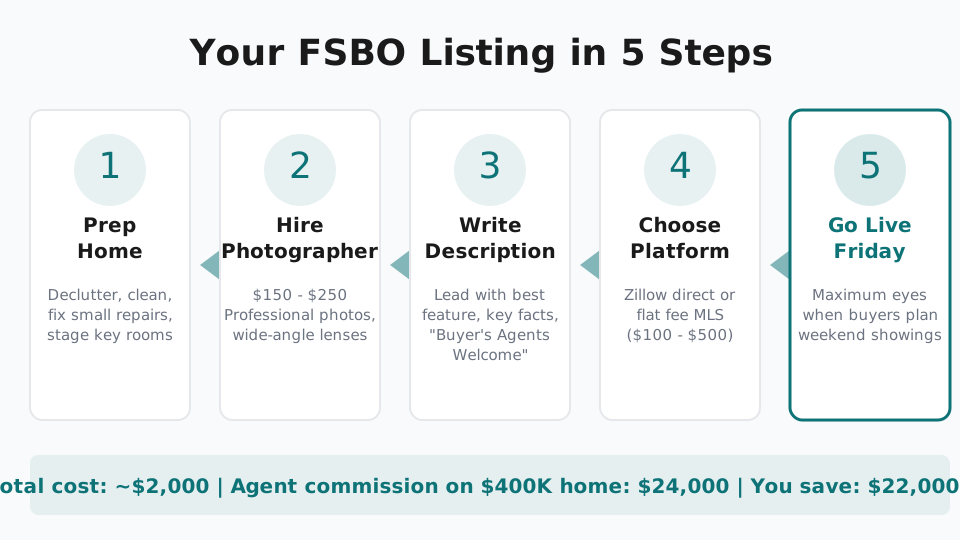
Professional real estate photographers cost between $150 and $250. They bring wide-angle lenses, proper lighting equipment, and they know how to make a 1,200-square-foot living room look like a living room instead of a closet. The last house I sold, I paid $200 for a photographer. She spent 90 minutes in the house and delivered 45 edited photos by the next morning.
Those photos got me 11 showings in the first weekend.
That $200 is a rounding error compared to the $12,000 to $24,000 you’d spend on agent commissions for a $400,000 house. Don’t try to save money by doing this yourself. You’re already keeping tens of thousands of dollars by not hiring a listing agent. The $200 you spend on professional photography is the highest-return investment in your entire listing.
Once you have the photos, organize them the way a buyer would walk through your home. Start with the exterior front shot. Then the front door and foyer. Kitchen and main living area come next — these are the rooms that sell houses. After that: master suite, the rest of the bedrooms, any offices or bonus rooms, basement, garage, and backyard.
You don’t need 50 photos. Pick the best 25 to 35 that highlight the main features of each room. One or two great shots per room beats five mediocre ones.
Make sure your photography package includes a license for personal use. You’ll be posting these on Zillow, potentially the MLS, and social media. Some photographers charge extra for commercial licensing, so confirm that upfront before you book.
Get your listing on Zillow (and the MLS)
Zillow gets over 230 million monthly visits. When a buyer starts shopping for a home, there’s a very good chance they’re starting there. Your listing needs to be on Zillow.
You have two paths to get there.
Post directly on Zillow. In some markets, Zillow lets you create a FSBO listing for free. Go to zillow.com, click “Sell,” and look for the FSBO option. If it’s available in your area, this is the simplest and cheapest route. I wrote a full step-by-step walkthrough for posting on Zillow if you want the details.
Use a flat fee MLS service. If Zillow doesn’t support direct FSBO posting in your market, a flat fee MLS service is your next best option. These services put your home on your local Multiple Listing Service for $100 to $500, one-time fee. Once it’s on the MLS, your listing automatically syndicates to Zillow, Realtor.com, Redfin, and every other major search site.
Not all flat fee services are worth your money. Before you hand over your credit card, ask these four questions:
- Are there cancellation fees if I want to take my listing down?
- Can I review and edit my listing before it goes live on the MLS?
- Will buyer leads come directly to me, or will they be routed through your agents first?
- Are there any fees beyond the flat rate?
A good flat fee service is one of the best deals in real estate. A bad one will waste your time and try to upsell you into full-service representation you don’t need. Spend 20 minutes reading reviews before you commit.
My recommendation: if your area lets you post directly on Zillow, skip the flat fee service and save the money. If the only way to get on Zillow is through MLS syndication, a flat fee listing is worth every penny. Flat fee MLS services vary significantly by state, so we’ll be publishing state-by-state reviews of the best options in the coming months.
Write a description that does its job
Your listing description doesn’t need to be literary. It needs to tell buyers what makes your home worth seeing, give them the key facts, and make them want to schedule a showing.
Lead with your strongest feature. Brand-new kitchen? First sentence. Half-acre lot in a neighborhood of quarter-acre lots? First sentence. Don’t bury the good stuff under generic filler about “charming” this and “desirable” that.
Include the basics: bedrooms, bathrooms, square footage, lot size, year built, recent upgrades, school district. Buyers are scanning dozens of listings at a time. Give them the information fast so they can decide if yours is worth a closer look.
Here’s a tip that a lot of FSBO sellers miss: add the line “Buyer’s Agents Welcome” somewhere in your description. About 86% of buyers work with an agent. If those agents think you’ll be difficult to work with or won’t cooperate on their commission, they may steer their clients toward other listings. That one line signals you’re a professional seller who’s easy to do business with. It doesn’t commit you to any specific commission percentage. It just opens the door.
List on a Friday
Friday. That’s your day.
Buyers browse listings during the week and schedule showings for the weekend. If your listing goes live on a Friday morning, it hits the market fresh right when buyers are making their weekend plans. Maximum eyes at the exact moment people are deciding which houses to visit Saturday and Sunday.
List on a Monday and your listing is five days old by the weekend. It’s buried under newer listings. You lose the urgency that comes with being the new listing on the block.
Have everything ready — photos uploaded, description written, price set — so you can publish Friday morning and be ready for calls by Friday afternoon.
Be ready when the calls come
Your listing is live. Now the real work starts.
When inquiries come in, respond within the hour. Buyers and their agents are reaching out to multiple sellers at once. The seller who responds first gets the showing. Wait until the next day and they’ve already booked someone else’s house for the weekend.
Buy a lockbox for your front door. They run $20 to $40 at any hardware store. When a buyer’s agent schedules a showing, you give them the lockbox code, leave the house, and let them do their thing. You should not be there during showings. It makes buyers uncomfortable and less likely to talk openly with their agent about what they like.
If you’re not comfortable putting your personal cell phone number on the internet, set up a Google Voice number. It’s free, it forwards calls to your phone, and it gives you a layer of privacy. Turn it off when the house sells.
The first two weeks after your listing goes live are the highest-traffic period. Don’t waste them. Keep the house clean, keep your schedule flexible, and treat every showing like it could be the one.
Your listing is built, it’s live, and buyers are calling. The next step is knowing what to do when offers come in — how to evaluate them, how to work with buyer’s agents, and how to negotiate without giving away your equity. That’s where the real money gets made or lost.
For the full process from start to finish, the complete FSBO guide walks through every step.
Keep reading
Selling FSBO after the NAR settlement: what changed in 2024 and 2025
The NAR commission lawsuit settlement eliminated mandatory buyer-agent fees on the MLS and gave FSBO sellers real negotiating power. Here's what actually changed and what it means for your sale.
Free FSBO purchase agreement template for California
California FSBO sellers have several contract options beyond the CAR RPA -- here's which form to use, what each section means, and the disclosure traps that sink deals.
Free FSBO purchase agreement template for Ohio
Ohio FSBO sellers don't need a Realtor's form to write a valid purchase contract -- here's which forms to use, what each section covers, and the regional quirks that trip sellers up.