Counteroffer tactics for FSBO sellers
A counteroffer is your written response to a buyer’s offer that changes one or more terms. You don’t accept what they proposed, and you don’t reject it. You send back your own version with different numbers, different conditions, or both. Legally, a counteroffer voids the original offer entirely and starts a new negotiation.
Most homes don’t sell on the first offer. Almost every transaction involves at least one counteroffer. The difference between a good counteroffer and a bad one can be $5,000, $15,000, or more in your pocket. And as a FSBO seller, nobody is going to write this for you. Your real estate attorney will review it, but the strategy is yours.
Know your floor before you start
Before you write a single word of a counteroffer, you need two numbers locked in your head.
Your net proceeds floor. This is the minimum amount you’ll walk away with after paying off the mortgage, closing costs, and any buyer-agent commission you’ve agreed to. Not the sale price. The money that actually hits your bank account. If you haven’t done this math, you’re negotiating blind.
Your walk-away price. This is the lowest offer you’d accept rather than keep the house on the market. It should factor in your carrying costs (mortgage payments, insurance, taxes, utilities) for however many more months you’re willing to wait. If keeping the house listed for three more months costs you $6,000 in carrying costs, an offer that’s $4,000 below your target might actually be the smart move.
Write both numbers down before any offer arrives. When you’re staring at a real offer from a real buyer, emotions cloud the math. Having your floor on paper keeps you grounded.
Already covered the basics? If you haven’t read how to handle offers and negotiate as a FSBO seller, start there. That post covers evaluating offers, reading contingencies, and comparing net proceeds. This article picks up where that one leaves off: you’ve evaluated the offer, it’s not good enough, and now you need to counter.
The anatomy of a good counteroffer
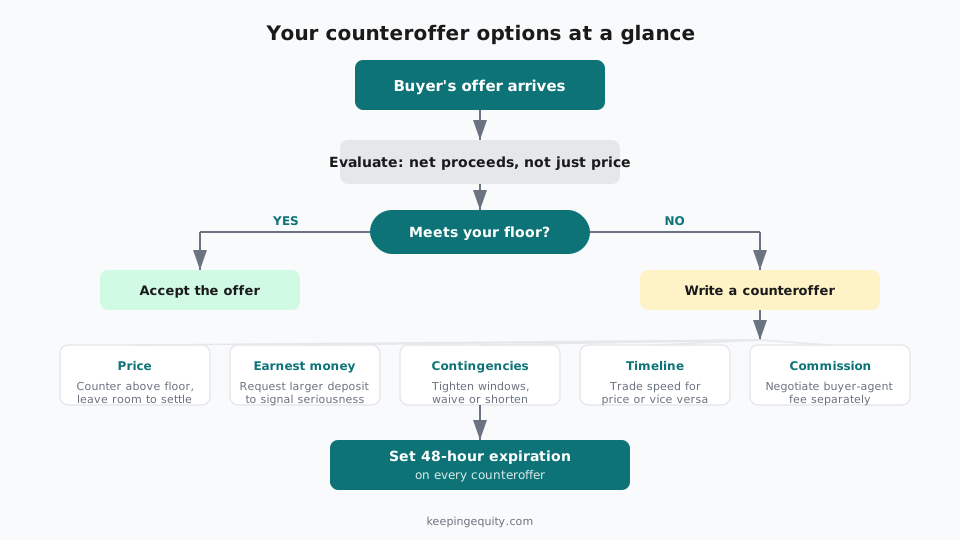
A counteroffer isn’t just “I want more money.” The best counteroffers adjust multiple terms at once to create a package that works for both sides. Here’s what you can change:
Price. The obvious one. But don’t just split the difference between asking and offering. Counter at a number that’s close to your target but leaves a small margin for one more round. If your house is listed at $415,000, a buyer offers $395,000, and your floor is $405,000, counter at $412,000. That gives you room to settle around $407,000 to $410,000 without hitting your floor.
Earnest money. Ask for a larger deposit. A buyer who puts down $8,000 instead of $3,000 is more committed to closing. It also signals that you’re serious and sets the tone for the rest of the negotiation.
Contingencies. You can ask the buyer to waive or tighten contingencies. An inspection contingency with a 7-day window is much better for you than a 14-day window. A buyer willing to waive the appraisal contingency (common with strong financing) reduces your risk of the deal falling apart.
Closing timeline. If you need a faster close, ask for it. If the buyer needs extra time, you can grant it in exchange for a higher price or fewer contingencies. Time is a bargaining chip.
Closing cost credits. Instead of dropping your price by $5,000, you could offer a $5,000 credit toward the buyer’s closing costs. You net the same amount, but the buyer’s mortgage is based on the higher purchase price, which can help with appraisal issues. Your attorney can explain the mechanics.
Buyer-agent commission. Since the NAR settlement, this is a separate negotiation. If a buyer’s agent asks you to cover their 2.5% fee, you can counter with 1.5%, or offer a flat dollar amount instead of a percentage. You can also fold it into the overall deal: “I’ll contribute $6,000 toward your agent’s fee if we agree on $410,000.” Read do sellers have to pay the buyer’s agent? for the full breakdown of what you’re actually obligated to pay (nothing) versus what the market expects.
Five counteroffer scripts you can actually use
Knowing the theory is one thing. Putting it in writing is another. Here are five real-world scenarios with language you can adapt. Your attorney should review any counteroffer before you send it, but these give you a starting framework.
1. The offer is low but the buyer is qualified
The buyer came in 5-8% below asking with strong pre-approval and reasonable contingencies. They’re testing you.
Your move: Counter close to asking. Don’t meet in the middle. The “split the difference” trap is the oldest buyer trick in real estate. If you listed at $415,000 and they offered $390,000, the buyer is hoping you’ll counter at $402,500 so they can “split it again” and land at $396,000. Instead, counter at $412,000 and hold.
Language: “Thank you for your offer. We’ve reviewed it carefully and are countering at $412,000. This price reflects recent comparable sales in the neighborhood, including [address] which sold for $418,000 in [month] with similar square footage and lot size. We’re including [list anything you’re leaving: appliances, window treatments]. We’d like a response within 48 hours.”
Include your CMA data. Attaching two or three comps that justify your price turns the counteroffer from “I want more” into “the market says this is fair.” If you need a refresher on pulling comps, check out how to price your home without a realtor.
2. The offer is fair on price but loaded with contingencies
The price is acceptable, but the buyer wants a 14-day inspection window, a financing contingency, an appraisal contingency, and a home sale contingency (their offer depends on selling their current home first). That’s four opportunities for the deal to collapse.
Your move: Accept the price but tighten the contingencies. Shorten the inspection window. Remove the home sale contingency entirely, or add a kick-out clause that lets you keep the house on the market and accept other offers.
Language: “We’re pleased with the proposed purchase price of $405,000. We’d like to adjust the following terms: inspection contingency shortened to 7 days from the effective date, home sale contingency removed (or replaced with a 72-hour kick-out clause), and closing moved to [specific date]. All other terms as proposed. Please respond by [date/time].“
3. The buyer’s agent is pushing you to cover their fee
A buyer’s agent submits an offer and includes a request for you to pay 2.5% of the sale price as their commission. On a $400,000 sale, that’s $10,000 out of your pocket.
Your move: You have three options. Offer a reduced amount, offer a flat fee, or counter with zero and let the buyer decide if they want to pay their own agent or negotiate the agent’s rate down. Since the NAR settlement eliminated the MLS compensation field, there’s no market expectation that you’ll pay the full 2.5%.
Language: “We’re willing to contribute $4,000 toward the buyer’s agent compensation as part of the overall transaction. This is reflected in our counteroffer price of $408,000. Alternatively, we’re prepared to accept $400,000 with zero seller contribution toward buyer-agent fees.” Give the buyer two clear paths and let them pick.
This approach works because it frames the commission as part of the total cost, not a separate obligation. The buyer and their agent can see the math and decide where they want the money to go. For context on how buyer representation agreements work and what agents are actually entitled to, read that before you sit down at the table.
4. You have multiple offers
Two or more buyers want your house. This is where FSBO sellers often leave money on the table by accepting the first good offer instead of using competition to their advantage.
Your move: Let all buyers know you’ve received multiple offers (don’t share details of competing offers) and set a “best and final” deadline. This is not a sketchy tactic. NAR’s own guidelines for agents in multiple-offer situations describe exactly this process.
Language: “We’ve received multiple offers on the property. We’d like to give all interested buyers an opportunity to submit their best and final offer by [date] at [time]. Please include your highest purchase price, preferred contingencies, and proposed closing timeline. We will make a decision within 24 hours of the deadline.”
Set the deadline 48 to 72 hours out. That’s enough time for buyers to talk to their lenders and come back strong, but not enough time for the excitement to fade.
5. The lowball offer
Someone offers 15%+ below asking. Maybe they’re an investor. Maybe they’re testing every house in the neighborhood. Maybe their agent told them “you never know.”
Your move: Decide if they’re worth your time. If the offer is below your walk-away number by a wide margin, you have two choices: counter at or near full price to signal you’re not negotiating from weakness, or simply reject it.
Language (if countering): “We appreciate the offer. Based on recent comparable sales and the condition of the property, we’re countering at $413,000. We believe this reflects fair market value and would welcome a revised offer closer to this range.”
Language (if rejecting): “Thank you for your interest. We’ve decided not to counter at this time. If your buyer’s budget increases, we’d be happy to review a new offer.” Short, professional, done.
The 48-hour rule
Every counteroffer should include an expiration. Forty-eight hours is the sweet spot. Here’s why.
Too short (24 hours) and you pressure a buyer into saying no. They may need to run numbers with their lender, talk to a spouse, or sleep on it. Rushing them creates resentment and kills deals.
Too long (a week) and you lose momentum. The buyer tours other houses. Their excitement fades. Their agent starts showing them alternatives. In real estate, time kills deals faster than bad numbers.
Forty-eight hours gives the buyer time to think without giving them time to wander. It also protects you: while your counteroffer is outstanding, you’re legally tied to it. If the buyer accepts your counter in writing before the deadline, you have a binding contract whether you’ve changed your mind or not.
What to do when they counter your counter
Most negotiations involve two to three rounds. Here’s how to handle each stage without spiraling.
Round one (their offer, your counter): You’ve seen what they want. You’ve sent back what you want. The gap is visible.
Round two (their counter to your counter): This is where most deals either come together or fall apart. Look at how far they moved. If they came up significantly, they’re negotiating in good faith. If they barely budged, they may be anchored to their original number and hoping you’ll cave.
Round three (final round): If you’re still apart, it’s time for the “take it or leave it” offer. Be honest. “This is our final number. We’re at $408,000 and we’re comfortable keeping the house on the market if this doesn’t work.” Mean it. If you bluff and they walk, you’ve lost a buyer. If you mean it and they walk, you’ve held your floor.
After three rounds, stop. Extended back-and-forth signals desperation and gives the buyer leverage. Either close the gap or move on.
Don’t negotiate against yourself
This is the most common mistake FSBO sellers make, and it’s easy to do when you’re emotionally invested in the sale. Here’s what it looks like.
You counter at $410,000. The buyer doesn’t respond for a day. You panic. You call their agent and say, “Would they do $407,000?” You just dropped your own price without the buyer even asking. That’s negotiating against yourself.
Once your counteroffer is out, be quiet. The silence is uncomfortable. Sit with it. If the deadline passes and you hear nothing, the buyer wasn’t serious. If they come back with a lower number, you respond from your last position, not from whatever anxious number you were rehearsing in your head.
Your attorney can be a useful buffer here. Let the buyer’s agent call your attorney’s office instead of your cell phone. It adds a layer of professionalism and prevents you from saying something in the moment that costs you money.
Commission as a negotiation lever
The post-NAR world gives FSBO sellers a negotiation tool that didn’t exist before August 2024. Since buyer-agent compensation is no longer advertised on the MLS, you can use your willingness to contribute toward that fee as a bargaining chip.
Here’s an example. A buyer offers $400,000 and asks you to pay their agent’s 2.5% ($10,000). Your net on that deal: $390,000 minus closing costs.
Instead of arguing about the commission, fold it into a package counteroffer: “We’ll accept $395,000 with a $5,000 seller contribution toward buyer-agent compensation.” Your net: $390,000 minus closing costs. Same money in your pocket. But the buyer sees a lower purchase price (better for their monthly payment), and their agent still gets paid something. Everyone can say they won.
If the buyer is unrepresented, you skip this entire dimension of the negotiation. Zero commission on both sides. That’s the cleanest deal you can close as a FSBO seller.
Get your attorney involved early
I’ve said it throughout this article and I’ll say it one more time. Your real estate attorney should review every counteroffer before you send it. Not after. Before.
An attorney catches things you’ll miss: ambiguous language that could let the buyer wiggle out, missing deadlines, contingency terms that favor the buyer more than they appear to at first glance. At $500 to $1,500 for the entire transaction, the attorney is the cheapest insurance you’ll buy in this process.
Now that you’ve got your counteroffer strategy locked in, the next step is understanding what happens when the buyer says yes and the deal goes under contract. That’s when inspections, appraisals, and the closing process take over. Knowing what’s coming keeps you in control all the way to the closing table.
Keep reading
Free FSBO purchase agreement template for Michigan
Michigan FSBO sellers can use a free purchase agreement template, but the contract only works if you attach the right disclosures and get an attorney to review it.

How to handle unrepresented buyers when selling FSBO
More buyers are ditching agents after the NAR settlement. Here's how to sell your home directly to an unrepresented buyer, what paperwork you need, and why this is the best deal a FSBO seller can get.
How to Create a FSBO Listing That Attracts Serious Buyers
Your listing does the job you'd otherwise pay an agent $24,000 for. Here's exactly how to get the photography, description, platform, and timing right.