
Selling a House FSBO During Divorce: Legal Considerations
An FSBO sale during divorce may be possible, but only if the applicable law, title, and court orders allow the transaction. Selling without a listing agent is not a shortcut around those requirements. Before advertising the home, establish who has authority to sign, who can make pricing and repair decisions, how proceeds will be handled, and what the court order or written agreement requires. State law and the facts of the case matter, so use this as a planning framework—not legal or tax advice.
The goal is a sale process both spouses can follow and a closing professional can document. If either spouse is uncertain about the agreement, title, mortgage, or disclosure duties, pause and get advice from a divorce attorney and a local real-estate attorney before the listing goes live.
1. Start with ownership, debt, and authority
Pull the deed, the latest mortgage statement, any home-equity loan information, and the current divorce filings or order. Then answer the unglamorous questions in writing:
- Whose names are on title?
- Whose names are on the mortgage or other liens?
- Does a temporary order restrict a sale, occupancy, spending, or contact with buyers?
- Does one spouse have authority to sign, or must both approve every material step?
- Where will sale proceeds be held and who decides how they are distributed?
Do not assume a person who can show the house can also bind the sale. A title company or closing attorney can flag title requirements, but your divorce counsel should interpret the court order and settlement terms.
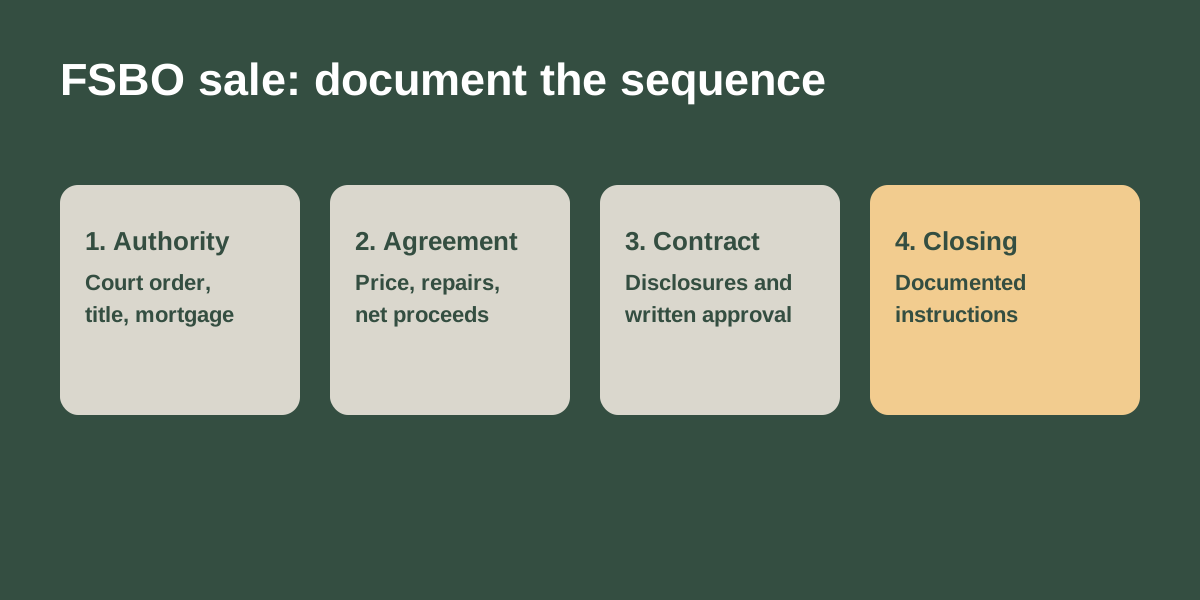
2. Put the sale rules into a written operating agreement
Even cooperative spouses benefit from a short written process. Decide how you will choose a price, approve repairs, accept a buyer, respond to inspection requests, and communicate with the title company. Include a time limit for responses so a buyer is not left waiting while the sellers disagree.
An FSBO sale still needs the same disciplined numbers as an agent-assisted sale. Build a conservative seller closing-cost estimate, decide who pays each item, and update it when the contract changes. This keeps a good offer from becoming an argument because the net proceeds were never discussed.
3. Treat disclosures and contracts as high-stakes paperwork
“For sale by owner” does not mean “informal.” Local disclosure rules can be strict, especially for known property conditions. Use the documents required where the property sits, retain copies of communications and repair records, and have a local professional review the purchase contract before signatures.
Our FSBO closing checklist can help organize the work. It does not replace local legal advice, and it should be used alongside—not instead of—the instructions in the divorce case.
Protect the practical side of showings and communication
Decide who is allowed to enter the home, who holds keys or lockbox codes, how buyers and agents will contact the sellers, and how you will communicate without putting children or other family members in the middle. A shared written log for showings, offers, repair requests, and deadlines can reduce confusion. It is also useful evidence of what each seller approved.
If the home is still occupied by one spouse, agree on notice, personal-property boundaries, and photo or video rules before a photographer or buyer comes through. Those decisions are small compared with the division of the proceeds, but leaving them unwritten can derail the sale at exactly the wrong moment.
4. Do not leave tax issues until closing week
Separate a transfer between spouses from a sale to a buyer. IRS Publication 504 generally provides nonrecognition for transfers to a spouse, or to a former spouse when incident to divorce. It also lists exceptions, including a nonresident-alien recipient and certain trust transfers. “Incident to divorce” has timing and relationship rules; a divorce label alone is not enough. A later sale to a third party is a separate tax event.
Publication 523 explains the home-sale exclusion and its ownership, residence, and prior-sale tests. The usual full-exclusion test includes owning and using the home as a main home for at least two years within the five years before sale. Divorce-specific rules can matter: transferred ownership periods may count, and a sole or joint owner may count residence use by a spouse or former spouse who lives there under a qualifying divorce or separation instrument. Neither rule promises that every spouse qualifies for a full exclusion; the publication also describes possible partial exclusions.
Before agreeing to the sale, have a tax professional review basis, title-transfer history, occupancy dates, prior exclusions, filing status, and the divorce documents. Have local divorce counsel determine whether the transaction and proceeds instructions comply with the actual orders. Federal tax guidance cannot authorize a sale that the local court restricts.
A safer FSBO workflow during divorce
- Have counsel confirm that a sale is permitted and who must approve it.
- Verify title, mortgages, liens, and the closing path with a title company or closing attorney.
- Agree in writing on pricing, marketing, access, repairs, offer responses, and proceeds.
- Use the required local disclosures and a professionally reviewed contract.
- Send every accepted offer and closing statement to both spouses and counsel promptly.
- Get tax guidance before closing, not after funds are distributed.
If there is disagreement about the sale, pressure from a buyer, uncertainty about title, or concern about a spouse’s safety, an FSBO process is probably not the right place to force a compromise. A real-estate attorney can help define the transaction; divorce counsel can help ensure it fits the case.
Your next step
Put the deed, loan statements, and current court orders in one file. Have local counsel confirm sale authority before advertising, then agree on pricing, contract approval, and written closing instructions for the proceeds.
Keep reading
The FSBO Inspection and Closing Process: What to Expect
From accepted offer to keys in the buyer's hand, here's every step of the inspection and closing process when you're selling FSBO.

How to advertise buyer agent compensation off the MLS
The NAR settlement banned compensation offers on the MLS, but you can still advertise what you're willing to pay buyer's agents through six other channels. Here's how.
Selling FSBO after the NAR settlement: what changed in 2024 and 2025
The NAR commission lawsuit settlement eliminated mandatory buyer-agent fees on the MLS and gave FSBO sellers real negotiating power. Here's what actually changed and what it means for your sale.