
What Is a Comparative Market Analysis and How Do You Make One?
If you’ve spent any time researching how to price a home, you’ve probably seen the term “CMA” thrown around. Real estate agents talk about comparative market analyses like they’re some proprietary tool that only licensed professionals can create. They’re not.
A comparative market analysis is a research project. You look at what similar homes in your area sold for recently, adjust for differences between those homes and yours, and arrive at a price range. That’s it. Agents do this before every listing appointment. There’s nothing about it that requires a license, special software, or years of training.
How a CMA works
The core idea is simple: your home is worth roughly what similar homes nearby have sold for recently.
“Similar” is the key word. Not every recent sale in your zip code is useful. A good CMA depends on finding comparable sales — “comps” — that actually match your property. You’re looking for homes that sold within the past 3 to 6 months, within about a mile of your home, with similar square footage, the same general style, and in the same school district.
Find three to five homes that hit those criteria, and you’ve got the raw material for your CMA.
From there, you adjust. No two homes are identical, so you account for the differences. If a comp has an extra bathroom your home doesn’t have, you adjust that comp’s price down. If your home has a renovated kitchen and the comp doesn’t, you adjust the comp’s price up. You’re always adjusting the comp to match your home, not the other way around.
Once you’ve adjusted each comp, you average the adjusted prices. That average is your CMA-derived price — a data-backed starting point for your listing price.
CMA vs. appraisal: not the same thing
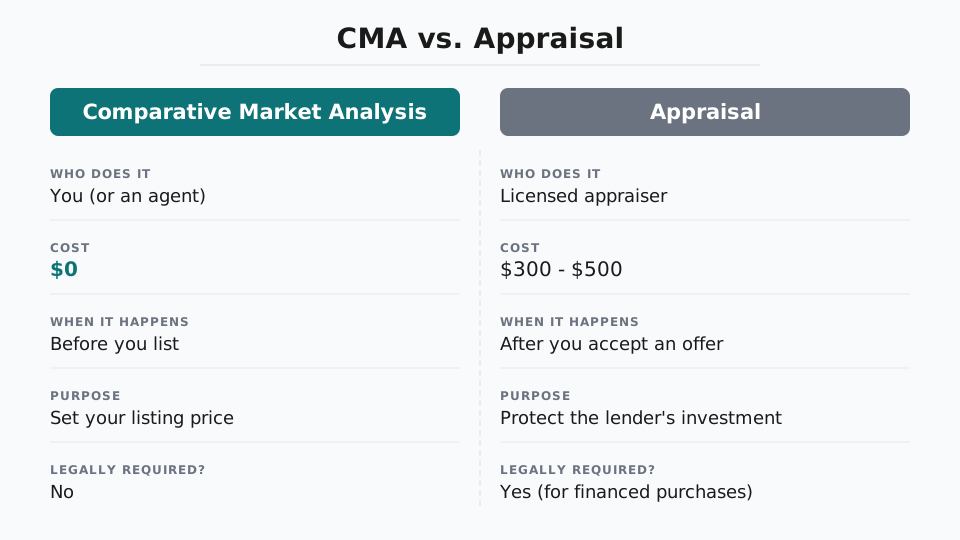
People mix these up constantly. A CMA and an appraisal both estimate a home’s value, but they serve different purposes and happen at different points in a sale.
A CMA is what you do before listing. It’s informal research. You can do it yourself on a Saturday morning with a laptop and free data from Zillow, Redfin, and your county assessor’s website. Cost: $0.
An appraisal is a formal valuation performed by a licensed appraiser, usually ordered by the buyer’s lender after you’ve accepted an offer. The appraiser physically inspects the property and produces a report the lender uses to confirm the home is worth what the buyer agreed to pay. Cost: $300 to $500, paid by the buyer.
You don’t need an appraisal to set your listing price. The buyer’s lender handles that later. What you need right now is a CMA.
What agents don’t tell you about their CMA
When a real estate agent shows up at your kitchen table with a glossy CMA packet, they’re presenting it like a deliverable that justifies their 5-6% commission. Thick report, lots of pages, maybe a few charts.
Here’s what’s actually in that packet: the same data you can pull from Zillow in 20 minutes. Agents use the MLS (Multiple Listing Service) to find comps, but Zillow, Redfin, and Realtor.com syndicate the same listing data. The sold prices, square footage, bedroom counts, and property photos are all publicly available. Free. For anyone.
The adjustments? Those come from local market knowledge, and you have that by virtue of living in your neighborhood. You know which streets are desirable. You know if the house down the road backs up to a highway or a park. An agent who drove through your neighborhood once doesn’t know that as well as you do.
The five things that make a comp useful
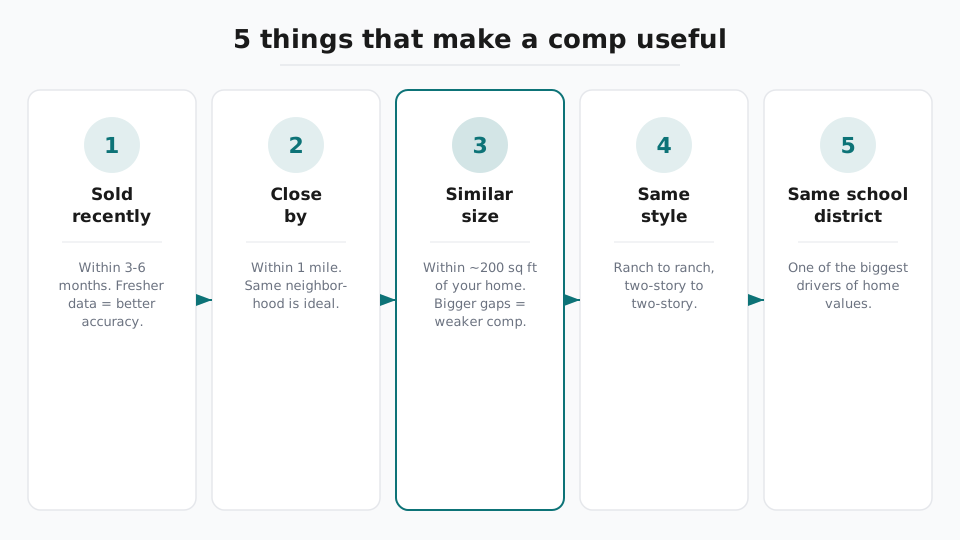
Not every recently sold home belongs in your CMA. A good comp matches your property on five criteria:
- Sold within 6 months. Three months is better. Markets shift, and a sale from last year may not reflect what buyers are paying right now.
- Within a mile. Same neighborhood is ideal. Different neighborhoods have different price dynamics even when the houses look similar on paper.
- Similar square footage. Within about 200 square feet of your home. A 1,200-square-foot ranch and a 2,400-square-foot colonial aren’t comparable no matter how close they are.
- Same style. Ranch to ranch, two-story to two-story. Home style affects price per square foot more than most people realize.
- Same school district. School districts are one of the biggest single drivers of home values. A comp in a different district can skew your entire analysis.
Three to five homes that hit all five criteria and your CMA will be solid. If you can’t find three within a mile, expand your radius, but know that the data gets less reliable the wider you go.
How to run real estate comps yourself
A CMA is a two-hour project. You need a laptop, an internet connection, and a basic spreadsheet. That’s the same “expertise” agents use to justify charging tens of thousands of dollars on a service that amounts to posting your house on a website.
Here’s the quick version of the process:
- Pull recent sales from Zillow, Redfin, and your county assessor’s website. Filter for homes sold within 6 months, within a mile, with similar square footage and style.
- Build a simple spreadsheet with each comp’s sale price, square footage, bedrooms, bathrooms, lot size, and condition.
- Adjust each comp to match your home. If a comp has an extra bathroom, adjust its price down. If your home has a renovated kitchen, adjust the comp’s price up.
- Average the adjusted prices. That’s your CMA-derived market value.
- Cross-reference with Zillow’s Zestimate, Redfin Estimate, and active listings at your price point.
I’ve priced every home I’ve sold FSBO using a CMA I built myself. The houses sold within a few percentage points of asking price. The process is straightforward. It just requires a little time and attention to detail.
For the full step-by-step — finding comps, building your spreadsheet, making adjustments, and setting a strategic listing price — I wrote the complete walkthrough in How to Price Your Home Without a Realtor: The FSBO CMA Guide. And once you’ve set your price, the savings calculator shows you exactly what you keep at different commission levels.
Keep reading

Florida FSBO disclosure requirements: what you must tell the buyer
Florida FSBO sellers must disclose known material defects plus flood, HOA, property-tax, sewer, radon, and lead-paint notices.

Best flat fee MLS services in Ohio (2026)
A side-by-side comparison of Ohio flat fee MLS companies, with real pricing, local MLS coverage questions, and the closing-fee math sellers miss.
Ohio FSBO disclosure requirements: what you must tell the buyer
Ohio Revised Code 5302.30 requires most 1-4 unit sellers to deliver a Residential Property Disclosure Form. Here's what it covers, who is exempt, and when a buyer can cancel.