Ohio FSBO disclosure requirements: what you must tell the buyer
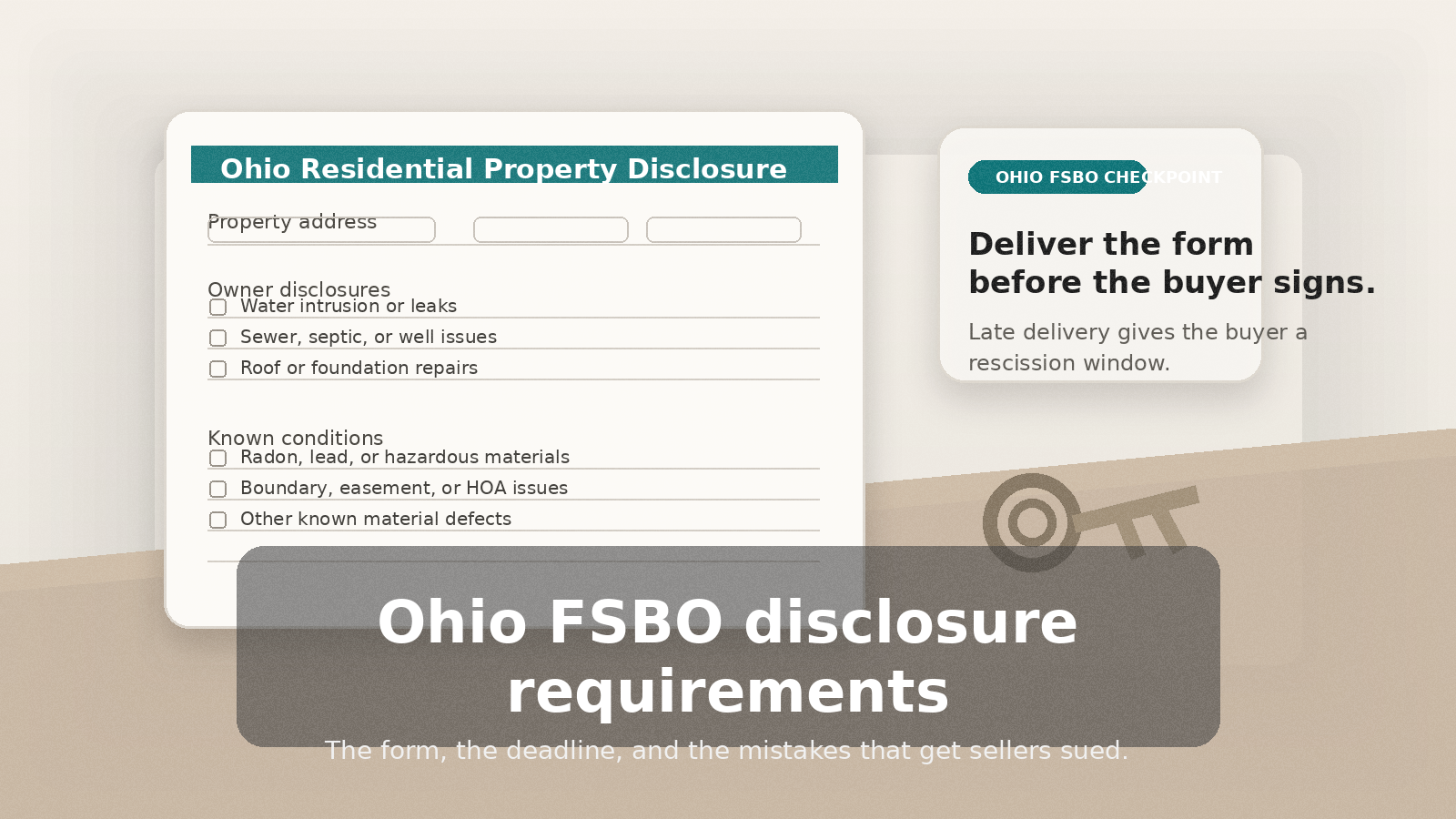
Ohio is not a “figure it out at closing” state. For most 1-4 unit home sales, Ohio Revised Code 5302.30 requires the seller to complete the Residential Property Disclosure Form and deliver it to the buyer as soon as practicable. If you hand it over after the contract is signed, the buyer gets a short cancellation window. If you never hand it over at all, they can still walk before the earlier of closing or 30 days after you accepted the offer.
That is the part Ohio sellers underestimate. The disclosure form is not busywork. It is one of the easiest ways to either protect yourself or blow up your own deal.
New to FSBO? Start with the main FSBO guide. This post assumes you are already putting your Ohio paperwork together.
Where to get the official Ohio form
Use the official Ohio Residential Property Disclosure Form, which the Ohio Department of Commerce adopted under Ohio Administrative Code rule 1301:5-6-10. The current form in the code appendix is the June 2022 version. Download that one, not some random fillable PDF with a law-firm logo on it.
If you are also working through the Ohio purchase agreement, keep both documents open at the same time. The purchase contract handles the deal terms. The disclosure form handles what you know about the property. They work together.
And if your house is on septic or another non-public system, the statute specifically says operating and maintenance information is available from the local board of health. That matters in Ohio because buyers with private sewage systems will ask.
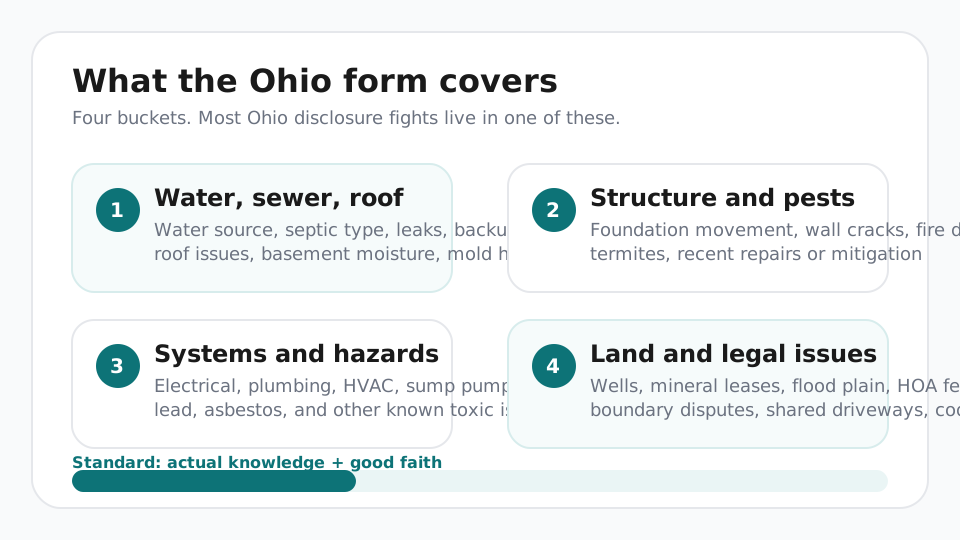
What the Ohio form actually asks you to disclose
Ohio’s form is broader than most sellers expect. It is not just a roof-and-basement checklist.
| Area | What Ohio asks about | Why sellers get tripped up |
|---|---|---|
| Water, sewer, roof | Water source, water quality issues, sewer backups, septic type, roof leaks, water intrusion | Sellers remember the old stain but forget the repaired cause |
| Structure and pests | Foundation movement, wall cracks, smoke/fire damage, termites | ”It was fixed” still counts as something you knew about |
| Systems and hazards | Electrical, plumbing, HVAC, sump pump, appliances, lead, asbestos, radon, mold | Buyers care about both the defect and what you did about it |
| Land and legal | Wells, mineral leases, flood plain, drainage, code violations, HOA, easements, boundaries, encroachments | Rural and older Ohio properties get messy fast |
The first page is the water-and-leak page
The official form starts with water supply, sewer, roof, and water intrusion. It asks whether the property is on public water, a private well, a shared well, a cistern, or something else. Then it asks whether you know about leaks, backups, water-quality problems, or sewer problems. If the property is not on a public or private sewer, it asks for the date of the last inspection and who inspected it.
That page alone catches a lot of Ohio sellers. A sump-pump backup three winters ago. A basement seepage issue you “solved” with grading. A well that tests fine now but had sulfur odor before you installed treatment. Those are disclosure facts.
The form also drills into roof leaks, basement or crawl-space moisture, prior flooding, sewer backups, and even whether the property was inspected for mold. Ohio is telling you, very clearly, that water problems are lawsuit problems.
The middle pages are where the real fights start
On the next pages, the form asks about structural movement, settling, foundation issues, fire or smoke damage, termites, and the major mechanical systems. Electrical, plumbing, heat, AC, sump pump, chimney, sprinkler system, water softener, built-in appliances. If you know a system has a defect, or if you repaired one in the last five years, say so.
Then it gets into hazardous materials. The form specifically names lead-based paint, asbestos, urea-formaldehyde foam insulation, radon gas, and other toxic substances. If you have had radon testing and know the level, the form gives you a place to write it in. If the home was built before 1978, the separate federal lead-paint disclosure rule still applies on top of the Ohio form, including the buyer’s 10-day opportunity to inspect unless both sides agree in writing to a different period.
The last section is more Ohio-specific than most people realize
The back half of the form asks about underground tanks, abandoned wells, oil and gas wells, mineral-right leases, flood plains, Lake Erie coastal erosion areas, drainage or grading issues, zoning or code problems, HOA fees, special assessments, boundary disputes, shared driveways, party walls, and encroachments from neighboring property.
That means Ohio sellers cannot treat this like a suburban drywall form. If you own a rural property, an older house, or anything near the lake, the land questions matter just as much as the house questions.
The form also has an “other known material defects” catchall. If the problem does not fit a checkbox but could be dangerous or could interfere with normal use of the property, that is where it goes.
The standard is actual knowledge, not perfection
This is the part that should calm you down a little. Ohio says the form is based on your “actual knowledge” and must be completed in good faith. The statute also says the form is not a warranty and not a substitute for the buyer’s own inspections.
So no, you are not required to hire an inspector on yourself before you list. You are not required to rip open walls looking for trouble. And if something truly was not within your actual knowledge, the statute gives sellers protection against damages for that omission.
But do not twist that into an excuse. “Actual knowledge” protects honest sellers. It does not protect a seller who knew the basement took water, painted over the stain, and marked “No.” Ohio also says the disclosure law does not limit other duties that exist to prevent fraud by misrepresentation, concealment, or nondisclosure. In plain English: disclose first, explain second.
If you want the broader 50-state version before getting into Ohio specifics, read the general seller’s disclosure guide.
When to deliver the form and when the buyer can cancel
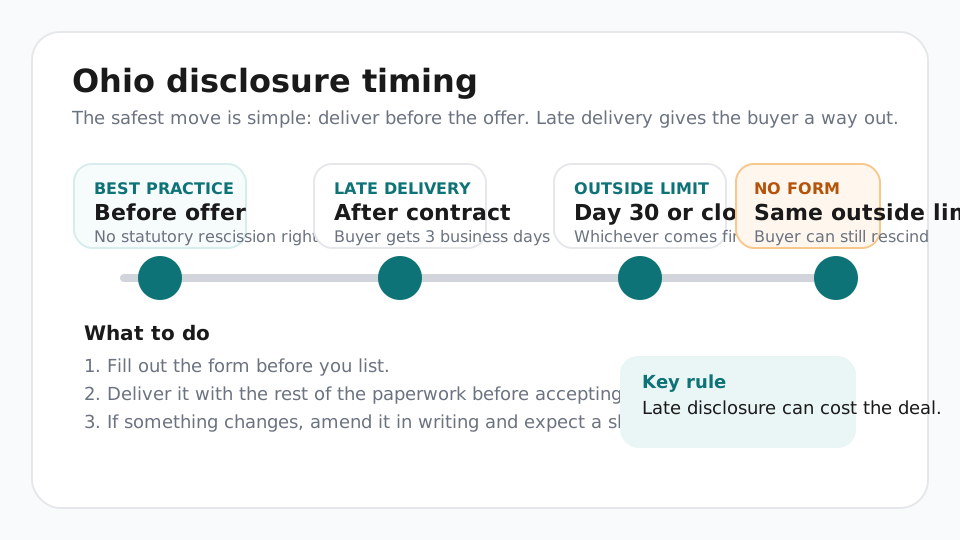
Ohio says you must deliver the signed disclosure form “as soon as is practicable.” Smart FSBO sellers read that as “before accepting an offer.”
Why? Because late delivery opens the exit door.
- If the buyer receives the form or an amendment after the contract is signed, they can rescind within 3 business days after receipt.
- That rescission right expires at the earlier of 30 days after you accepted the offer or the closing date.
- If you never provided the form after contract, the buyer can still rescind until the earlier of 30 days after acceptance or closing.
- If you delivered the form before the buyer made the offer, that statutory rescission right does not apply.
That is why I would not wait for “once we are under contract.” Bad move. Get the form done before you even start serious negotiations. A flat-fee attorney review in Ohio costs a fraction of one messy cancellation.
Who is exempt
Not every Ohio transfer has to use this form. The big exemptions in section 5302.30(B)(2) include:
- court-ordered transfers, bankruptcy transfers, foreclosure-related transfers, and deeds in lieu
- estate, guardianship, conservatorship, and trust transfers handled by a fiduciary
- transfers between co-owners, spouses, former spouses, or close lineal family members
- transfers to or from government entities
- brand-new residential property that has never been inhabited
- transfers to a buyer who already occupied the home as a personal residence for at least a year
- transfers by a seller who inherited the property and has not lived there as a personal residence within the prior year
Even if you fall into an exemption, do not get cute. Exemption from the Ohio form does not erase the federal lead rule for pre-1978 housing, and it definitely does not give you a fraud license.
”As is” still means disclose
Ohio sellers mix this up constantly. “As is” means you are not promising repairs. It does not mean “mystery box.” You still disclose what you actually know.
If the roof leaked last spring, the basement backed up in 2021, or you had a radon mitigation system installed, that belongs on the form even if the buyer is taking the property as is. The honest way to handle defects is simple: disclose them, price accordingly, and let the buyer decide. That is a negotiation. Hiding them is a legal problem.
Ohio details sellers miss
Offsite issues are mostly the buyer’s job
The Ohio form says the owner makes no representation about offsite conditions. It specifically tells buyers to do their own diligence on offsite issues, Megan’s Law notices, abandoned underground mines, and hazardous-material resources listed in Appendix A. That is useful for sellers because it draws a line around what the form is and what it is not.
Still, do not confuse “offsite issues are buyer diligence” with “I can hide what I know on the property.” Different issue entirely.
The form does not require updates, but amendments matter
The form itself says owners have no obligation to update it, though division (G) allows written amendments at any time. If a new leak starts after you delivered the form, amend it anyway. That is the clean move, and it is the move your attorney will want.
Just understand the tradeoff: a late amendment can give the buyer a fresh rescission window under the same 3-business-day and 30-day/closing limits. Better a short, lawful decision window than a fraud argument after closing.
Ohio asks about wells, mineral rights, and Lake Erie erosion for a reason
Those questions are not filler. Rural sellers may have abandoned wells, old tanks, or mineral leases they barely think about anymore. Lakefront or near-lake sellers can run into the coastal-erosion question. If the answer might be in your deed, county recorder records, or an old file drawer, go look before you sign.
And if your property has a private well or septic system, pair this form with the well-water FSBO guide. Buyers treat water issues like a direct hit to their peace of mind.
Your Ohio disclosure checklist
Before you accept an Ohio offer, get these done:
- Download the official Ohio disclosure form from the code appendix, not a third-party template site.
- Walk the property with the form in your hand and answer from actual knowledge, not optimism.
- Gather roof invoices, basement waterproofing records, radon reports, mold paperwork, septic or well records, HOA documents, and permit files.
- If the home was built before 1978, prepare the separate federal lead-paint disclosure package.
- Deliver the completed form before the buyer submits an offer whenever possible.
- If something changes after delivery, amend it in writing instead of hoping it never comes up.
- Have your Ohio real estate attorney review the disclosure alongside your purchase agreement.
Your next move: download the Ohio form tonight, fill it out while the house details are still fresh, and send it to your attorney before you negotiate price with anyone. Then use the FSBO closing checklist to make sure the rest of your paperwork is just as tight.
Keep reading

Best flat fee MLS services in Texas (2026)
A side-by-side comparison of the top flat fee MLS companies in Texas, with real pricing, hidden fees exposed, and what changed after the NAR settlement.

Free FSBO purchase agreement template for Pennsylvania
Pennsylvania FSBO sellers can use a free purchase agreement template, but it needs the right zoning, disclosure, and transfer-tax terms before anyone signs.

What Is a Comparative Market Analysis and How Do You Make One?
A comparative market analysis is the same pricing tool real estate agents use to price your home. Here's what goes into one and how to do it yourself.